

Oct 28, 2026: a second day of gains after a no-news crash
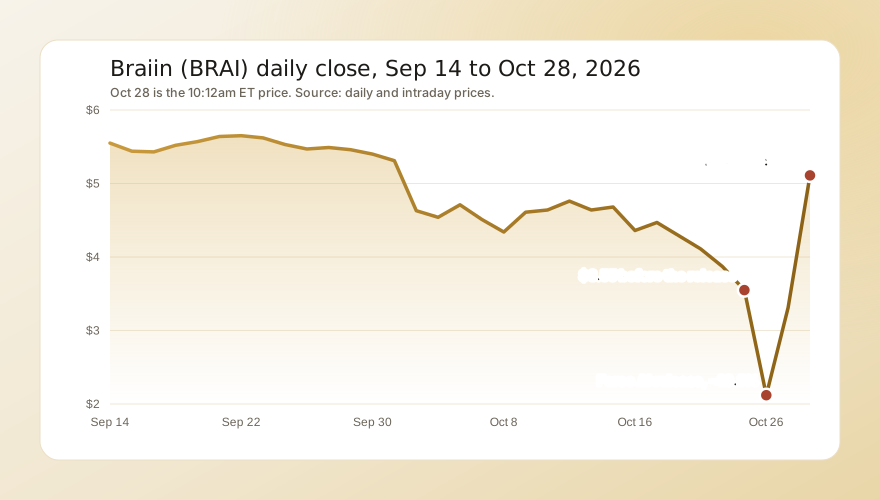
The rally started after hours on Oct 27. The stock closed that day at $3.31, then traded as high as $5.20 before 8pm. It opened Oct 28 at $4.94, dipped to $4.44 by 9:40am, and hit a session high of $5.40 at 10:05am, up 63%. At 10:12am it was $5.11.
How the three sessions played out:
| Session | Open | High | Low | Close or latest | Change | Volume |
|---|---|---|---|---|---|---|
| Oct 23 | $3.88 | $4.40 | $3.48 | $3.55 | -8.3% | 0.2 million |
| Oct 26 | $4.28 | $5.05 | $2.10 | $2.12 | -40.3% | 6.5 million |
| Oct 27 | $3.23 | $4.16 | $3.00 | $3.31 | +56.1% | 45.7 million |
| Oct 28, 10:12am | $4.94 | $5.40 | $4.44 | $5.11 | +54.4% | 28.0 million |
The Oct 26 session is the key to the week. Braiin issued its release at 9:00am ET. The stock opened at $4.28, traded near $4.83 at 10:00am and reached $5.05 at 12:15pm. It held above $4.10 until 3:00pm, then fell through $2.50 by 3:30pm and closed at $2.12. We found no filing, halt notice or news item that explains the last hour. Two days later the stock is back above the Oct 26 high, again on no new information.
Other contact center and small AI stocks did not move with it. At 10:11am Five9 was up 2.3%, NICE was down 1.5%, SoundHound was down 1.6%, BigBear.ai was down 4.2%, and the software ETF IGV was down 0.3%. The move is Braiin's alone.
After the jump, RSI(14) stood at 56, the shares sat 20% above their 20-day average and 3% above their 50-day average, volume ran 10.5 times its 20-day average, and the stock was 84% below its 52-week high of $33.00.
What the release says, and what it leaves out
The release describes RADIUS as an AI-powered contact center as a service platform with three modules: AI Engage, which handles routine requests without a human agent; AI Assist, a co-pilot for human agents; and AI Insight, which scores every conversation. Force AI sits under all three and connects to OpenAI's GPT, Anthropic's Claude, Google's Gemini, Azure OpenAI and open models such as Llama and Mistral, in the cloud, on premises or both. Braiin says RADIUS handled more than 4.5 million customer interactions with 99.9% uptime in the twelve months to March 31, 2026.
The performance claims, such as up to 60% self-service containment and up to 30% more first-contact resolution, carry a footnote calling them "indicative" results from selected deployments. The clients listed are a customer experience outsourcer in India, a government agency in Malaysia and two Indian retailers, all unnamed. The release cites a $56.9 billion market estimate for contact center software but gives no Braiin revenue, bookings or targets. Our guide on reading an 8-K for catalysts covers the test we apply to releases like this: what new number does it put in the model? Here, none.
What the numbers say
Braiin listed on Feb 12, 2026 through a direct listing, so it raised no money in the listing itself. The prospectus combines Braiin with businesses it agreed to buy for shares, including VIS Networks, a Bangalore contact center and communications company that the prospectus says expands its customer experience business, and Connect Simple, an Australian household billing platform. For the year to June 30, 2025:
- Pro forma revenue was $73.4 million, and the pro forma loss before other income was $22.0 million, mostly from $10.0 million of amortization and $14.6 million of other adjustments.
- VIS Networks booked $62.0 million, up 12% from $55.6 million, with a $1.9 million profit.
- Braiin on its own lost $1.97 million, had $0.11 million of cash and a working capital deficit of $4.86 million.
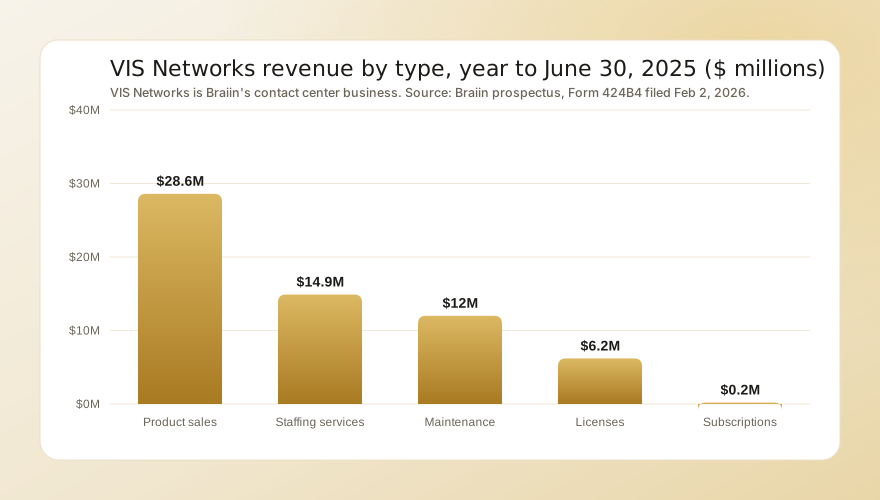
The chart is the gap in one picture. The release sells Force AI as a software platform, but in the last full year of figures VIS Networks, Braiin's contact center arm, earned $0.19 million from subscriptions, down 20%, against $28.6 million from selling products and $14.9 million from staffing. At $1.05 billion the company trades near 14 times pro forma sales, a multiple usually paid for recurring software revenue; our explainer on the price-to-sales ratio covers why the type of revenue matters as much as the amount.
Ownership is concentrated. The prospectus says founder and CEO Natraj Balasubramanian controls about 61% of the voting power, making Braiin a controlled company. Holders of 10,000 or more shares before the listing are under a 12-month transfer restriction from the first trading day, which runs to February 2027; smaller holders can sell at any time. Our piece on lockup expirations explains why that date matters for supply. The share count rose from 68.7 million to 206.1 million in the three-for-one split that took effect on April 29.
The case for the stock
- A real operating business. VIS Networks has $62.0 million of revenue, grew 12% and was profitable, which is more than many small AI stocks can show.
- A live product. RADIUS, which the release calls the engine of Braiin's customer experience business, runs in production for enterprise and government clients, and a model-neutral layer answers a real buyer worry about being tied to one AI vendor.
- No crowded short. Short interest is about 0.04% of the float, so a fall would not be made worse by a squeeze unwinding; see short interest and squeeze risk.
- One broker is far higher. Maxim Group started coverage on June 15 with a Buy rating and a $10 target. Maxim was also Braiin's financial adviser on the listing and received about 1.35 million shares before the split, per the prospectus.
The risks
- The price rests on a release, not results. Nothing in the Oct 26 release changes revenue, costs or cash.
- A $1 billion value on thin disclosure. No filing since June 17, no half-year results in the filing list and no audited figures since the listing.
- Revenue quality. Subscriptions were $0.19 million of $62.0 million at VIS Networks, and staffing services were $14.9 million.
- Extreme swings both ways. The stock fell 58% from its high in one hour on Oct 26 with no news, and it is 84% below its listing-day high.
- Funding and dilution. Braiin alone ended fiscal 2025 with $0.11 million of cash and is paying for deals in shares, so new issuance is likely; our guide to dilution shows how to track it.
What comes next
- The Form 20-F. As a foreign private issuer, Braiin must file its annual report within four months of its June 30 year end. With Oct 31 a Saturday, the deadline falls on Nov 2. A late filing would come with a Form 12b-25 notice. Our guide to searching SEC EDGAR shows where it will appear.
- A 6-K for the release. Braiin furnished earlier partnership releases on Form 6-K; as of Oct 28 none has been filed for Force AI.
- Contract news. A named client with a dollar value would be the first hard figure behind the Force AI story.
- Trading supply. With about 14% of the share count changing hands in the first 42 minutes today, the next sessions will show whether buyers stay once the turnover fades.
For how we date and test a view like this one, see how to write a dated investment thesis, and more of today's biggest stock moves.