

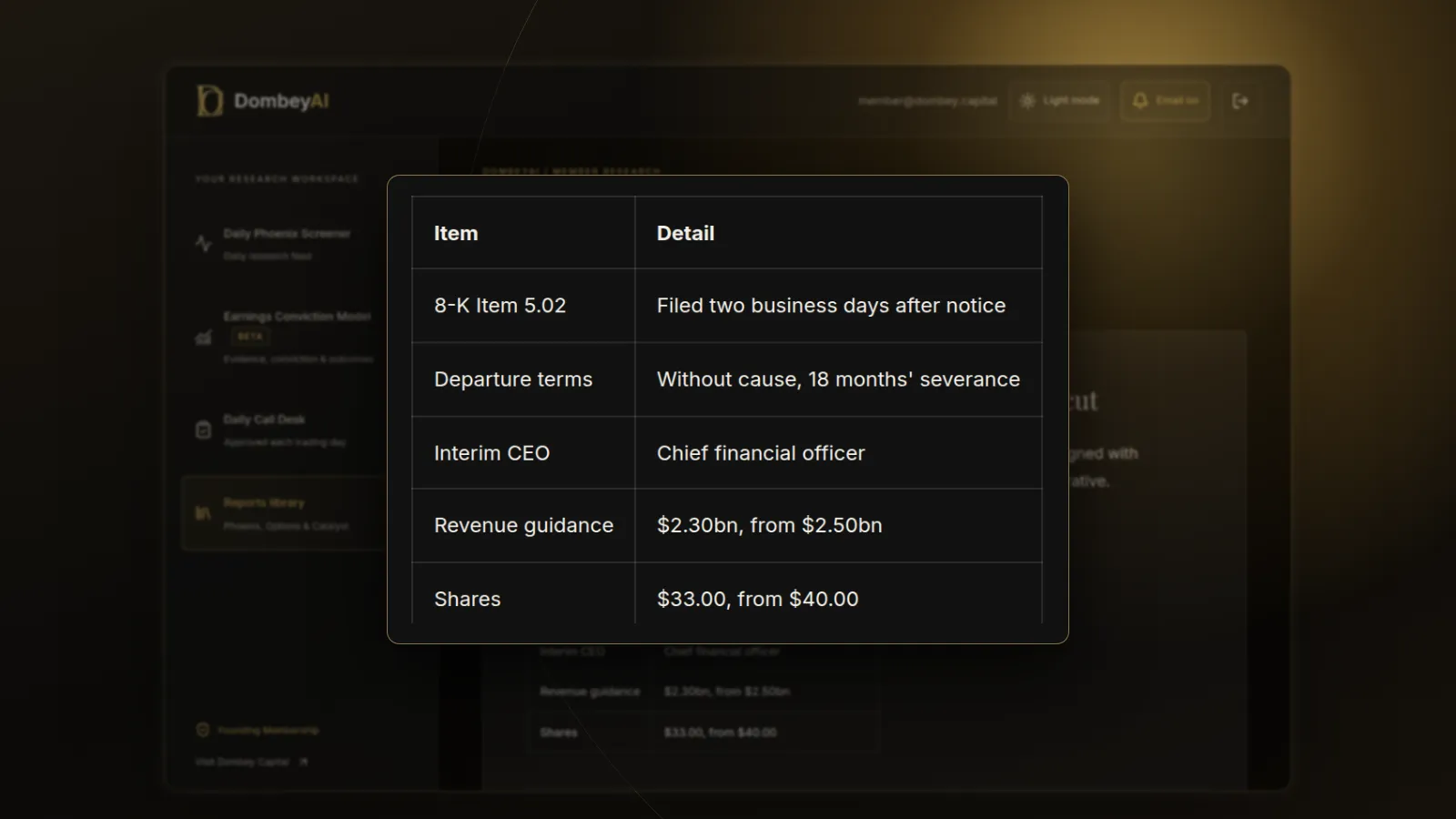
Why a CEO change moves a stock
Investors price a company partly on who is making capital allocation decisions. When that person leaves, three things can change at once:
- Information. An unexpected exit can suggest the board knows something the market does not, such as weaker results, an investigation or a failed strategy.
- Strategy. A successor may sell divisions, cut costs, stop a buyback or start a sale process. The market tries to price the new path before it is announced.
- Uncertainty. Until a permanent leader is in place, guidance and plans are less reliable, and some investors step aside.
The sign of the move depends on which of these dominates. A departure that removes a leader investors had lost faith in can lift the stock. One that removes a well-regarded operator can push it down even when the business is fine.
How the departure is disclosed
A company must file a Form 8-K under Item 5.02 within four business days of a CEO's decision to leave, or of the board's decision to remove them. The same item covers the appointment of a new principal executive officer and material new compensation arrangements. Most companies issue a press release on the same day.
Read three things in the filing:
- The verb. "Retired" after a long tenure reads differently from "resigned" with immediate effect or "terminated."
- The effective date. A departure effective in six months with a named successor is planned. One effective today is not.
- The exhibits. A separation agreement shows whether the exit was treated as without cause, which usually triggers severance and accelerated vesting, and whether the former CEO stays as an adviser.
Types of CEO departures
| Type | Typical signs | What the market usually reads into it | What to check |
|---|---|---|---|
| Planned retirement | Long notice, named internal successor | Little new information | Whether the successor keeps the strategy |
| Board-led change | Short notice, outside successor search | Strategy or performance problem | Recent results, activist holders, guidance |
| Abrupt resignation | Effective immediately, interim CEO | Possible hidden problem | Same-week filings, auditor and CFO changes |
| Termination for cause | Conduct language, no severance | Governance issue | Investigation disclosures, restatement risk |
| Activist-driven | Recent 13D, settlement, new directors | Push for sale or breakup | Settlement terms, review committees |
| Post-deal or health | Merger closing, personal reasons | Usually limited | Integration plan, depth of the bench |
The table is a starting point. The same type can carry very different information depending on what else is happening at the company.
Reading the context around the exit
The departure is one data point. Put it next to the others:
- Guidance. Was guidance cut in the same release or the previous quarter? A guidance change next to a leadership change suggests the board is reacting to the numbers.
- Other executives. A chief financial officer leaving at the same time raises the stakes. So does a change of auditor.
- Shareholders. An activist with a recent 13D filing may have pushed for the change, which makes a strategic review or sale more likely.
- Insider trading. Recent sales by the departing CEO, or purchases by directors after the announcement, are visible on Form 4.
- Balance sheet. A company near a debt maturity or covenant test has fewer options, whoever runs it.
The new CEO's first year
A new chief executive usually spends the first months on a review. Investors should expect some combination of:
- A reset of guidance, often lower, so that targets are achievable.
- Write-downs of goodwill, inventory or projects started under the previous leader. Our explainer on goodwill and impairments covers how these affect book value.
- Portfolio changes, such as selling a non-core unit or closing a loss-making line. See how a divestiture can reset a stock's value.
- A capital allocation statement on buybacks, dividends and debt.
- An investor day to set out the new plan, often six to twelve months into the tenure.
Each of these is a dated event worth putting on a catalyst calendar.
What the price already assumes
Before deciding what a departure means, check what the stock was pricing the day before. A company trading at a deep discount to peers on EV/EBITDA may already reflect a failed strategy, so the exit of the leader behind it can remove a source of the discount. A company trading at a premium may have priced in its chief executive's record, and the market can mark that premium down quickly.
Short interest and options positioning also shape the first move. Heavy short interest can turn a modestly good change into a sharp rally as positions close. Neither effect says much about value a quarter later.
How event-driven investors use departures
A useful process has four steps:
- Classify the departure using the table above.
- List what else changed in the same filing window.
- Write down the scenarios the change makes more or less likely: a sale, a breakup, a turnaround or further bad news. Probability-weighted valuation helps put numbers on them.
- Date the next decision points: the permanent appointment, the first earnings call, the first full-year guidance and any investor day.
For daily coverage of stocks moving on leadership changes, results and other events, see Dombey's market coverage.
Where this goes wrong
- Reading too much into the first day. The initial move often reflects uncertainty, not a reasoned view of the successor.
- Assuming a new CEO means change. An internal successor chosen to continue the strategy may change very little.
- Ignoring the board. The board chose the old CEO and will choose the new one. If the board is the problem, a new chief executive may not fix it.
- Missing the second shoe. Abrupt departures sometimes precede restatements, investigations or covenant problems disclosed weeks later. Our explainer on material weaknesses covers one common follow-on disclosure.
- Overpaying for hope. A stock can rise on the announcement of a well-known turnaround leader and leave little return for the turnaround itself.
The bottom line
A CEO departure moves a stock through the information it carries, so classify the exit before reacting to the price. Read the 8-K for the verb, the effective date and the separation terms, and check what else the company disclosed in the same window. A new leader usually brings a review, a guidance reset and portfolio changes, each of which is a dated event. Price the scenarios the change makes more likely, and watch for the follow-on disclosures that sometimes come after an abrupt exit.