

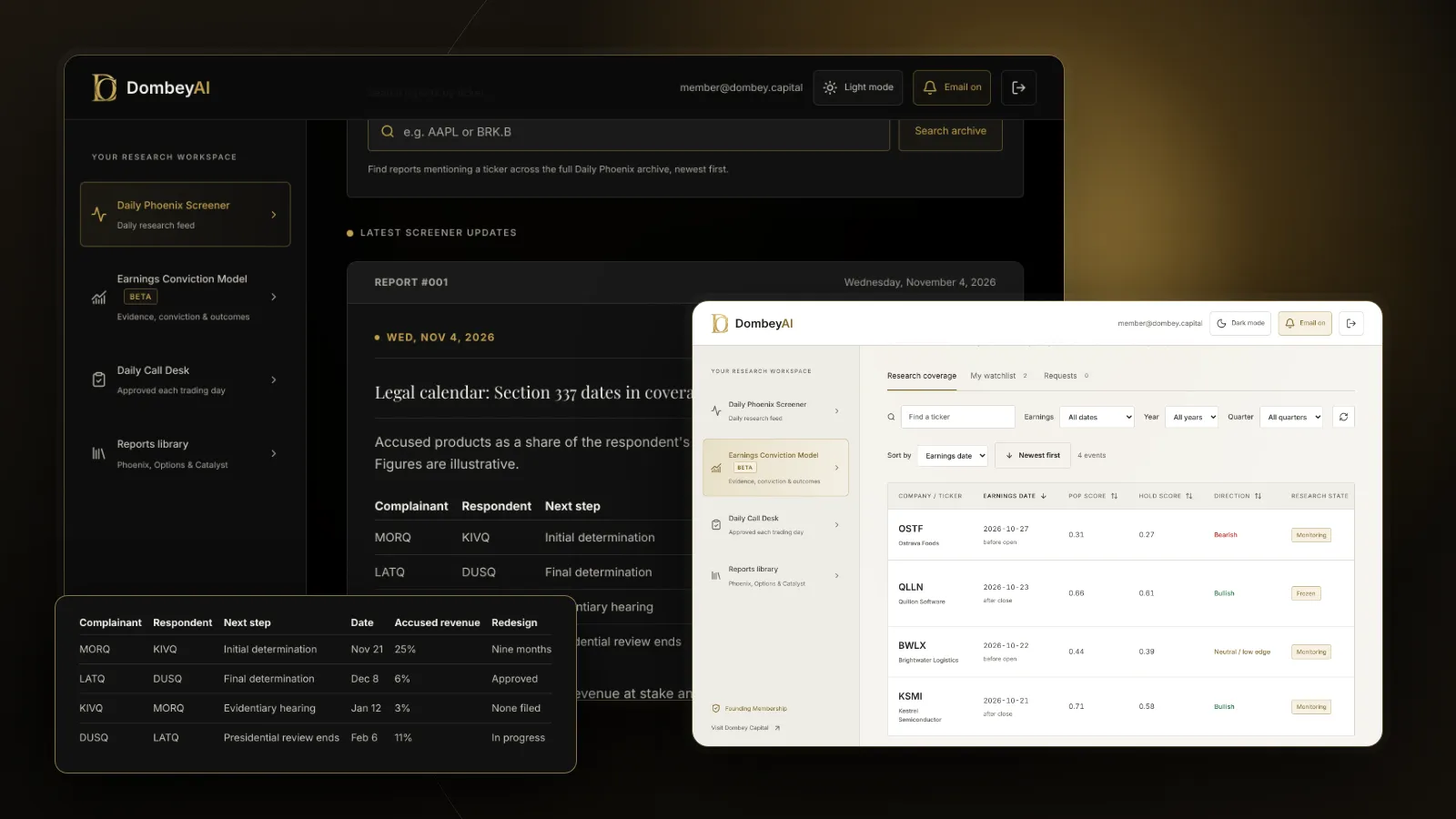
How a Section 337 case works
Section 337 of the Tariff Act of 1930 makes it unlawful to import articles that infringe a valid US patent, trademark or copyright, among other unfair practices. A company files a complaint with the Commission naming the importers, called respondents, and the products at issue. To bring a case, the complainant must show a domestic industry in the United States related to the protected product, such as significant investment in plant, labor or research.
If the Commission institutes an investigation, an administrative law judge runs discovery and a trial-like evidentiary hearing. The judge then issues an initial determination on whether there is a violation. The full Commission can review that determination and issues a final determination, along with any remedy.
The remedies are:
- Limited exclusion order. Blocks infringing products of the named respondents.
- General exclusion order. Blocks infringing products from any source, available only in narrower circumstances.
- Cease and desist order. Stops respondents from selling infringing inventory already in the United States.
The ITC does not award money damages. Patent holders who want damages sue in federal district court, often at the same time. A respondent named in both can ask the court to stay the parallel claims on the same patents while the ITC case runs.
The dates that move stocks
| Stage | What happens | Why the market cares |
|---|---|---|
| Complaint filed | Complainant names respondents, patents and products | First public sign of import risk for the respondent |
| Institution | Commission votes to investigate, usually within about 30 days | Case is real; target date is set soon after |
| Evidentiary hearing | Trial before the administrative law judge | Testimony and briefs show the strength of each side |
| Initial determination | Judge rules on violation | First ruling on the merits; often the largest move |
| Commission review | Commission decides whether to review and on what issues | Signals which findings may change |
| Final determination | Commission rules and issues any remedy | The order is set, subject to presidential review |
| Presidential review | 60 days; imports may continue under bond | A rare disapproval, or a settlement deadline |
| Appeal | Federal Circuit review of the final determination | Can reverse findings, usually long after the order |
Public companies often report these steps in an 8-K or in the legal proceedings section of a 10-Q. Our guide to reading an 8-K for catalysts covers where to look, and the Commission's own docket holds the notices and opinions.
What an exclusion order is worth
The order's value depends on the product, not the patent. A ban on a respondent's main product line in its largest market is a large event. A ban on one model that a supplier can redesign in a quarter is a small one. Before a ruling, the questions are:
- What share of the respondent's US revenue is in the accused products?
- Can the respondent design around the patent, and has Customs or the Commission already approved a redesign?
- How long until the patents expire? An order ends when the patent does, which links the case to any patent cliff analysis.
- Does the complainant make the product, or does it mainly license? A licensor usually wants a royalty, not a ban.
- What has each side said about settlement?
Because the ITC awards no damages, most of the value to a patent holder is leverage. An import ban, or a credible threat of one, often ends in a licensing deal. Many cases settle between the initial and final determinations.
A worked example
The investor values Company D in three outcomes. No violation: shares worth $62. Violation with a quick design-around: $54. Violation with no workable design-around for nine months, ending in a license at a 6% royalty: $46. Weighting these at 55%, 25% and 20% gives about $56.80, against a share price of $55.
The same framework applies to Company C, with the licensing income as the upside. The point of the exercise, described in our guide to probability-weighted valuation, is to see what each price implies about the ruling. Our guide on valuing a litigation outcome shows the steps in more detail.
Reading a case before the ruling
Most of what you need to judge a Section 337 case is public, though some documents are filed in redacted form. Four sources do most of the work.
- The complaint. It lists the patents, the accused products and the domestic industry the complainant relies on. The product list is the starting point for estimating revenue at stake.
- The notice of institution. It confirms the respondents and the scope of the investigation, and the target date is set soon after.
- The initial determination. The public version explains which claims were found infringed, which were found invalid and why. It also includes the judge's recommendation on remedy and bond.
- The Commission's notice of review. It lists the issues the Commission will reconsider and sometimes asks the parties specific questions. Questions about remedy or the public interest often hint at where the Commission is leaning.
Company disclosures add the financial side. A respondent that says it has a redesign ready, or that the accused products are a small share of sales, is telling the market how much it expects to lose. A complainant that discusses licensing talks is signaling that it wants a royalty more than a ban. Read both sides' statements together, because each has a reason to describe the case in its own favor.
How exclusion orders compare with other legal catalysts
An ITC ruling is a hard catalyst: it has a date and a binary outcome. In that respect it resembles a regulatory approval more than a jury trial. The differences are the remedy and the speed. A district court can award damages but rarely bars products quickly; the ITC cannot award damages but can stop imports within about a year and a half of institution. Like a regulatory approval, the final step can slip, and the schedule can be extended.
Where this goes wrong
- Treating the initial determination as final. The Commission can review and reverse findings. The final determination, not the initial one, sets the remedy.
- Ignoring the design-around. A respondent with an approved redesign may lose little revenue even after an order. Read company statements on redesigns closely.
- Assuming the order will be enforced as issued. The presidential review period allows imports under bond, and the Federal Circuit can reverse findings on appeal.
- Missing the settlement. Many cases end in a license before the final determination, which can cap the upside for both stocks.
- Overrating the market share at stake. Accused products are often a narrow set of models. Check the complaint's list of products against the company's segment disclosures.
The bottom line
An ITC exclusion order bars infringing imports and is the main remedy in a Section 337 case. Because the case follows a published schedule, the initial determination, final determination and presidential review are dated events that the market prices ahead of time. The order's value depends on the revenue at stake, the chances of a design-around and the patent's remaining life, not just on who wins. For more scheduled events, see the market page; Dombey's published research on legal catalysts is in the research archive.