

Who reviews a merger
Both agencies enforce the federal merger laws. They divide deals between them through a clearance process based largely on industry experience, so only one agency investigates a given transaction. Their tools differ:
| FTC | DOJ Antitrust Division | |
|---|---|---|
| Legal basis | Clayton Act Section 7, FTC Act | Clayton Act Section 7 |
| How it blocks | Seeks a preliminary injunction in federal court under FTC Act Section 13(b), with an administrative case in parallel | Sues in federal district court to block the deal |
| Settlement form | Consent order | Consent decree entered by a court |
| Final word | The federal court's injunction ruling often decides the deal | The district court's ruling, subject to appeal |
State attorneys general can also sue under federal or state law, and foreign regulators review deals with business in their countries. Deals involving foreign buyers and sensitive assets can also face CFIUS review.
The path from filing to challenge
Most deals above the HSR size threshold are filed with both agencies. Our explainer on the HSR waiting period covers the filing in detail. The main stages:
| Stage | What happens | Typical signal in filings |
|---|---|---|
| HSR filing | Both parties file; a 30-day waiting period starts (15 days for cash tender offers and certain bankruptcy sales) | 8-K or press release noting the filing |
| Early clearance or expiry | Waiting period ends with no action | Press release, closing soon after |
| Pull and refile | Buyer withdraws and refiles to give the agency another 30 days | 8-K or proxy update |
| Second request | Agency asks for documents and data; waiting period extended until 30 days after substantial compliance | 8-K disclosing the second request |
| Timing agreement | Parties agree not to close for a period after compliance, giving the agency time to decide | Often disclosed in proxy updates |
| Decision | Clear, settle, or sue | Press release from the agency and the parties |
A second request does not mean a challenge is coming, but it does mean the agency has concerns worth months of work. Many deals that receive one are cleared, some with remedies.
How the agencies build a case
Under Section 7, the question is whether the effect of the deal "may be substantially to lessen competition, or to tend to create a monopoly." The agencies typically argue one or more of these:
- Horizontal overlap. The two companies compete directly, and combining them raises concentration in a defined market.
- Vertical foreclosure. The buyer could deny rivals access to an input or a customer the target controls.
- Elimination of a potential competitor. The target or buyer was likely to enter the other's market.
- Entrenchment. The deal helps a dominant firm protect its position.
The FTC and DOJ set out these theories, along with concentration thresholds, in the Merger Guidelines they issued jointly in December 2023. Courts are not bound by the guidelines, but they show what the complaint will argue.
The three outcomes
Abandonment. The parties walk away, often after a second request or a complaint. The merger agreement decides whether the buyer pays a reverse termination fee. Our explainer on deal breaks covers what follows.
Settlement. The parties agree to sell overlapping businesses, license assets or accept conduct conditions. The agency must accept the buyer of divested assets, which adds time. Settlements let most of the deal survive, and the market usually treats an announced settlement as a sharp rise in the odds of closing.
Litigation. The case goes to a federal judge, usually on an expedited schedule. The ruling often decides the deal, because many parties abandon a merger after losing an injunction hearing rather than wait for an appeal or the administrative process.
What the merger agreement says
The agreement sets how much antitrust pain the buyer must accept. Our guide on how to read a merger agreement covers where to find each term.
- Efforts covenant. Ranges from "reasonable best efforts" to "hell or high water," which obliges the buyer to accept any divestiture needed. Many agreements cap required divestitures by revenue or name specific assets.
- Obligation to litigate. Some agreements require the buyer to fight a challenge in court; others let it walk.
- Outside date. The date after which either party can terminate, often with automatic extensions for pending regulatory approvals.
- Reverse termination fee. A payment from buyer to target if the deal fails for regulatory reasons. It compensates the target and signals the buyer's confidence.
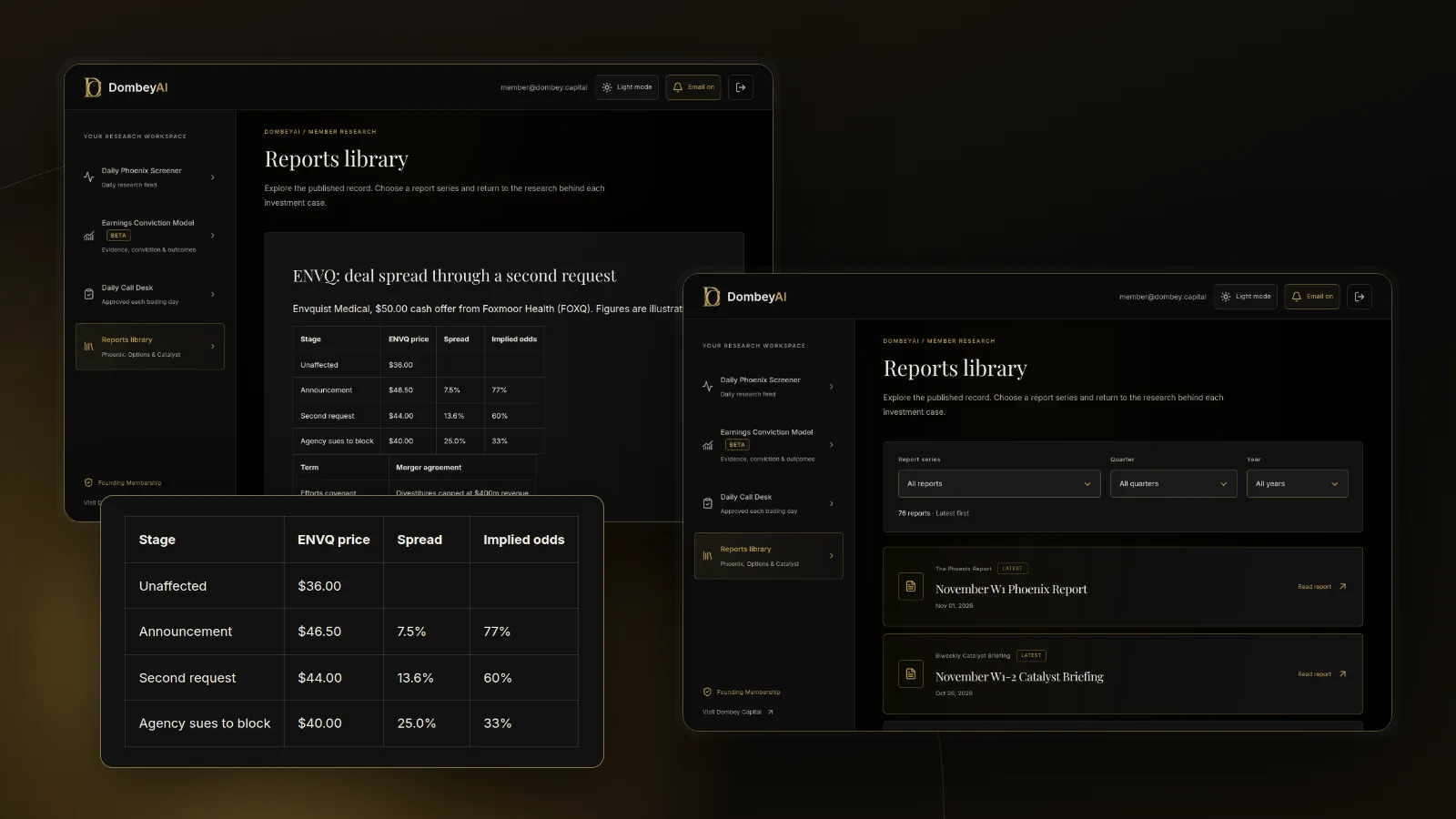
A worked example
The same probability method is set out in our explainer on probability-weighted valuation for binary events. A reverse termination fee paid to T would raise the break value and narrow the drop. For the full spread calculation, see our guide on how to calculate a merger arbitrage spread.
What to watch during a challenge
- The complaint. It defines the market and shows how strong the agency thinks its case is.
- The parties' response. A quick offer of divestitures suggests a settlement path; a vow to litigate suggests a trial.
- The trial schedule. It sets the timeline and the cost of carry for anyone holding the spread.
- Changes to the outside date. Extensions, sometimes with a higher price or fee, show whether the buyer still wants the deal.
- Foreign reviews. Approval elsewhere does not bind US agencies, but a block abroad can end the deal.
Our guide on how to track a merger through approval lists the filings that report each step, and the market page covers large moves on regulatory news. Dombey's published research models these outcomes for deals under review; see the research archive.
Where this goes wrong
- Reading the second request as a death sentence. Many deals that get one still close, often with remedies.
- Ignoring the break price. The downside if the deal fails decides the trade more than the upside. The target's standalone value may have changed since announcement.
- Underestimating time. Litigation can take many months, and the cost of waiting compounds.
- Overlooking state and foreign regulators. A deal cleared by the FTC or DOJ can still be challenged by states or blocked abroad.
- Assuming the buyer will fight. An efforts covenant without a litigation obligation lets the buyer walk.
- Treating past cases as a guide to this one. Agency leadership and priorities change, and courts weigh each market on its own facts.
The bottom line
The FTC and DOJ challenge mergers they believe may substantially lessen competition, usually after a second request, and the deal then ends in abandonment, a settlement with remedies, or a court ruling. The merger agreement, through its efforts covenant, outside date and reverse termination fee, sets how hard the buyer must push. For investors, the work is estimating the probability of each outcome and the break price. The deal spread is the market's estimate; merger arbitrage is the practice of disagreeing with it carefully.