

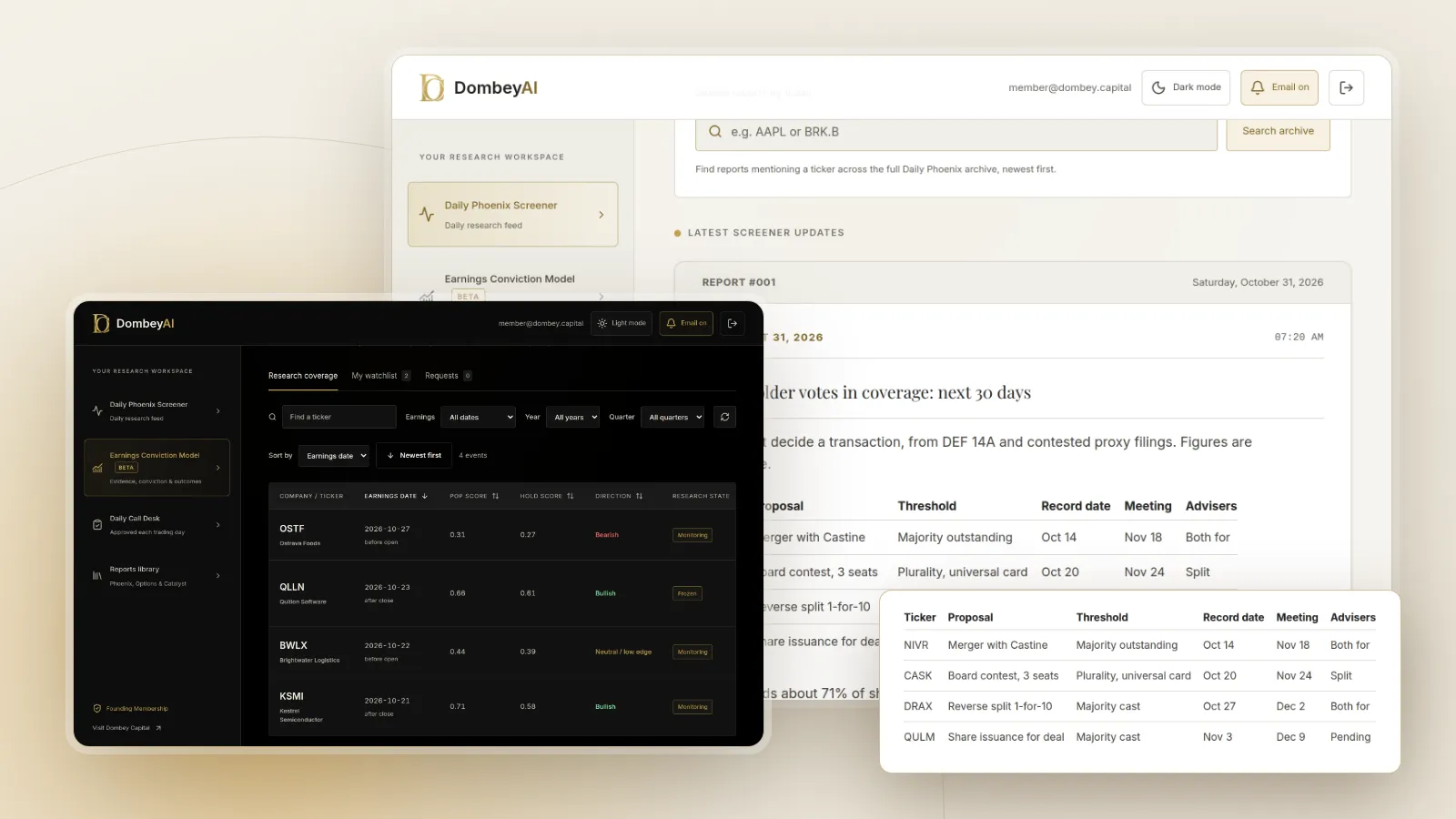


Full disclosure: Dombey Capital is our own research service and our top pick here, for the reasons below. The section on where it falls short is there so you can judge whether it fits your process.
What a proxy tracker needs to do
A shareholder vote becomes a catalyst when its outcome decides whether something happens: a merger closes, a dissident wins board seats, a reverse split goes ahead or a large share issuance is approved. For those votes, an investor needs three things:
- The date and the terms: meeting date, record date and the exact proposals, from the proxy statement.
- The likely outcome: who owns the shares, how large holders and proxy advisers tend to vote, and what vote threshold applies.
- The meaning: what each outcome does to the stock's value.
Our explainer on shareholder votes and proxy season catalysts covers the first two in depth. The tools below cover different parts of that list.
Quick comparison
| Tool | Best for | Key features | Price (as of October 2026) |
|---|---|---|---|
| Dombey CapitalTop pick | Votes read as dated special situation catalysts | Founding Membership: weekly Phoenix Report, weekly Options Research, Catalyst Briefing, DombeyAI Portal with the Daily Phoenix Screener and Earnings Conviction Model | Founding Membership $1,200/year (annual only); Standard Access $80/year or $8/month; Public Archive free |
| SEC EDGAR | Primary-source proxies and results | DEF 14A and contested proxy filings, 8-K Item 5.07 vote results, Form N-PX fund votes, full-text search, RSS | Free |
| ProxyVote (Broadridge) | Voting your own shares | Proxy materials and voting by control number for shares held through a broker | Free for shareholders |
| ISS | Institutional voting research and execution | Governance research, voting recommendations, end-to-end voting platform | See the vendor's pricing page (through sales) |
| Glass Lewis | Proxy research with contested and M&A coverage | Proxy voting policies and research, Viewpoint voting technology, contested situations and M&A research, N-PX reporting | See the vendor's pricing page (through sales) |
| Diligent Market Intelligence | Activism and voting datasets | Shareholder activism, proxy voting and stewardship data, investor voting patterns, proprietary alerts | See the vendor's pricing page (demo on request) |
| 13D Monitor | Activist campaigns and their deadlines | Activist profiles and campaigns, deadline calendar, standstill database, voting database, proxy commentary | See the vendor's pricing page (subscription) |
| Proxy Monitor | Free history of shareholder proposals | Proposals at the 250 largest companies since 2006, say-on-pay votes since 2011, annual score card | Free |

How we compared these tools
We compared these tools from vendor documentation, product pages and public pages, read in October 2026. We did not run trials of the paid services, and we make no claims about the accuracy of any recommendation or dataset, or about investment results.
| Criterion | Weight | What it measures |
|---|---|---|
| Catalyst context | 25% | Whether the tool ties a vote to what it means for a stock |
| Voting data and history | 20% | How institutions and funds have voted, and on what |
| Contested and transaction coverage | 20% | Proxy fights, merger votes and activist campaigns |
| Primary-source access and speed | 15% | Proxies, results and alerts as they are filed |
| Cost and access | 20% | Price, and whether an individual investor can buy it |
We weighted catalyst context most because, for special situations, the useful question is what a vote does to value, not only when it happens. If you vote shares for an institution and weight voting data most, ISS, Glass Lewis and Diligent lead; if you weight cost, EDGAR and Proxy Monitor lead.
Quick picks by job
Best for votes as dated catalysts: Dombey Capital
Dombey's Founding Membership is written research: the weekly Phoenix Report, weekly Options Research, the Catalyst Briefing and the DombeyAI Portal with the Daily Phoenix Screener and the Earnings Conviction Model. It suits readers who want merger votes, contests and other corporate votes analyzed for what each outcome means for the stock, published before the meeting.
Best free primary source: SEC EDGAR
Every proxy statement, contested filing and vote result is on EDGAR, with full-text search and RSS feeds by company or form type. Our guide on how to search SEC EDGAR filings shows how to set them up.
Best for voting your own shares: ProxyVote
ProxyVote is where most holders who own through a broker read the materials and vote, using the control number on their notice.
Best for institutional voting research: ISS
ISS provides governance research, voting recommendations and a voting platform used by institutional investors.
Best for contested and M&A research: Glass Lewis
Glass Lewis lists research on contested situations and M&A alongside its proxy research, Viewpoint voting technology and N-PX reporting.
Best for activism and voting datasets: Diligent Market Intelligence
Diligent describes activist and proxy voting datasets with global coverage, investor voting pattern comparisons and alerts.
Best for activist campaign deadlines: 13D Monitor
13D Monitor tracks activists and their campaigns, with a deadline calendar, a standstill database and a voting database.
Best free proposal history: Proxy Monitor
Proxy Monitor tracks shareholder proposals and say-on-pay results at the largest US companies, free.
Full reviews
1. Dombey Capital
What it does. Dombey publishes independent research on special situations and event-driven equities, including mergers, spin-offs and corporate actions that need a shareholder vote. Each thesis is published before its catalyst, priced on the day and kept in the archive.
Best for. Readers who want an analyst's view of which votes matter and what each outcome means for value.
Pricing. Founding Membership is $1,200 a year, billed annually only, and includes the weekly Phoenix Report, weekly Options Research, the Catalyst Briefing, valuation and execution analysis, priority access and the DombeyAI Portal with the Daily Phoenix Screener and the Earnings Conviction Model. Standard Access is the lower-cost option at $80 a year (about $6.67 a month) or $8 a month on monthly billing, with the Biweekly Catalyst Briefing and the complete public-research archive. The Public Archive is free.
Pros
- Votes are dated and tied to a written case.
- The Catalyst Briefing lists forthcoming events across coverage.
- Theses are archived for comparison with what followed.
Cons
- No database of every meeting or every institutional vote.
- Coverage is a short list of situations.
- Founding Membership costs more than free sources.
Verdict: Our top pick for votes as special situation catalysts. Pair it with EDGAR alerts for the filings.
2. SEC EDGAR
What it does. EDGAR holds every proxy statement (DEF 14A), preliminary proxy (PRE 14A), contested filings such as PREC14A, DEFC14A and DFAN14A, vote results on 8-K Item 5.07 and fund voting records on Form N-PX.
Best for. Anyone who wants the original documents, free, as they are filed.
Pricing. Free.
Pros
- The primary source for every date, proposal and result.
- Full-text search and RSS alerts by company or form type.
- N-PX shows how funds actually voted.
Cons
- No calendar view or analysis.
- N-PX data arrives once a year, after the fact.
Verdict: The free foundation every other tool here builds on. Our guide on how to read a proxy statement shows what to look for.
3. ProxyVote (Broadridge)
What it does. ProxyVote is the site where shareholders who hold through a bank or broker view proxy materials and vote, using the control number from their notice or email.
Best for. Voting shares you own.
Pricing. Free for shareholders.
Pros
- The standard place to vote street-name shares.
- Materials and ballot in one place.
Cons
- Shows only meetings for shares you hold.
- No research, history or alerts across the market.
Verdict: Necessary for voting, not a research tool.
4. ISS
What it does. ISS, part of ISS STOXX, provides governance research, voting recommendations and an end-to-end voting platform for institutional investors, among a wider set of data and index services.
Best for. Institutions that need research and execution across many meetings.
Pricing. See the vendor's pricing page; sold through sales.
Pros
- Broad coverage of meetings worldwide.
- Research, recommendations and voting in one workflow.
Cons
- Built and priced for institutions.
- Recommendations are one input, not the outcome.
Verdict: The institutional standard for voting research and execution.
5. Glass Lewis
What it does. Glass Lewis lists proxy voting policies and corporate governance research, Viewpoint voting technology, vote disclosure and N-PX reporting, and research on contested situations and M&A.
Best for. Institutions voting in proxy fights and merger votes.
Pricing. See the vendor's pricing page; sold through sales.
Pros
- Dedicated contested situations and M&A research.
- Voting technology and disclosure tools.
Cons
- Built and priced for institutions.
- Not designed for individual investors.
Verdict: The pick for institutional coverage of contests and deals.
6. Diligent Market Intelligence
What it does. Diligent Market Intelligence provides shareholder activism, proxy voting and stewardship data, with global coverage, aggregated investor voting patterns and proprietary alerts.
Best for. Advisers, investors and companies who need data on how investors vote and where activists are active.
Pricing. See the vendor's pricing page; demos on request.
Pros
- Activism and voting data together.
- Comparisons of investor voting patterns.
- Alerts on new campaigns and votes.
Cons
- No public price.
- A dataset to analyze, not a view on value.
Verdict: The pick for data on how investors vote and where activism is building.
7. 13D Monitor
What it does. 13D Monitor publishes research on activist investors: activist profiles, campaign searches, a deadline calendar, a board representation and standstill database, a voting database and proxy commentary.
Best for. Investors who follow activist campaigns and their nomination and meeting deadlines.
Pricing. See the vendor's pricing page; subscription with demos on request.
Pros
- Deep coverage of activist campaigns.
- Deadline calendar for nominations and meetings.
Cons
- Focused on activism; routine meetings are out of scope.
- No public price.
Verdict: The pick for following activist campaigns. Our list of activist investor trackers covers it alongside other 13D tools.
8. Proxy Monitor
What it does. Proxy Monitor, from the Manhattan Institute, is a database of shareholder proposals at the 250 largest US companies by revenue from 2006, with say-on-pay votes from 2011 and an annual score card.
Best for. Researching proposal history and support levels at large companies.
Pricing. Free.
Pros
- Long history of proposals and support levels.
- Searchable by company, proponent and topic.
Cons
- Large companies only.
- Proposals, not merger or contest votes.
Verdict: A useful free history for governance proposals at the largest companies.
Where Dombey falls short
- Narrow coverage. Dombey covers a short list of special situations. Most shareholder meetings each year concern companies Dombey will never cover.
- No broad stock data terminal. No meeting database, voting records or proxy adviser recommendations. You still need EDGAR.
- Small team. A small team limits how many situations it can follow properly.
- Pen-name author. Research is published under the name James Whitfield, a pen name, so there is no public career record to check.
- Short history. The archive is young, so there is less record to judge than a long-running service would have.
Where this goes wrong
A tracker tells you a vote is coming. It does not tell you the threshold, the holder base or what the result is worth.
For merger votes, our guide on how to track a merger through approval lists every step, and for contests, our explainer on proxy fights covers the universal proxy card and the timetable.
Free vs paid
| Tool | Free | What paying adds |
|---|---|---|
| Dombey | Public Archive of published research | Founding Membership adds the weekly reports and DombeyAI Portal; Standard Access, the lower-cost option, adds the Catalyst Briefing and full archive |
| SEC EDGAR | Everything | Nothing to buy |
| ProxyVote | Voting your own shares | Nothing to buy |
| Proxy Monitor | Full database | Nothing to buy |
| ISS, Glass Lewis, Diligent | Public commentary and policies | Research, recommendations, datasets and voting platforms |
| 13D Monitor | Public profile pages | Campaign research, calendars and databases |
An individual investor can cover most of the job for free with EDGAR alerts, ProxyVote and Proxy Monitor. Paying buys either institutional data or analysis.
How to choose
| Your situation | Pick | Add later when |
|---|---|---|
| You follow special situations that hinge on a vote | Dombey CapitalTop pick | You want every filing as it lands: add EDGAR RSS |
| You want the documents, free | SEC EDGAR | You want analysis of what matters: add Dombey |
| You vote shares for an institution | ISS or Glass Lewis | You want activism data: add Diligent |
| You follow activist campaigns | 13D Monitor | You want voting patterns: add Diligent |
| You research governance proposals at large companies | Proxy Monitor | You want current filings: add EDGAR |
- If the vote decides whether a deal or a contest succeeds, start with Dombey and the proxy itself.
- If you simply want to vote your shares, ProxyVote and the proxy statement are enough.
Dombey's published work is in the research archive. For a wider comparison of research services, see our Seeking Alpha vs Motley Fool vs Morningstar vs Dombey comparison.
The bottom line
Dombey Capital is our top pick for investors who want shareholder votes read as dated catalysts, provided you accept that it is written research on a narrow list and not a meeting database. EDGAR is the free primary source for every proxy and result, ProxyVote is where holders vote, ISS, Glass Lewis and Diligent sell the institutional layer, 13D Monitor follows activist campaigns and Proxy Monitor gives free proposal history. Whatever you use, read the threshold and the record date in the proxy before judging the odds of a vote.