

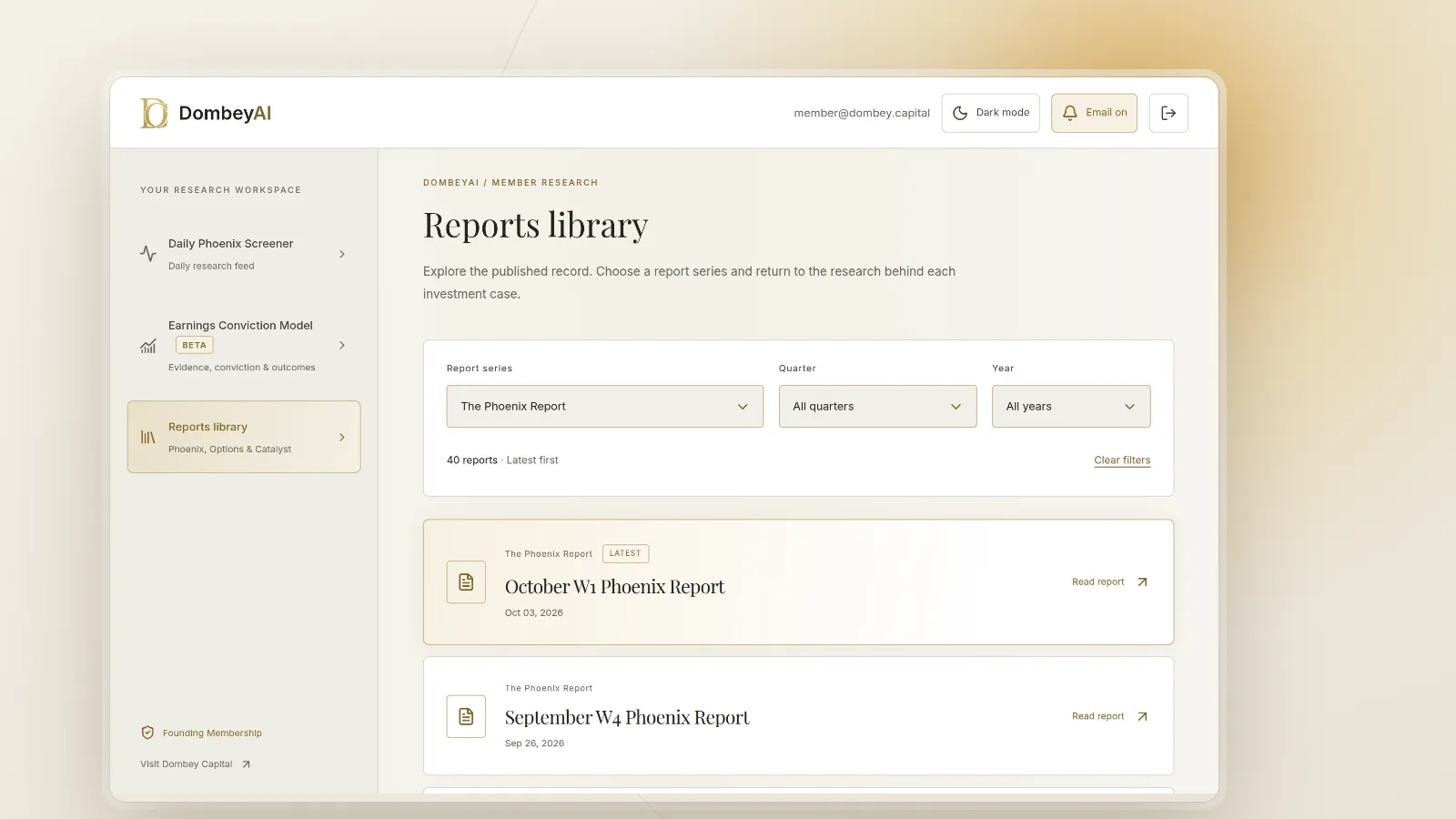


Full disclosure: Dombey Capital is our own research service and our top pick here, for the reasons below. The section on where it falls short is there so you can judge whether it fits your process.
Quick comparison
| Tool | Best for | Key features | Price (as of October 2026) |
|---|---|---|---|
| Dombey CapitalTop pick | Investors in special situations and dated catalysts | Founding Membership: weekly Phoenix Report, weekly Options Research, Catalyst Briefing and the DombeyAI Portal; Standard Access: Biweekly Catalyst Briefing and public-research archive | Founding Membership $1,200/year; Standard Access $6.67/month; Public Archive free |
| Morningstar Investor | Long-term investors who want analyst research and portfolio tools in one place | Analyst reports, fair value and competitive advantage ratings, screener with 200+ data points, portfolio analysis, watchlists, alerts | $249/year or $34.95/month; 7-day free trial |
| Seeking Alpha Premium | Investors who want quant ratings and many viewpoints | Quant ratings, screeners, analysis on 4,000+ stocks and ETFs, AI tools such as Virtual Analyst Reports and Earnings Call Insights | $299/year; new subscribers $4.95 for the first month |
| Motley Fool Stock Advisor | Investors who want a short list of ideas each month | 2 new stock recommendations a month, monthly rankings including a top 10, three entry strategies, Fool IQ data | $199/year list; $99 introductory for new members |
| Zacks Premium | Investors who screen on earnings estimates and ranks | Zacks Rank, Style Scores, Industry Rank, Earnings ESP Filter, premium screens, equity research reports, Focus List | $249/year |
| Value Line (digital) | Investors who want standardized one-company research pages | Investment Survey packages covering 600 to 3,000+ stocks, ranks and ratings, model portfolios in the Savvy Investor package | $199 to $795/year depending on package |
How we compared these tools
We compared these services from vendor documentation, pricing pages and public product pages, read on the publish date. We did not subscribe to each service for this article, so nothing below describes the member experience beyond what the vendors publish. We also make no claims about any service's performance or the accuracy of its ratings. Vendors publish their own track records; those figures are theirs, and we do not repeat or judge them here.
We used five criteria:
- Job fit. What problem does the service solve: finding ideas, researching ideas you already have, tracking a portfolio, or covering a specific style such as event-driven investing?
- Depth versus breadth. How many securities it covers, and how much work goes into each one.
- Method transparency. Whether the vendor explains how its ratings or picks are made, so you can judge when to trust them.
- Tools. Screeners, portfolio analysis, alerts and models.
- Price and terms. List price, introductory price, trial and refund terms, all from the vendor's own pages.
| Criterion | Weight | What it measures |
|---|---|---|
| Job fit | 30% | How directly the service solves one research job |
| Depth versus breadth | 20% | Securities covered and the work behind each one |
| Method transparency | 20% | Whether the vendor explains how ratings or picks are made |
| Tools | 15% | Screeners, portfolio analysis, alerts and models |
| Price and terms | 15% | List price, introductory price, trial and refund terms |
Quick picks by job
Best for special situations and dated catalysts: Dombey Capital
Dombey covers a narrow set of situations: stocks below cash or book, spin-offs, deal spreads, and legal and corporate events with a date attached. If your process starts from "what event could reprice this stock, and when," the Catalyst Briefing and the Phoenix Report are built for that job. If you want broad market coverage, pair it with one of the platforms below.
Best for most long-term investors: Morningstar Investor
Morningstar combines independent analyst coverage with portfolio tools in one subscription. Its stock ratings rest on fair value and competitive advantage, which suits investors who hold for years. The portfolio tools show allocation, fees and overlap between holdings, which the idea-driven services on this list do not focus on.
Best for quant ratings and many viewpoints: Seeking Alpha Premium
Seeking Alpha Premium pairs data-driven ratings and screeners with a large library of articles written by third-party authors. You get many opinions on the same stock, which is useful when you want to test your own view against bulls and bears. The trade-off is that contributors vary in experience, and Seeking Alpha says some are not licensed or certified.
Best for ready-made stock ideas: Motley Fool Stock Advisor
Stock Advisor delivers two new stock recommendations a month and a monthly ranking list. If you want a short, regular list of long-term ideas and do not want to screen yourself, it is the simplest product here. It is a recommendation service rather than a research platform.
Best for earnings-estimate screening: Zacks Premium
Zacks is organized around the Zacks Rank and earnings estimate data. The Earnings ESP Filter and the premium screens suit investors who build lists from estimate revisions and industry ranks.
Best for standardized company pages: Value Line
Value Line's Investment Survey gives each company a consistent research page with ranks and ratings, sold in packages sized by how many stocks you want covered. Investors who like to compare companies on the same template will find that format efficient.
Full reviews
1. Dombey Capital
What it does. Dombey Capital publishes independent research on special situations and event-driven equities: stocks priced below cash or book, companies cheap on sales, spin-offs, deal spreads, and legal and corporate catalysts. Every thesis is published before its catalyst, priced on the day and kept in the archive, so the original case can be compared with what happened.
There are three access levels:
- Founding Membership ($1,200 a year): the weekly Phoenix Report, weekly Options Research, the Catalyst Briefing, the DombeyAI Portal with the Daily Phoenix Screener and the Earnings Conviction Model, valuation and execution analysis, and priority access.
- Standard Access ($6.67 a month), the lower-cost option: the Biweekly Catalyst Briefing on forthcoming corporate and market events, plus the complete public-research archive.
- Public Archive (free): published executive theses and public research.
Best for. Investors whose process starts from a dated event: a shareholder vote, a court ruling, a spin-off distribution, a deal closing or an earnings date. If you are new to the style, what is a special situation and what is a stock catalyst cover the basics.
Pricing. Founding Membership $1,200 a year. Standard Access, the lower-cost option, $6.67 a month, which is about $80 over twelve months. Public Archive free. See the subscription options.
Pros
- Each piece is tied to an event with a date, which makes it easier to judge whether a thesis worked.
- Every thesis is published before its catalyst and kept in the archive.
- Founding Membership puts the weekly reports and the DombeyAI Portal in one plan, and Standard Access is the lowest-priced paid tier in this comparison. The Public Archive is free.
Cons
- Narrow coverage: no ratings on thousands of companies, fund research or whole-market screener.
- Founding Membership at $1,200 a year costs more than the other main plans in the table.
- The full list of limits is in the section on where Dombey falls short.
Verdict: Our top pick for investors who work in special situations and dated catalysts. Pair it with a broad platform if you also need market-wide data.
2. Morningstar Investor
What it does. Morningstar Investor is the paid individual-investor product from Morningstar. Its page describes analyst reports and commentary on thousands of securities, proprietary ratings that include fair value and competitive advantage for stocks, a screener with more than 200 data points, and portfolio tools that show performance, allocation, fees and stock overlap. Watchlists, custom views and alerts on ratings changes and analyst notes round it out.
Best for. Long-term investors who hold stocks and funds together and want one place to research both and check the portfolio.
Pricing. $249 a year or $34.95 a month. First-time users get a seven-day free trial. Morningstar notes that promotional offers apply only to the first year of a yearly subscription and that the rate can change.
Pros
- Fund and stock coverage in one product.
- Fair value estimates come with the reasoning, so you can read and question the valuation.
- Portfolio analysis that most stock-pick services do not offer.
Cons
- The method emphasizes long-term value, so it does less for investors who trade around specific events.
- Very small companies and special situations such as spin-offs or merger spreads are not its focus.
Verdict: The most complete broad platform here for long-term investors who hold stocks and funds together.
3. Seeking Alpha Premium
What it does. Seeking Alpha calls Premium its flagship research service. Its help center lists data-driven stock ratings and screeners, AI research tools such as Virtual Analyst Reports, Earnings Call Insights and Ask Seeking Alpha, and analysis on more than 4,000 stocks and ETFs, powered by its Quant System. The offer page adds that the library includes 1,300 securities that Wall Street does not cover.
Best for. Investors who want to read several viewpoints on a stock, use quant grades as a first filter, and do their own selecting.
Pricing. $299 a year plus applicable tax. New subscribers can start with a one-month paid trial at $4.95, after which the annual price is charged unless they cancel.
Pros
- Breadth: many stocks, many authors and many data points.
- Quant ratings give a quick, consistent first pass.
- Contributor articles often cover small companies that get little attention elsewhere.
Cons
- Quality varies by author, and Seeking Alpha states its analysts are third-party authors who may not be licensed or certified.
- The volume of content takes time to filter.
Verdict: A good fit for investors who want many viewpoints and quant grades and are willing to do the selecting themselves.
4. Motley Fool Stock Advisor
What it does. Stock Advisor delivers two new stock recommendations every month: one from the Hidden Gems team on the first Thursday and one from the Rule Breakers team on the third Thursday. Both teams update a ranking list on the fourth Thursday. The page also lists three entry strategies (cautious, moderate and aggressive), access to financial data in Fool IQ, news coverage and a planning hub.
Best for. Investors who want a short list of long-term stock ideas on a fixed schedule and a suggested way to build a portfolio from them. The Motley Fool suggests a portfolio of $25,000 or more.
Pricing. $199 a year list. The compare page shows a $99 introductory price for new members, with renewal at the then-current list price. The Fool lists a 30-day window to get the membership fee back. Its larger tiers, Epic and Epic Plus, list at $499 and $1,999 a year.
Pros
- Simple to use, with a published recommendation schedule.
- Guidance on allocation for a buy-and-hold investor.
Cons
- Two ideas a month is a narrow funnel.
- Not built for screening, deep valuation work or event-driven situations.
- You rely on the service's selection rather than your own process.
Verdict: The simplest choice for investors who want a short, regular list of long-term ideas rather than tools.
5. Zacks Premium
What it does. Zacks Premium centers on the Zacks Rank for stocks, mutual funds and ETFs. The order page also lists Style Scores, premium screens, equity research reports, the Zacks Industry Rank, the Earnings ESP Filter for stocks ahead of reports, a Zacks #1 Rank list, and a Focus List of 50 stocks.
Best for. Investors who build watchlists from earnings estimate revisions and industry ranks and want ready-made screens.
Pricing. $249 for one year on the Zacks order page. Zacks offers a free trial and lists a satisfaction guarantee with cancellation up to 90 days after the trial.
Pros
- A consistent, rules-based ranking you can sort and screen on.
- Earnings-focused tools that fit an earnings-season workflow.
Cons
- The ranks are model outputs; you still need to understand the business and the balance sheet.
- Not organized around special situations, deal spreads or legal events.
Verdict: A sound pick for investors who build lists from estimate revisions and industry ranks.
6. Value Line
What it does. Value Line's principal service is The Value Line Investment Survey, sold in digital packages by coverage. Investor 600 covers about 600 large-cap stocks. Investor 900 adds about 300 small and mid caps. Investor 2400 combines the 600 largest stocks with about 1,800 small and mid caps. Smart Investor covers companies representing about 90% of US market capitalization across more than 90 industries. Savvy Investor covers more than 3,000 stocks and includes ranks, ratings and seven model portfolios.
Best for. Investors who want standardized research pages so they can compare companies on the same template.
Pricing. One-year digital prices on Value Line's site: Investor 600 $199, Investor 900 $249, Investor 2400 $448, Smart Investor $598, Savvy Investor $795. Two-year terms are listed at twice those amounts.
Pros
- Consistent format across a large universe.
- Packages let you pay only for the coverage you need.
Cons
- The top package costs more than the broad platforms above.
- Built for comparing ongoing businesses, not for tracking an event such as a tender offer or a spin-off date.
Verdict: Best suited to investors who like to compare companies on one standard template.
Where Dombey falls short
- Narrow coverage. Dombey covers special situations and catalyst-driven stocks. It does not offer ratings on thousands of companies, fund research or a general stock screener for the whole market.
- No broad data terminal. There is no financial statements database, portfolio analytics or fund tools of the kind Morningstar and Seeking Alpha offer. Most readers will still want a general platform or SEC EDGAR alongside it.
- Small team. Output is limited by how many situations a small team can research properly. That means fewer ideas than the broad platforms.
- Pen-name author. Research is published under the name James Whitfield, a pen name. Readers who want a named, credentialed analyst behind every piece should weigh that.
- Short history. The public record is young. The archive keeps every thesis with its date and price, but a short record says less than a long one.
- Founding Membership price. At $1,200 a year, the full tier costs more than any other plan in the quick comparison table. Only the Fool's higher tiers, such as Epic Plus at $1,999 a year, cost more. It is priced for investors who will use the options research and portfolio tools, not for occasional readers.
Free vs paid
You can do a lot for free. SEC EDGAR has every filing, company investor relations pages post earnings dates and presentations, and several vendors publish free material: Dombey's Public Archive, Value Line's free market newsletters, and the free pages on Seeking Alpha, Morningstar and Zacks.
What paid plans add is mostly speed and structure:
- Ratings and ranks that let you sort thousands of stocks quickly (Morningstar, Seeking Alpha, Zacks, Value Line).
- Selection done for you (Motley Fool Stock Advisor).
- Event calendars and catalyst research for special situations (Dombey).
- Portfolio analysis that shows overlap and fees (Morningstar).
Much special-situations work can start free. Our guides on how to find stocks trading below net cash and how to read a 10-Q for special situations use only public filings. A paid service saves time; it does not supply information that is unavailable in the filings.
How to choose
Start with the job, not the brand.
| Your situation | Pick | Add later when |
|---|---|---|
| You invest in spin-offs, deal spreads or stocks below cash | Dombey CapitalTop pick | You want market-wide ratings and data: add Morningstar Investor or Seeking Alpha Premium |
| You hold funds and stocks and check the portfolio monthly | Morningstar Investor | You start holding event-driven positions: add Dombey Founding Membership, or Standard Access as the lower-cost option |
| You want quant grades and many viewpoints | Seeking Alpha Premium | You want dated catalyst research: add Dombey Capital |
| You want ideas handed to you | Motley Fool Stock Advisor | You want to screen for yourself: add Zacks Premium or Morningstar Investor |
| You screen on estimate revisions around earnings | Zacks Premium | You want options research on earnings: add Dombey Founding Membership |
A short checklist:
- Do you want ideas handed to you, or tools to find your own? Ideas: Stock Advisor. Tools: Morningstar, Seeking Alpha, Zacks or Value Line.
- Do you hold funds as well as stocks? Morningstar covers both and analyzes the whole portfolio.
- Do you trade around earnings? Zacks has earnings-estimate tools; Dombey's Founding tier has the Earnings Conviction Model and options research.
- Do you invest in spin-offs, deal spreads or stocks below cash? None of the broad platforms is organized around these. Read spin-off investing and merger arbitrage explained, then decide whether a specialist service is worth paying for.
- What will you actually read? A $299 platform you open twice a year costs more per use than a $1,200 service you use weekly.
An illustrative example
The figures here are hypothetical and for illustration only. Investor A holds $60,000, mostly in index funds and ten long-term stocks, and checks the portfolio monthly. Morningstar Investor at $249 a year fits: fund and stock research plus overlap analysis. Investor B holds $60,000 in fifteen positions, four of them tied to pending events such as a spin-off and a tender offer. Investor B might pair a broad platform for data with a catalyst-focused service, because the four event positions need dated tracking that a general platform does not organize. Neither choice is about which vendor is better overall. Each matches the job.
Trials and refunds
Use trials and refund windows to test fit before committing. Morningstar lists a seven-day free trial, Seeking Alpha a $4.95 first month, the Motley Fool a 30-day refund window on Stock Advisor, and Zacks a free trial with a satisfaction guarantee. Read the renewal terms: most of these renew automatically at the list price.
The bottom line
Dombey Capital is our top pick for investors who work in special situations and dated catalysts, with a free archive and a low-cost Standard tier. For one broad subscription, Morningstar Investor is the most complete for long-term investors. Seeking Alpha Premium suits investors who want quant ratings and many viewpoints, Stock Advisor suits investors who want a short monthly list of ideas, Zacks suits earnings-estimate screening, and Value Line suits investors who like standardized company pages. Prices change, so confirm each one on the vendor's own page before you subscribe.