

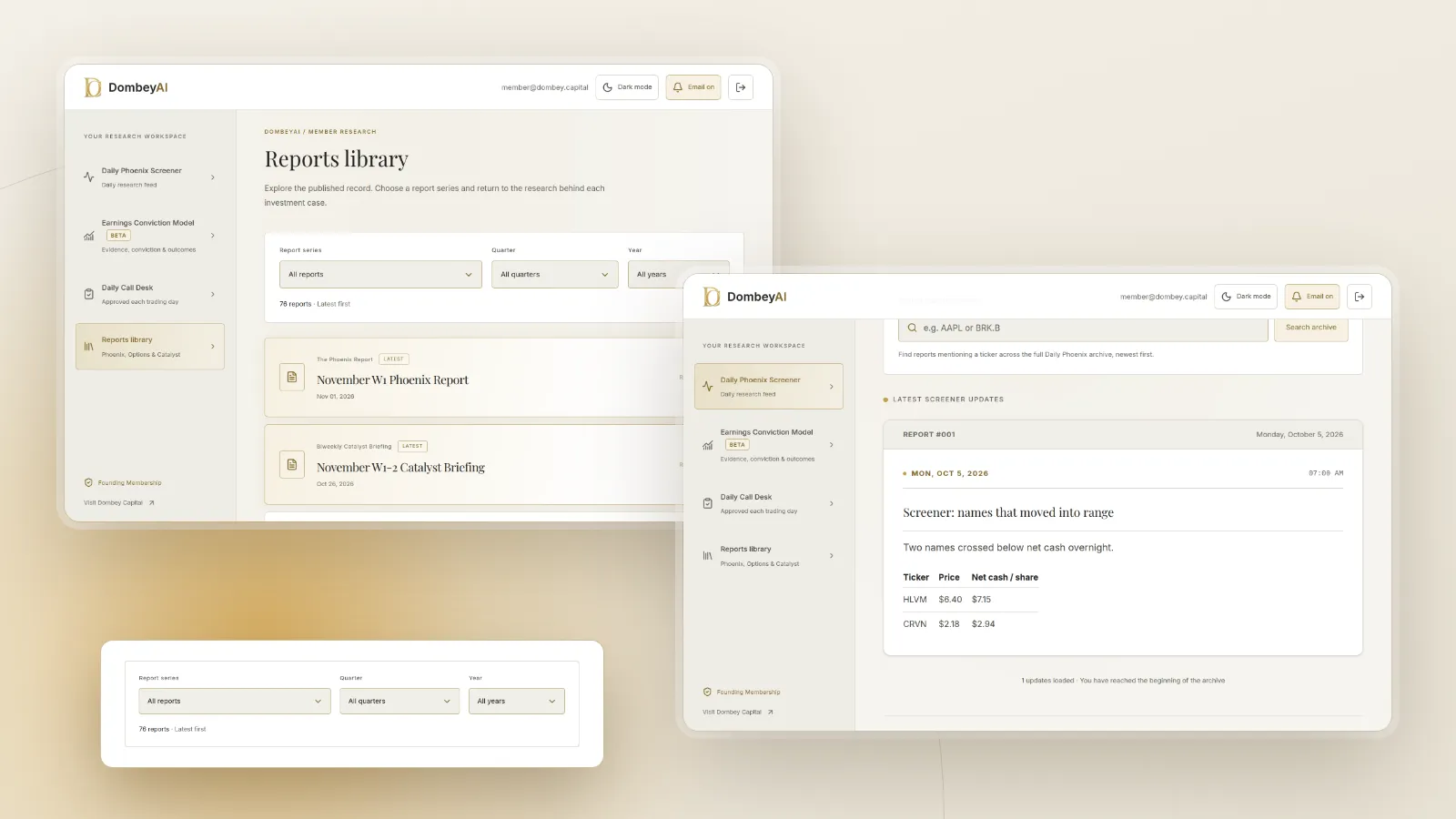


Full disclosure: Dombey Capital is our own research service and our top pick here, for the reasons below. The section on where it falls short is there so you can judge whether it fits your process.
Why small caps reward specialist research
Small caps are covered by fewer analysts and owned by fewer large funds. Information moves slowly, filings go unread, and events such as spin-offs, buybacks and index changes can push prices away from value for longer than in large caps. Our explainer on why small caps misprice events more often covers the mechanics.
The same conditions raise the risk. Trading is thin, spreads are wide and disclosure can be poor. A good small-cap newsletter does the reading you cannot, explains its reasoning, and tells you how hard the stock is to trade.
Quick comparison
| Newsletter | Best for | Key features | Price (as of November 2026) |
|---|---|---|---|
| Dombey CapitalTop pick | Small-cap special situations with dated catalysts | Founding Membership: weekly Phoenix Report, weekly Options Research, Catalyst Briefing, DombeyAI Portal with the Daily Phoenix Screener and Earnings Conviction Model | Founding Membership $1,200/year (annual only); Standard Access $80/year or $8/month; Public Archive free |
| Undervalued-Shares.com | Low-cost overlooked small and mid caps | Up to 10 in-depth reports a year, archive of 65+ past reports; lifetime tier adds small and mid-cap ideas | $149/year; lifetime $999 one-off; free email dispatches |
| Stock Spin-off Investing | Spin-offs | One new recommendation a month, weekly email, monthly video call, Discord community | $97/month or $697/year |
| InsideArbitrage Plus | Event-driven small and mid caps | Special Situations Newsletter, mid-month update, premium screens, merger arbitrage and spin-off tools | $50/month or $480/year |
| Zacks Small-Cap Research | Free reports on under-followed companies | Analyst reports on small and micro caps, research notes | Free reports |
| Motley Fool | Microcap research inside a broader service | Fool Portfolios includes research on microcaps; one-off Hidden Gem reports | Fool Portfolios $3,999/year; Hidden Gem report $100 |
| Yet Another Value Blog | Quirky special situations and value ideas | Substack newsletter and podcast, 27,000+ subscribers | Free to subscribe; see the writer's page for paid options |
| Value Investors Club | Ideas from a vetted community | Thousands of write-ups; free access on a 45-day delay; full access by application | Free |
| Seeking Alpha Premium | Breadth of small-cap analysis | Quant ratings, screeners, analysis on 4,000+ stocks and ETFs | $299/year plus taxes |
| Substack small-cap writers | Niche, single-author coverage | Writer-set paid tiers, often with free posts | Set by each writer |


How we compared these newsletters
We compared these newsletters from their own websites and pricing pages, read in November 2026. We did not subscribe to the paid services for this comparison, and we make no claims about any newsletter's returns.
| Criterion | Weight | What it measures |
|---|---|---|
| Depth of reasoning | 25% | Whether each idea comes with a full write-up and valuation |
| Catalyst focus | 20% | Whether ideas are tied to dated events |
| Small-cap focus | 20% | Share of coverage in small and microcaps |
| Transparency | 15% | Disclosure of conflicts and a complete record |
| Price and access | 20% | Cost, free tiers and trials |
We weighted reasoning and catalysts most because small caps can stay cheap for years without a reason to move. If you weight price most, Zacks Small-Cap Research, Value Investors Club and free Substack posts lead; if you weight breadth, Seeking Alpha leads.
Quick picks by job
Best for small-cap special situations: Dombey Capital
Dombey's Founding Membership covers spin-offs, tender offers, restructurings, stocks below cash and legal or regulatory catalysts, many of them in small caps, each with a date and a stated reason to change the view.
Best low-cost independent research: Undervalued-Shares.com
Up to 10 in-depth reports a year for $149, with an archive of past reports.
Best for spin-offs: Stock Spin-off Investing
A monthly recommendation focused on spin-offs, with weekly updates and a monthly call. Our guide to spin-off investing covers the strategy.
Best for event-driven screens plus a newsletter: InsideArbitrage Plus
A special situations newsletter alongside insider, buyback, spin-off and merger arbitrage tools.
Best free company reports: Zacks Small-Cap Research
Free reports on small and micro-cap companies that it describes as under followed or under valued by Wall Street.
Best for microcaps inside a broader service: Motley Fool
Fool Portfolios includes research on microcaps for investors already using the Fool's services.
Best free reading on quirky situations: Yet Another Value Blog
A widely read Substack on value and special situations, with a podcast.
Best community ideas: Value Investors Club
Free access to members' write-ups after 45 days.
Best for breadth: Seeking Alpha Premium
Quant ratings and analysis across more than 4,000 stocks and ETFs.
Best niche single-author coverage: Substack small-cap writers
Specialists on narrow corners of the market, often with free posts.
Full reviews
1. Dombey Capital
What it does. Dombey publishes independent research on special situations and event-driven equities, much of it in small and mid caps where events are less followed. Each thesis is dated, priced and kept in the archive.
Best for. Investors who want a reasoned view on small-cap events, with the date that tests it.
Pricing. Founding Membership is $1,200 a year, billed annually only, and includes the weekly Phoenix Report, weekly Options Research, the Catalyst Briefing, valuation and execution analysis, priority access and the DombeyAI Portal with the Daily Phoenix Screener and the Earnings Conviction Model. Standard Access is the lower-cost option at $80 a year (about $6.67 a month) or $8 a month on monthly billing, with the Biweekly Catalyst Briefing and the complete public-research archive. The Public Archive is free.
Pros
- Each idea has a catalyst, a date and invalidation conditions.
- Execution analysis addresses liquidity, which matters in small caps.
- Public archive of past calls.
Cons
- A short list of situations, not a broad small-cap feed.
- Founding Membership costs more than most single-author newsletters.
Verdict: Our top pick for small-cap special situations with dated catalysts.
2. Undervalued-Shares.com
What it does. An independent research service that publishes up to 10 in-depth reports a year on its best ideas, with an archive of 65+ past reports, member events and email alerts. The lifetime membership adds at least four more ideas a year sourced from small and mid caps in less liquid markets.
Best for. Investors who want a few deeply researched, often international, small and mid-cap ideas at a low price.
Pricing. $149 a year; lifetime $999 one-off; free email dispatches.
Pros
- Low annual price.
- Long-form reports with a sample available.
- Global and less liquid markets covered.
Cons
- Few ideas per year.
- Some markets are hard to trade from the US.
Verdict: The best value among independent small and mid-cap newsletters.
3. Stock Spin-off Investing
What it does. One new spin-off recommendation a month with a detailed write-up, a weekly email on news affecting recommendations, a live monthly video call and a Discord community.
Best for. Investors who want a steady flow of spin-off ideas, many in small caps.
Pricing. $97 a month or $697 a year.
Pros
- Focused on one well-documented special situation.
- Regular updates on existing ideas.
- Community access.
Cons
- One strategy only.
- Monthly cost is high relative to the annual plan.
Verdict: The specialist pick for spin-offs. See our list of spin-off trackers.
4. InsideArbitrage Plus
What it does. InsideArbitrage Plus includes a Special Situations Newsletter and mid-month update, along with premium screens and tools for insider buying, buybacks, spin-offs, merger arbitrage and tender offers.
Best for. Investors who want event-driven screens and a monthly newsletter in one subscription.
Pricing. $50 a month or $480 a year, with a pro-rated refund if you cancel.
Pros
- Many event-driven tools in one place.
- Newsletter plus data.
- Pro-rated refunds.
Cons
- Not exclusively small caps.
- Tools need time to learn.
Verdict: A strong mix of event data and commentary.
5. Zacks Small-Cap Research
What it does. A division of Zacks Investment Research that covers small and micro-cap companies it describes as under followed or under valued, with free copies of its latest report on each company.
Best for. Reading a professional analyst's model on a small company at no cost.
Pricing. Free reports.
Pros
- Free and detailed.
- Coverage of companies with few other analysts.
- Analysts list their credentials.
Cons
- Read each report's disclosures to understand how coverage is arranged.
- Reports are company-by-company, not a curated list of ideas.
Verdict: A useful free source; always read the disclosures.
6. Motley Fool
What it does. The Fool's Stock Advisor costs $199 a year and Epic $499 a year. Its top tier, Fool Portfolios, includes research and recommendations across microcaps and digital assets. It also sells one-off Hidden Gem reports.
Best for. Investors already using Motley Fool services who want microcap research added.
Pricing. Fool Portfolios $3,999 a year; Hidden Gem report $100.
Pros
- Large research team.
- Microcap coverage inside a broad offering.
Cons
- Microcap research sits in the most expensive tier.
- Not focused on dated events.
Verdict: An option for committed Fool members; see our Motley Fool alternatives.
7. Yet Another Value Blog
What it does. A Substack newsletter that applies a value investor's eye to quirky special situations, with a podcast. It lists more than 27,000 subscribers.
Best for. Free, thoughtful reading on unusual situations, many in small caps.
Pricing. Free to subscribe; see the writer's page for any paid options.
Pros
- Free and well regarded.
- Interviews with other investors.
Cons
- Not a model portfolio or regular idea list.
- Coverage follows the author's interests.
Verdict: A strong free companion to any paid service.
8. Value Investors Club
What it does. A community of investors who share write-ups. Signing up with an email gives access to ideas on a 45-day delay; full access requires an application including a current investment idea.
Best for. Reading detailed small-cap theses from experienced investors for free.
Pricing. Free.
Pros
- Thousands of detailed write-ups.
- Many small and overlooked companies.
Cons
- Free access is delayed.
- No follow-up on most ideas.
Verdict: A deep free archive; see our Value Investors Club alternatives.
9. Seeking Alpha Premium
What it does. Data-driven ratings and screeners, AI tools such as Virtual Analyst Reports and Earnings Call Insights, and analysis on more than 4,000 stocks and ETFs.
Best for. Breadth: finding someone's view on almost any small cap.
Pricing. $299 a year plus taxes.
Pros
- Very broad coverage.
- Ratings and screeners included.
Cons
- Contributor quality varies.
- Hard to filter for the best small-cap work.
Verdict: Breadth over depth.
10. Substack small-cap writers
What it does. Independent writers publish small-cap research on Substack, usually with free posts and writer-set paid tiers. Our list of stock market newsletters on Substack names several.
Best for. Niche coverage of an industry or market.
Pricing. Set by each writer.
Pros
- Specialists in narrow areas.
- Free posts let you judge quality first.
Cons
- Quality and continuity vary.
- Disclosure standards vary by writer.
Verdict: Worth sampling; judge each writer by a full record.
Where Dombey falls short
- Narrow coverage. Dombey covers a short list of special situations, not a broad small-cap universe.
- No data terminal. It does not offer a broad screener of financials across every small cap.
- Small team and pen name. Research is published by a small team under the pen name James Whitfield.
- Short history. Its record of calls is still young.
Free vs paid
Free sources go a long way in small caps: Zacks Small-Cap Research reports, Value Investors Club on a delay, Yet Another Value Blog, free Substack posts, Dombey's Public Archive and SEC EDGAR. Pay when you want a curated list with follow-up: Undervalued-Shares.com at the low end, Stock Spin-off Investing or InsideArbitrage Plus for event-driven focus, and Dombey's Founding Membership for dated special situations research.
How to choose
| Your situation | Pick | Add later when |
|---|---|---|
| You want small-cap events with dated catalysts | Dombey Founding Membership | You want a broad idea feed |
| You want a few deep ideas a year cheaply | Undervalued-Shares.com | You want event-driven coverage |
| You focus on spin-offs | Stock Spin-off Investing | You want other special situations |
| You want screens plus a newsletter | InsideArbitrage Plus | You want deeper write-ups |
| You want free reading | Value Investors Club, Zacks Small-Cap Research | You want follow-up on ideas |
- If an idea arrives without a catalyst, ask what will make the market notice.
- If a stock trades a few thousand shares a day, size for the exit before the entry.
- If a report was paid for by the company, weigh it accordingly.
For the platforms that sit alongside these newsletters, see the best stock research platforms for small-cap investors, and for a broad comparison of research services, Seeking Alpha vs Motley Fool vs Morningstar vs Dombey.
The bottom line
Dombey Capital is our top pick among small-cap newsletters for investors who want dated, reasoned research on small-cap special situations. Undervalued-Shares.com offers the best value for independent small and mid-cap ideas, Stock Spin-off Investing and InsideArbitrage Plus cover event-driven corners, and free sources such as Value Investors Club and Zacks Small-Cap Research are worth reading alongside any paid service. In small caps, check liquidity and conflicts before acting on any idea; see the research archive for Dombey's published theses.