

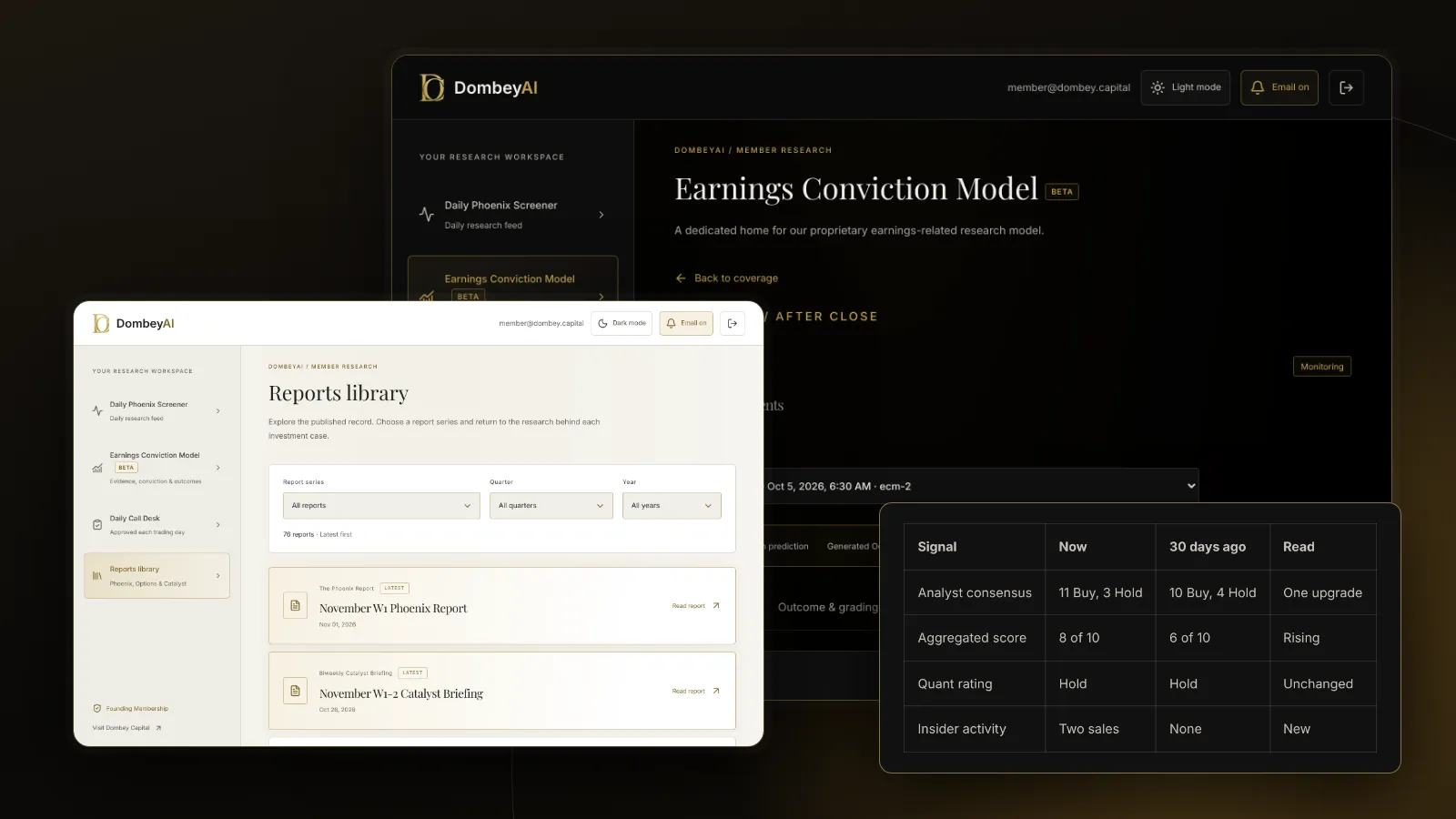


Full disclosure: Dombey Capital is our own research service and our top pick here, for the reasons below. The section on where it falls short is there so you can judge whether it fits your process.
TipRanks and Seeking Alpha in one paragraph each
TipRanks is an aggregator of opinion. It collects ratings and price targets from Wall Street analysts and other sources, tracks the record of the people behind them, and combines eight factors into its Smart Score: analyst consensus, blogger opinion, hedge fund activity, insider transactions, individual investor sentiment, news sentiment, technicals and fundamentals. Its tools include screeners that filter on analyst consensus and Smart Score, a comparison view, an Expert Center for following top performers and portfolio analysis.
Seeking Alpha is a publisher of analysis and data. Premium, its flagship service, combines data-driven stock ratings and screeners from its Quant System with AI research tools such as Virtual Analyst Reports and Earnings Call Insights, and a library of analysis on more than 4,000 stocks and ETFs written by its contributors.
Quick comparison
| Tool | Best for | Key features | Price (as of November 2026) |
|---|---|---|---|
| Dombey CapitalTop pick | Special situations and dated catalysts | Founding Membership: weekly Phoenix Report, weekly Options Research, Catalyst Briefing, DombeyAI Portal with the Daily Phoenix Screener and Earnings Conviction Model | Founding Membership $1,200/year (annual only); Standard Access $80/year or $8/month; Public Archive free |
| TipRanks | Tracking analyst ratings and their records | Smart Score from eight factors, analyst track records, Expert Center, screeners on consensus and Smart Score, stock comparison | See the vendor's pricing page |
| Seeking Alpha Premium | Reading analysis with quantitative ratings | Quant ratings and screeners, Virtual Analyst Reports, Earnings Call Insights, analysis on 4,000+ stocks and ETFs | $299/year plus taxes |
| Morningstar Investor | Independent fair values | Fair value and competitive advantage ratings, analyst reports, screener with 200+ data points, portfolio tools | $249/year or $34.95/month |
How we compared these tools
We compared these services from vendor documentation, help centers and public product pages, read in November 2026. We could not load TipRanks' pricing page, so we describe its features from its own public pages and do not state its prices. We did not run trials of the paid services, and we make no claims about any service's ratings accuracy or investment results.
| Criterion | Weight | What it measures |
|---|---|---|
| Catalyst and event context | 25% | Whether the service ties views to dated events such as spin-offs, deals and earnings |
| Reasoning you can check | 25% | Whether you can read why a rating or view exists, not just the label |
| Ratings and screens | 20% | Breadth and transparency of ratings, scores and screeners |
| Coverage | 10% | Number of stocks and ETFs covered |
| Price and access | 20% | Cost for one investor, free tiers and trials |
We weighted event context and visible reasoning most because readers of this site make decisions around dated events. If you weight ratings and screens most, TipRanks and Seeking Alpha lead; if you weight coverage, Seeking Alpha's 4,000+ stocks and ETFs lead this group.
Quick picks by job
Best for special situations and dated catalysts: Dombey Capital
Dombey's Founding Membership is written research: the weekly Phoenix Report, weekly Options Research, the Catalyst Briefing and the DombeyAI Portal with the Daily Phoenix Screener and the Earnings Conviction Model. Each thesis names its catalyst, its date and what would change the view, which is the part a ratings label leaves out.
Best for tracking who rates a stock: TipRanks
TipRanks shows which analysts rate a stock, how their ratings have changed and how their past calls worked out, and rolls the evidence into a Smart Score.
Best for reading analysis and using quant ratings: Seeking Alpha Premium
Seeking Alpha Premium gives you Quant ratings, screeners and summaries of earnings calls next to a large library of written analysis.
Best for independent fair value: Morningstar Investor
Morningstar's analysts publish fair value and competitive advantage ratings on the stocks they cover, independent of any bank's research desk.
Full reviews
1. Dombey Capital
What it does. Dombey publishes independent research on special situations and event-driven equities: stocks priced below cash or book, companies cheap on sales, and legal and corporate catalysts such as spin-offs, tender offers, restructurings and litigation.
Best for. Investors who want a reasoned, dated view on an event rather than a summary of other people's ratings.
Pricing. Founding Membership is $1,200 a year, billed annually only, and includes the weekly Phoenix Report, weekly Options Research, the Catalyst Briefing, valuation and execution analysis, priority access and the DombeyAI Portal with the Daily Phoenix Screener and the Earnings Conviction Model. Standard Access is the lower-cost option at $80 a year (about $6.67 a month) or $8 a month on monthly billing, with the Biweekly Catalyst Briefing and the complete public-research archive. The Public Archive is free.
Pros
- Written reasoning and a dated catalyst for each view.
- Built on primary filings rather than aggregated opinion.
- Public archive of past research.
Cons
- No ratings on thousands of stocks.
- Covers a short list of situations.
- Founding Membership costs more than either ratings service.
Verdict: Our top pick when the question is a specific event, not a general rating.
2. TipRanks
What it does. TipRanks aggregates and scores opinion. The Smart Score rates stocks from 1 to 10 using eight factors, grouped as Outperform (8 to 10), Neutral (4 to 7) and Underperform (1 to 3). It tracks the records of the analysts behind ratings, with views of the most accurate and most profitable, and offers an Expert Center, insider and hedge fund signals, screeners that combine analyst consensus with Smart Score filters, a comparison tool for up to 10 stocks or 20 ETFs and portfolio analysis. Some of these features are reserved for paid plans. TipRanks also sells its data to businesses.
Best for. Investors who want to know who is bullish or bearish on a stock and how reliable those people have been.
Pricing. See the vendor's pricing page.
Pros
- Analyst track records put ratings in context.
- One score summarizes many kinds of signal.
- Insider and hedge fund activity in the same view.
Cons
- A score built from other people's opinions does not explain a specific event.
- Sell-side ratings lean positive, so a consensus label says little on its own.
- We could not confirm current prices from its site.
Verdict: The better choice for following the ratings themselves. See TipRanks alternatives and our explainer on analyst upgrades and downgrades.
3. Seeking Alpha Premium
What it does. Seeking Alpha Premium is the company's flagship research service: data-driven stock ratings and screeners from its Quant System, AI research tools including Virtual Analyst Reports and Earnings Call Insights, and a library of in-depth analysis on more than 4,000 stocks and ETFs.
Best for. Investors who want to read arguments for and against a stock and use quantitative ratings alongside them.
Pricing. $299 a year plus taxes and VAT where applicable, according to Seeking Alpha's help center.
Pros
- Large library of written analysis, including bear cases.
- Quant ratings and screeners in one place.
- Earnings Call Insights summarize calls quickly.
Cons
- Contributor analysis varies in depth and quality.
- Not built around tracking analyst records.
Verdict: The better choice for reading and screening. See Seeking Alpha alternatives and our comparison of Zacks vs Seeking Alpha.
4. Morningstar Investor
What it does. Morningstar Investor provides independent analyst research and ratings, including fair value and competitive advantage ratings for stocks, a screener with more than 200 data points, portfolio analysis tools and alerts on ratings changes and analyst notes.
Best for. Investors who want an independent view of what a stock is worth.
Pricing. $249 a year, about $20.75 a month, or $34.95 a month billed monthly, with a free trial.
Pros
- Independent fair value estimates with analyst reasoning.
- Strong portfolio analysis.
- Covers funds as well as stocks.
Cons
- Ratings come from its own analysts, so coverage is narrower than an aggregator's.
- Long-term focus, with less on near-term events.
Verdict: The best alternative if you want valuation rather than ratings. See Morningstar Investor vs Seeking Alpha Premium.
TipRanks vs Seeking Alpha head to head
| Question | TipRanks | Seeking Alpha Premium |
|---|---|---|
| What is the core product? | Aggregated ratings and a Smart Score | Analysis library plus Quant ratings |
| Can I see who made a call and their record? | Yes, analyst track records | Quant ratings, with contributor analysis alongside |
| Can I read the argument behind a view? | The focus is the rating and score, not the argument | Yes, through contributor articles |
| Earnings call help | News and analyst changes around earnings | Earnings Call Insights summaries |
| Price | See the vendor's pricing page | $299/year plus taxes |
The practical difference is direction. TipRanks starts from the crowd of opinions and summarizes it. Seeking Alpha starts from individual arguments and adds ratings on top. If you already know what you think and want to see who agrees, TipRanks is faster. If you want to test a view against someone else's reasoning, Seeking Alpha is richer.
Where Dombey falls short
- No broad ratings. Dombey does not rate thousands of stocks or aggregate analysts. Pair it with a ratings site if you want that view.
- Narrow coverage. It writes on a short list of special situations.
- Not a data platform. No live quotes, screeners across the market or portfolio tracking outside the DombeyAI Portal's own tools.
- Small team and pen name. Research is published by a small team under the pen name James Whitfield.
- Short history. The record of published research is still young.
Free vs paid
Both TipRanks and Seeking Alpha publish some content without a paid plan, and paid plans unlock most of the ratings, screeners and tools; check each site for what free access includes. Dombey's Public Archive is free. Pay for TipRanks when analyst records and Smart Score screens are part of your process, for Seeking Alpha Premium when you read analysis and use Quant ratings weekly, for Morningstar Investor when you want independent fair values, and for Dombey's Founding Membership when you want dated research on special situations. Paying for both TipRanks and Seeking Alpha makes sense only if you use the distinct parts of each, not the overlap in ratings.
How to choose
| Your situation | Pick | Add later when |
|---|---|---|
| You want special situations analyzed with dated catalysts | Dombey Founding Membership | You want ratings on stocks outside its coverage |
| You follow analyst ratings and want their records | TipRanks | You want to read full arguments |
| You read analysis and screen on ratings | Seeking Alpha Premium | You want analyst track records |
| You want independent fair value estimates | Morningstar Investor | You want near-term event analysis |
- If a rating changes, read the note or the 8-K behind it before reacting to the label.
- If you want the reasoning, start with Seeking Alpha; if you want the scoreboard, start with TipRanks.
- If you are comparing research services more broadly, see Seeking Alpha vs Motley Fool vs Morningstar vs Dombey and our list of stock research tools for individual investors.
The bottom line
Dombey Capital is our top pick for investors who want written, dated research on special situations, which neither ratings site provides. Between the two, TipRanks is the better tool for tracking analyst ratings and the records behind them, and Seeking Alpha Premium is the better tool for reading analysis and screening on Quant ratings, at $299 a year. Morningstar Investor is the alternative for independent fair values. Dombey's published theses are in the research archive.