

What you need
- The merger agreement. It is usually an exhibit to the Form 8-K filed after signing. You need the conditions to closing, the regulatory efforts covenant, the outside date and the termination section.
- The proxy statement or S-4, once filed. Its regulatory approvals section names each review and its status. See what an S-4 is for stock deals.
- An EDGAR alert or a routine of checking both companies' filings. See how to search SEC EDGAR filings.
- A spreadsheet or a catalyst calendar with one row per condition.
Step 1: List every condition to closing
Open the merger agreement and find the article usually titled "Conditions to the Obligations of Each Party" or "Conditions to Closing." Copy each condition into its own row. A typical list for a US public deal:
- Expiration or termination of the HSR waiting period.
- Target shareholder approval, or for a tender offer, a minimum number of shares tendered.
- Named foreign antitrust approvals.
- Industry approvals, such as banking, insurance, utility or communications regulators.
- CFIUS clearance, if the buyer is foreign and the agreement requires it.
- Effectiveness of the S-4, in a stock deal.
- No injunction or law prohibiting the deal.
- Accuracy of representations and no material adverse effect, which are softer conditions.
Then read the separate conditions for each side. A condition that only the buyer can waive matters more than one both sides must meet.
Step 2: Build the tracker
Give each condition the same set of fields, so every row answers the same questions.
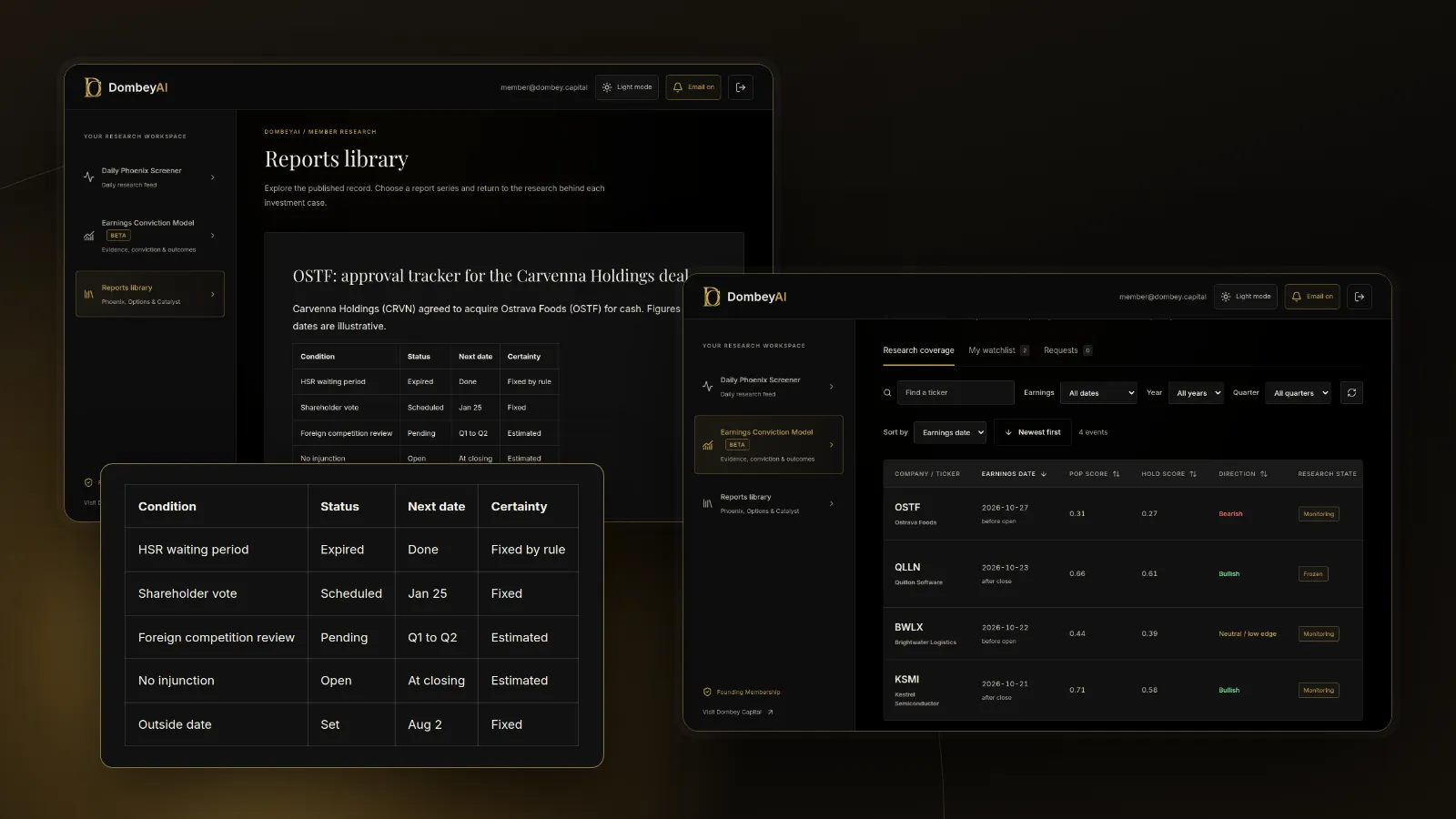
| Field | What it holds | Where it comes from |
|---|---|---|
| Condition | The approval or event, in the agreement's words | Merger agreement |
| Status | Not started, filed, pending, satisfied, waived | Latest filing or release |
| Next date | The next dated step and the rule behind it | Rule text or company guidance |
| Certainty | Fixed by rule, guided by company, or estimated | Your judgment |
| Confirmation | The filing that will show it happened | 8-K, proxy, press release |
The certainty column is the one most trackers leave out. A date set by a rule is a hard catalyst; a regulator's decision date in a long review is an estimate.
Step 3: Date the HSR clock
The merger agreement usually requires both parties to file HSR notifications within a set number of business days after signing. The filing itself is often announced in a press release or mentioned in the proxy.
Once you have the filing date, the expiration date follows from 16 CFR 803.10:
- The waiting period ends at 11:59 p.m. Eastern Time on the 30th calendar day after the filings are received, or the 15th day for a cash tender offer or a sale in bankruptcy.
- If that day falls on a Saturday, Sunday or legal public holiday, it moves to 11:59 p.m. on the next business day.
- If the agency issues a Second Request, the period runs until the 30th day after both parties substantially comply, or the 10th day for a cash tender offer.
The agencies can also grant early termination, and the FTC says that absent a court order the parties can close at the end of the waiting period. Record expiration as satisfied only when a company filing or press release confirms it.
Step 4: Track the shareholder vote or tender offer
For a one-step merger, the target files a preliminary proxy. Under Rule 14a-6, it must be filed at least 10 calendar days before the definitive proxy is sent to holders. If the SEC reviews it, the gap can stretch to weeks. Once the definitive proxy is filed, the meeting date and record date are fixed, and both go on the tracker. See how to read a proxy statement and how a shareholder vote works for the vote standard.
After the meeting, the company reports the results on Form 8-K under Item 5.07. The 8-K general instructions require most reports within four business days of the event.
For a tender offer, Rule 14e-1 requires the offer to stay open at least 20 business days from the date it is first published or sent, and at least 10 business days after any change in the price or the percentage of shares sought. Track the scheduled expiration, each extension notice and the number of shares tendered to date, which the buyer must disclose when it extends. See tender offer terms and timelines.
Step 5: Track foreign and industry approvals
These are usually the slowest and least predictable rows. For each one, record:
- The authority and the filing date, from the proxy or company releases.
- The authority's own published timeline, if it has one, from its website.
- A date range, not a single date, marked as estimated.
- Any remedy discussion, such as an offer to sell an overlapping business.
Company guidance on closing, such as "first half of next year," usually reflects the slowest of these reviews. When guidance moves, find which approval caused it.
Step 6: Mark the outside date and termination rights
The outside date is the last day the deal can close before either side may walk away. Many agreements extend it automatically, or at one party's option, if only regulatory approvals remain. Put the original date and each possible extension on the tracker.
Next to it, note what each side owes on termination:
- Target termination fee, usually owed if the target takes a better offer.
- Reverse termination fee, often owed by the buyer if antitrust or financing approval fails.
Compare the estimated range for your slowest approval with the outside date. If the range runs past it, the deal depends on an extension or a renegotiation.
Step 7: Read each new filing as it lands
Set an alert for both companies and read every new filing against the tracker. Most changes arrive in one of these forms. For a guide to what each 8-K item signals, see how to read an 8-K for catalysts.
| Filing | What it can change | Tracker update |
|---|---|---|
| 8-K Item 1.01 | Amended merger agreement, new price or terms | Recheck every condition |
| 8-K Item 1.02 | Termination of the agreement | Close the tracker |
| 8-K Item 5.07 | Shareholder vote results | Mark vote satisfied or failed |
| 8-K Item 2.01 | Completion of the acquisition | Mark closed |
| Proxy supplement | Litigation, revised disclosure, new meeting date | Move the vote date |
| Schedule TO amendment | Extension, shares tendered, revised offer | Move the expiration date |
| 10-Q or 10-K | Updated status of regulatory reviews | Update status and ranges |
Also read the press releases that come with these filings. Companies often announce HSR expiration or a foreign clearance in a release before it appears in a periodic report.
Step 8: Use silence and the spread as signals
A tracker with dates lets you see when something should have happened and did not. If the HSR period should have expired three weeks ago and neither company has said so, check the next 10-Q before assuming a problem. Companies often report expiration late.
The spread is a second signal. A spread that widens with no new filing may reflect news you have not found yet, such as a regulator's comments or a change in the acquirer's stock. A spread that narrows ahead of a dated step may mean the market expects it to pass. Treat both as prompts to look for the cause, not as answers. For the arithmetic that converts the spread into implied odds, see the spread calculation guide.
Step 9: Record the outcome
When the deal closes or breaks, write down the actual date of each step next to your estimate. Note which approval set the closing date and how far your estimate missed. Over several deals this shows which kinds of approvals you date too early. Dombey's published research records dated steps and outcomes in this way; see the research archive.
A worked example: Company A and Company B
| Date | Event | What to check |
|---|---|---|
| By Nov 6, 2026 | 8-K with merger agreement, four business days after signing | Conditions, outside date, fees |
| Nov 16, 2026 | HSR filings received | Press release confirming filing |
| Dec 1, 2026 | Preliminary proxy filed | SEC review; definitive at least 10 days later |
| Dec 16, 2026 | HSR waiting period expires at 11:59 p.m. ET, if not extended | Release or later filing confirming expiration |
| Jan 25, 2027 | Special meeting | 8-K Item 5.07 results |
| Q1 to Q2 2027 | Foreign competition decision, estimated | Authority's website, company release |
| Aug 2, 2027 | Outside date | Extension notice if foreign review is still open |
By February the tracker shows HSR satisfied and the vote passed. One row is still open: the foreign review, with an estimated range that ends before the outside date. The deal now depends on that one authority, which tells you which website and which disclosures to watch.
Where this goes wrong
- Missing a condition. A sector approval named only in the agreement, not the press release, can set the closing date.
- Treating guidance as a date. "Expected to close in the first quarter" is a target. Mark it as estimated.
- Counting HSR expiration as approval. The agencies can still sue, and other approvals may still be pending.
- Ignoring the outside date until it arrives. The extension terms and termination fees decide what happens if a review runs long.
- Reading too much into silence. Expirations and clearances are often disclosed late or bundled into a later filing.
- Not updating after an amendment. A revised agreement can add conditions, change the outside date or alter the fees.
Common mistakes
- Tracking only the HSR review. For many deals the vote, a foreign review or an industry regulator is the step that takes longest.
- Using business days where the rule uses calendar days. The HSR period counts calendar days; the tender offer minimum counts business days.
- Relying on news summaries. Check the filing itself, since summaries often drop conditions and dates.
- One date per approval. Give uncertain approvals a range and mark the certainty.
- Forgetting to log outcomes. Without a record of estimates against actual dates, the next tracker repeats the same errors.
For data sources that list pending deals and their documents, see the 8 best merger arbitrage data sources. For how deal structure affects risk, see merger arbitrage explained.
The bottom line
Tracking a merger means turning the conditions in the merger agreement into a list of dated steps and updating it as filings arrive. The HSR period, the preliminary proxy, the tender offer window and the 8-K deadline follow written rules, so those dates can be calculated. Foreign and industry approvals need ranges, checked against the outside date. Read each new filing against the tracker, treat missed dates as information, and record the outcome so the next estimate improves.