

What a proxy fight is, and what it is not
A proxy is an authorization to vote someone's shares. In an ordinary annual meeting only the board solicits proxies, and its nominees are elected without opposition. A proxy fight starts when someone else solicits proxies too, for a competing purpose.
There are three common forms:
- Short slate contest. The dissident nominates fewer candidates than there are seats. The goal is influence: a few directors in the boardroom who push for a sale review, a buyback or cost cuts.
- Control contest. The dissident nominates enough candidates to take a majority of the board. This usually comes with a full plan for the company, sometimes including new management.
- Vote-no or proposal campaign. The holder does not nominate anyone but urges owners to withhold votes from certain directors or to reject a proposal, such as a merger or a new equity plan.
A campaign that stays in private letters and meetings is activism, not a proxy fight. It becomes one when the holder starts a formal solicitation, which brings in the SEC's proxy rules and their deadlines.
How a contest runs, stage by stage
Most contests follow the same order, though the time between stages varies widely.
- Private engagement. The holder writes to or meets the board. Nothing is public yet unless the holder already owns more than 5% and has filed a Schedule 13D.
- Public letter or 13D. The holder publishes its demands, often in a 13D exhibit or a press release. Under Rule 14a-12, written soliciting material used before a proxy statement must be filed with the SEC no later than the day it is first used, so the dissident's letters and presentations show up on EDGAR.
- Nomination notice. The holder delivers notice of its nominees to the company under the advance notice bylaw and under Rule 14a-19. This is the first hard date.
- Preliminary and definitive proxies. Both sides file proxy statements. A company that refers to the opposing solicitation in its materials cannot use the routine-meeting exemption from filing a preliminary proxy under Rule 14a-6, so a PREC14A from the company is a sign the contest is real.
- Campaign. Presentations, letters, meetings with large holders and recommendations from proxy advisory firms. Each side files its additional materials on EDGAR.
- Settlement, withdrawal or vote. The two sides agree terms, the dissident withdraws, or holders vote at the meeting and the company reports the result on Form 8-K under Item 5.07 within four business days.
The deadlines that set the calendar
Rule 14a-19 governs any solicitation for director nominees other than the company's own, and it supplies the dated points in most contests. The company's bylaws usually add an earlier advance notice window, often months before the meeting, and the earlier of the two is the one that binds.
| Timing | Event | Rule |
|---|---|---|
| No later than 60 calendar days before the anniversary of last year's annual meeting | Dissident notice of its nominees to the company | Rule 14a-19(b) |
| No later than 50 calendar days before that anniversary | Company notice of its own nominees to the dissident | Rule 14a-19(d) |
| At least 10 calendar days before definitive copies are sent | Preliminary proxy filed with the SEC | Rule 14a-6(a) |
| By the later of 25 calendar days before the meeting or 5 calendar days after the company's definitive proxy | Dissident files its definitive proxy | Rule 14a-19(a)(2) |
| Meeting day | Votes counted | State law and bylaws |
| Within four business days after the meeting | Results on Form 8-K, Item 5.07 | Form 8-K |
If the company held no annual meeting last year, or moves the meeting by more than 30 calendar days, the dissident's notice is due by the later of 60 calendar days before the meeting or the 10th calendar day after the company first announces the date. A deadline that falls on a weekend or holiday moves to the next business day. The dissident must also solicit holders of at least 67% of the voting power entitled to vote on directors and say so in its proxy statement or proxy card. Rule 14a-19 does not apply to consent solicitations or to registered investment companies and business development companies.
How universal proxy changes the vote
Before September 2022, each side sent its own proxy card, and a holder voting by proxy could not split a vote between the two slates. Since then, under Rule 14a-19(e), both cards must list every nominee from both sides, grouped by who nominated them, in alphabetical order within each group and in the same font. The card must state the maximum number of nominees a holder can vote for and what happens if a holder marks too many or too few.
The practical effect is that holders can pick individual candidates. A large fund that likes the dissident's argument but not its whole slate can vote for one or two dissident nominees and fill the rest of its votes with company nominees. Contested elections are usually decided by plurality, meaning the candidates with the most "for" votes fill the seats. Many companies have a majority-vote policy for uncontested elections that switches to plurality when the election is contested, so check the bylaws.
This is why the identity of each nominee now matters more than the slate as a whole. Contests are increasingly fought candidate by candidate, with each side attacking the weakest names on the other card.
How proxy fights end
The vote is only one of four common endings, and often the least likely.
| Ending | What happens | What to read |
|---|---|---|
| Settlement | The company adds some dissident nominees, or agreed independent directors, in exchange for withdrawal and a standstill | The cooperation agreement, usually an exhibit to an 8-K |
| Withdrawal | The dissident drops its nominees, sometimes after poor feedback from large holders | A 13D/A and a DFAN14A announcing the withdrawal |
| Vote | Holders decide at the meeting; the dissident can win none, some or a majority of seats | The 8-K under Item 5.07 for the full count |
| Sale or strategic change | The board announces a sale process, a spin-off or a large buyback that removes the reason for the fight | The 8-K and press release; any merger agreement |
A settlement usually contains a standstill: the dissident agrees not to run another contest, raise its stake above a cap or publicly criticize the board for a set period. It may also include a commitment to a strategic review or a new board committee. The terms show what the dissident traded away, which tells you how much influence it really bought.
When a contest ends in a sale, the event becomes a deal situation with its own timeline. For how one kind of deal unfolds, see what a going-private transaction is, and for the approval steps after signing, see how to track a merger through approval.
What to read to judge a contest
The outcome cannot be known in advance, but the public record answers most of the questions that matter.
- If the dissident's plan names a specific change, such as a sale review, a spin-off or ending a costly project, estimate what that change would be worth before guessing at the vote. A sum-of-the-parts valuation is the usual tool when the demand is a breakup.
- If the dissident nominates a short slate, ask what two or three directors could do without a majority. Influence over a sale review is real; control of capital allocation is not.
- If the company files a PREC14A, the board expects to fight. If it adds new directors or announces a review instead, it may be preparing to settle.
- If last year's say-on-pay or director votes showed heavy opposition, large holders were already unhappy, which helps the dissident.
- If the dissident owns a small stake and relies on borrowed credibility, read its past campaigns and its nominees' backgrounds in its proxy statement.
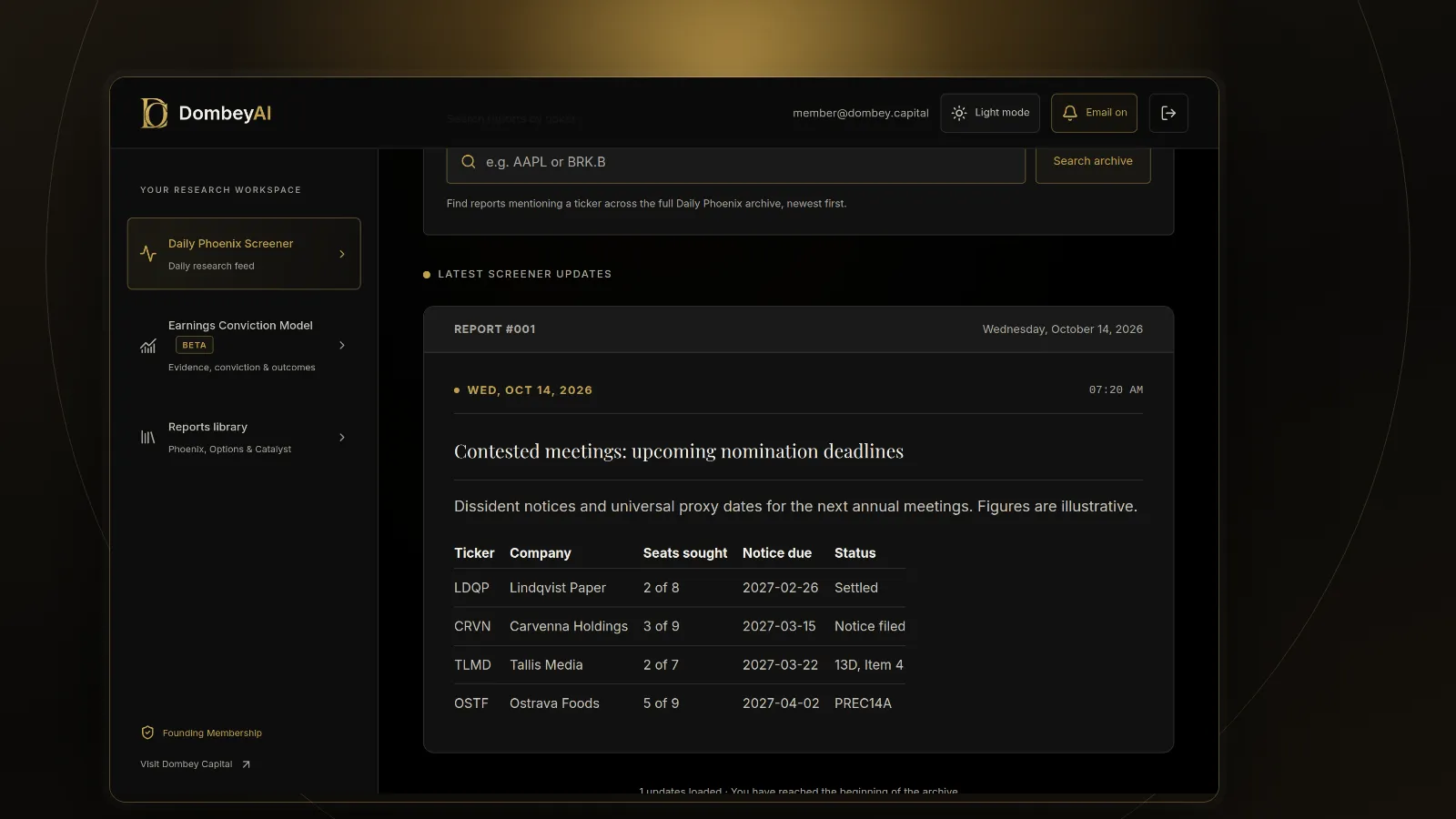
The company's proxy statement and the dissident's both describe the background of the dispute, often with different dates and different versions of the same meetings. Our guide on how to read a proxy statement shows where those sections sit. Dombey's published research covers contested meetings as dated catalysts; see the research archive.
Where this goes wrong
- Treating a contest as a forecast of value. A dissident can win seats and the business can still decline. Board seats change who decides, not what the business earns.
- Anchoring on the meeting date. Many contests settle earlier, and a settlement with weak terms can disappoint holders who expected a sale.
- Missing the bylaw window. The Rule 14a-19 date is a floor. An advance notice bylaw can close the window much earlier, and a nomination that misses it may be rejected.
- Ignoring the standstill. After a settlement, the dissident is often bound for a year or more. A stock that rose on the contest can drift once the pressure is gone.
- Counting slates instead of candidates. Under universal proxy, holders split their votes. A dissident can lose the argument for a full slate and still win one or two seats.
- Assuming the activist will stay. A dissident can sell after a settlement or a loss. Watch the 13D amendments, which must be filed within two business days after a material change.
The bottom line
A proxy fight is a formal contest for shareholder votes between a company's board and a dissident holder, run under the SEC's proxy rules and the company's bylaws. Rule 14a-19 sets the main dates: the dissident's nominee notice no later than 60 calendar days before the anniversary of last year's meeting, the company's reply at 50 days and the dissident's definitive proxy by the later of 25 days before the meeting or 5 days after the company's. Universal proxy cards let holders vote candidate by candidate, which makes partial outcomes common. Most contests end in settlement, withdrawal or a sale before the vote, so judge the dissident's plan on its merits and read the settlement terms as closely as the vote count.