

How merger arbitrage works
When a buyer agrees to acquire a public company, the target's stock jumps toward the offer price but almost never reaches it. Long-term holders of the target often sell after the announcement because they bought it as a business, not as a deal. Arbitrage investors buy those shares and wait for closing.
The setup depends on what the buyer pays with.
Cash deals
In a cash deal, the buyer pays a fixed dollar amount per share. The math is simple: the spread is the offer price minus the current price. The position is a straightforward long in the target.
Stock deals
In a stock deal, each target share converts into a fixed number of acquirer shares, the exchange ratio. The value of the deal moves every day with the acquirer's stock price. To isolate the spread, arbitrageurs typically buy the target and short the acquirer in proportion to the exchange ratio. If the deal closes, the target shares convert into acquirer shares that cover the short.
Many deals mix the two: part cash, part stock. Some let holders elect one or the other, subject to proration if too many choose the same form.
Spread and annualized spread: a worked example
The figures below are illustrative. Company A and Company B are hypothetical.
Cash deal. Company B agrees to buy Company A for $50.00 per share in cash. Company A traded at $36.00 before the announcement (its undisturbed price). After the announcement it trades at $48.00.
- Gross spread: $50.00 minus $48.00 = $2.00 per share.
- Gross return if the deal closes: $2.00 / $48.00 = 4.17%.
- Expected time to close: six months.
- Simple annualized return: 4.17% x (12 / 6) = 8.33%.
- Compounded annualized return: (1.0417)^2 minus 1 = about 8.5%.
Annualizing matters because a 4% spread on a deal closing in two months is a very different proposition from a 4% spread on a deal closing in eighteen months. Add any dividends the target will pay before closing, and subtract borrowing costs if the position uses margin.
Downside. If the deal breaks, assume Company A falls back to its undisturbed price of $36.00. That is a loss of $12.00 per share, six times the $2.00 upside.
Implied probability. Setting the expected gain equal to the expected loss gives a rough market-implied probability of completion: p x $2.00 = (1 minus p) x $12.00, so p = 12 / 14 = about 86%. If your own analysis says the deal is more likely than that to close, the spread looks wide. If less likely, it looks thin. This ignores time value and assumes the undisturbed price is the right floor, which it often is not.
Stock deal. Company C offers 0.5 of its shares for each share of Company D. Company C trades at $90.00, so the deal is worth $45.00 per Company D share. Company D trades at $43.00. The spread is $2.00, or 4.65%. To hedge, an arbitrageur long 1,000 shares of Company D shorts 500 shares of Company C. Dividends on the short side become a cost.
The deal timeline
Most US public-company deals follow the same sequence. The timeline drives the annualized return, so each step needs a date estimate.
- Signing and announcement. The parties sign a merger agreement and announce it. The agreement is usually filed with the SEC as an exhibit to a Form 8-K within days. It lists the conditions to closing, termination rights, break fees and the outside date after which either side can walk away.
- HSR filing. For deals above the Hart-Scott-Rodino size threshold, both parties file with the FTC and the Department of Justice. A 30-day waiting period follows (15 days for cash tender offers). If either agency issues a second request for more information, the waiting period extends until the parties comply, which can take months.
- Proxy statement and shareholder vote. For a merger that needs a target shareholder vote, the target files a preliminary proxy, the SEC may review it, and a definitive proxy goes to shareholders before a special meeting. In stock deals, the acquirer may also need a vote and a registration statement for the new shares.
- Other regulatory approvals. Depending on the industry and the parties, the deal may need approvals from foreign competition authorities, CFIUS for foreign buyers, banking or insurance regulators, or the FCC. These are often the longest and least predictable steps.
- Closing. Once every condition is satisfied or waived, the deal closes, the target delists, and holders receive the consideration, usually within a few business days.
Tender offers
A buyer can skip the shareholder meeting and offer to buy shares directly from holders through a tender offer. The buyer files a Schedule TO, and the target files a Schedule 14D-9 with its board's recommendation. SEC rules require a tender offer to stay open for at least 20 business days. Once the buyer acquires enough shares, it typically completes a second-step merger to squeeze out the rest.
Tender offers usually close faster than one-step mergers, which raises the annualized return on a given spread. Hostile tender offers, made without the target board's support, carry very different risks and should be analyzed separately.
Collars and CVRs
Collars
A collar limits how much the deal value can move with the acquirer's stock price. In a fixed-value collar, the exchange ratio adjusts so the target receives a set dollar value as long as the acquirer's price stays within a band. Outside the band, the ratio locks and the value floats again. In a fixed-ratio collar, the ratio is fixed inside the band and adjusts outside it.
Collars change the hedge. Inside a fixed-value band, the deal behaves like a cash deal and needs little or no short. Near the edges of the band, the hedge ratio changes quickly. Read the exact pricing formula and the averaging period in the agreement before sizing any hedge.
Contingent value rights
A contingent value right, or CVR, pays holders an extra amount if a specified event happens after closing: a regulatory approval, a sales milestone, or the outcome of a lawsuit. CVRs are common in pharmaceutical deals. Some trade on an exchange; many do not.
Treat a CVR as a separate option with its own probability. A conservative approach values it at zero in the base spread and counts it only as upside.
Quick reference: deal features and what they change
| Feature | What the holder receives | Main risk | What to read |
|---|---|---|---|
| Cash deal | Fixed dollars per share | Deal break, delay | Merger agreement, financing commitments |
| Stock deal | Fixed number of acquirer shares | Deal break, hedge cost, acquirer dividends | Exchange ratio, registration statement |
| Collar | Value or ratio that adjusts within a band | Acquirer price leaving the band | Pricing formula, averaging period |
| CVR | Extra payment if a later event happens | Event never happens, buyer effort clauses | CVR agreement, milestone definitions |
| Tender offer | Cash or stock, usually faster | Minimum tender condition, extensions | Schedule TO, Schedule 14D-9 |
Break risk and the downside
Break risk is the core of the trade. Deals fail for a few recurring reasons:
- Antitrust or regulatory challenge. An agency sues to block the deal, or a foreign regulator withholds approval.
- Financing failure. The buyer cannot raise the debt it needs, a larger risk in leveraged buyouts.
- Shareholder rejection. Holders of the target vote against a price they consider too low, or acquirer holders reject a dilutive deal.
- Material adverse change. The buyer claims the target's business has deteriorated enough to walk away. These claims are often litigated.
- Outside date. Approvals take too long and one party exercises its right to terminate.
When a deal breaks, the target rarely stops at the spread. It falls toward the undisturbed price, and the undisturbed price itself may be stale. If the target's peers have fallen since the announcement, or its own results have weakened, the post-break price can be lower than the pre-deal price. A sound estimate of downside uses a current value of the standalone business, not a number from months ago.
Two contract terms help. A target termination fee is paid by the target if it accepts a better offer. A reverse termination fee is paid by the buyer if the deal fails for specified reasons, often regulatory or financing. A large reverse fee paid to the target cushions the post-break price and signals the buyer's commitment.
Where this goes wrong
- Asymmetric payoff. The gain is capped at the spread. The loss can be several times larger. A run of small gains can be erased by one break.
- Timeline slippage. A deal that closes six months late still closes, but the annualized return can fall by half or more.
- Stale undisturbed price. Using the pre-announcement price as the floor understates the downside when markets or the target's business have moved.
- Crowding. When many arbitrage funds hold the same deal, a break triggers forced selling and the price can overshoot downward.
- Hedge mechanics. Short positions in stock deals can be recalled, can become expensive to borrow, and carry dividend obligations.
- Overpaying for a bump. Buying above the offer price in hope of a higher bid turns a deal trade into a speculation on a contest that may not come.
None of this makes the approach unworkable. It means the spread has to be judged against a sober estimate of what is lost if the deal fails.
How it fits with other special situations
Merger arbitrage sits alongside spin-offs and other special situations: the return depends on a corporate event more than on the market. Each requires reading primary filings: the merger agreement, the proxy, and the target's latest quarterly report, which shows whether the standalone business would hold up if the deal broke. The guide on reading a 10-Q for special situations covers that step. For a broader view of how dated events drive prices, see what a stock catalyst is.
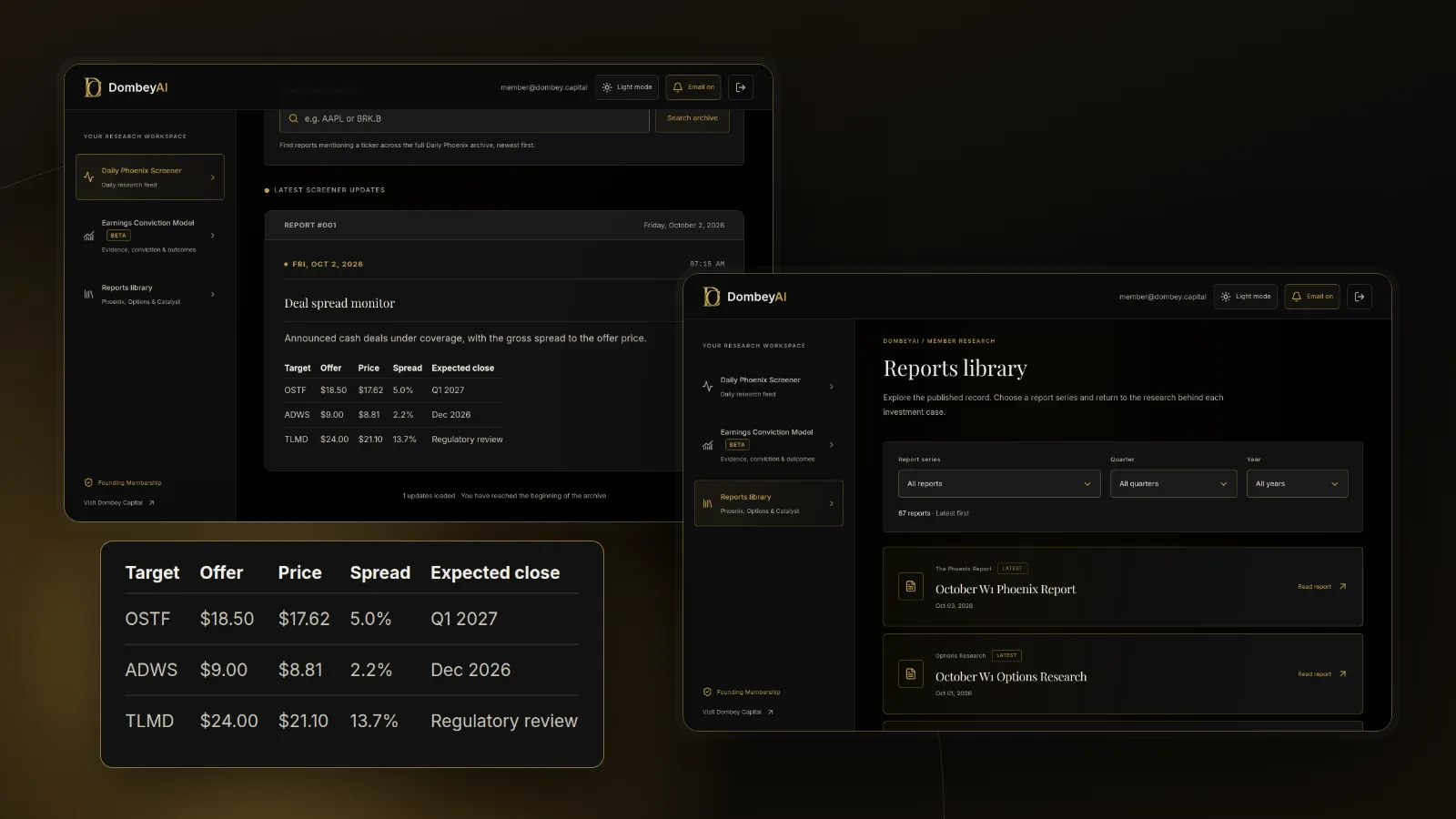
Dombey's published research applies the same discipline of catalyst, timeline and downside before each event; see the research archive.
The bottom line
Merger arbitrage earns the spread between a target's price and the deal value when a takeover closes. The useful number is the annualized spread, weighed against a current estimate of where the stock falls if the deal breaks. Cash or stock, collars, CVRs and tender offers each change that calculation, so start with the merger agreement. The trade rewards careful reading of conditions and timelines, and it punishes anyone who treats a signed deal as a closed one.