

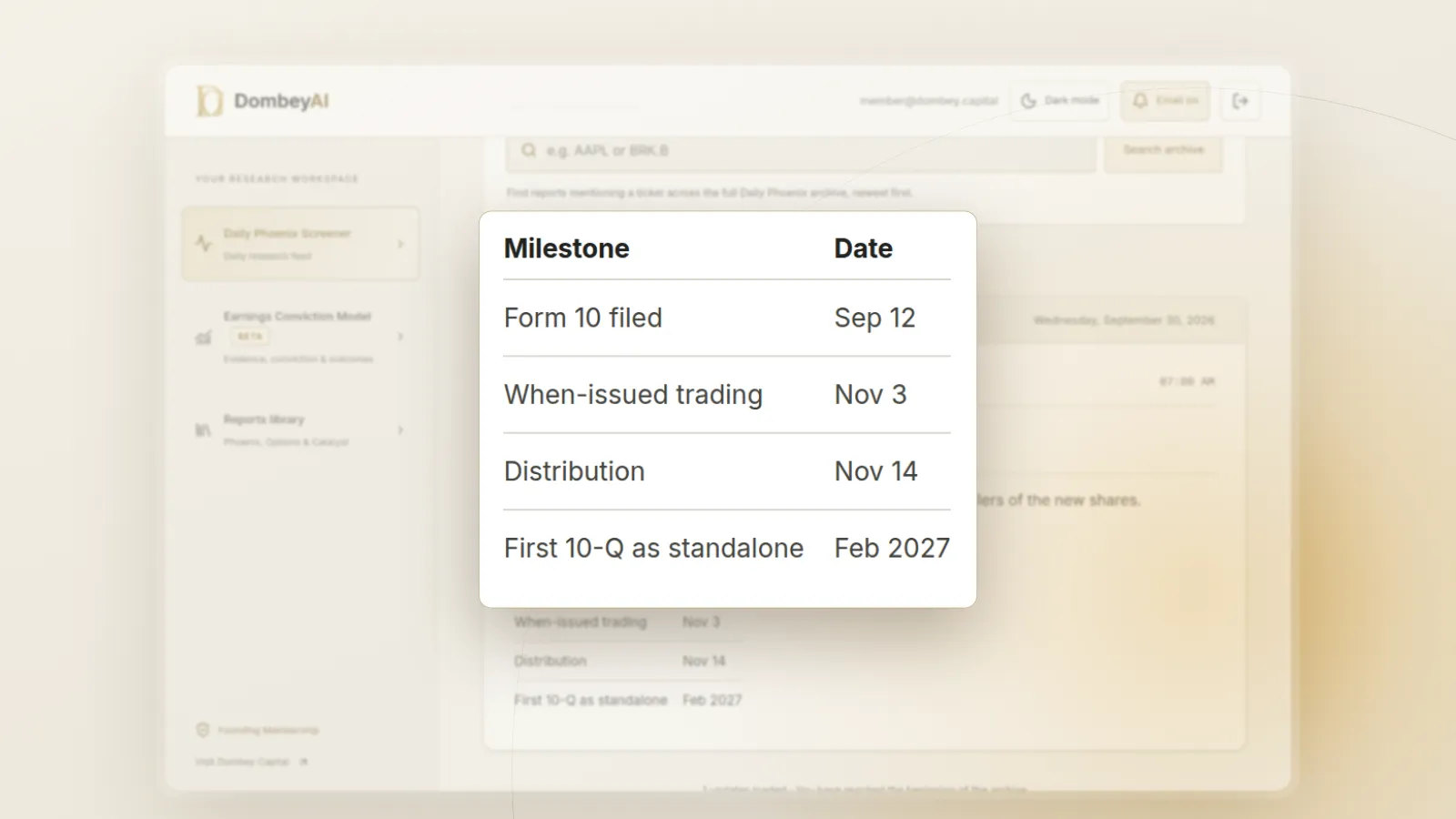
How a spin-off works
A parent company decides to separate a business. Instead of selling it, the parent puts the business into a new legal entity and distributes that entity's shares to its own shareholders, pro rata. If you own 100 shares of the parent and the ratio is one for five, you receive 20 shares of the spinco. You keep your parent shares.
Form 10 and the information statement
The spinco registers its shares with the SEC on Form 10 under the Securities Exchange Act. The Form 10 includes an information statement, which reads much like an IPO prospectus: business description, risk factors, carve-out financial statements, pro forma adjustments, management, compensation and the agreements with the parent. Early drafts are often filed months before the separation and amended several times. Each amendment can change important details, so read the latest one.
Record date, when-issued trading and distribution date
- Record date. Shareholders of the parent on this date are entitled to the spinco shares.
- When-issued trading. Shortly before the distribution, the spinco often trades on a when-issued basis, settling only once the shares exist. The parent may trade both "regular way," carrying the right to the spinco shares, and "ex-distribution," without it.
- Distribution date. The shares are delivered to holders' accounts. Regular-way trading in the spinco begins around this date.
When-issued prices give the first market view of each piece. They are often thinly traded, so read them as a rough signal.
Tax treatment under Section 355
Most U.S. spin-offs are structured to be tax-free to the parent and its shareholders under Section 355 of the Internal Revenue Code. The requirements include that both companies carry on an active trade or business after the separation and that the transaction is not mainly a device to distribute earnings. The parent typically obtains a tax opinion and sometimes an IRS ruling. Shareholders split their original basis between the two companies in proportion to their relative values, which the company usually publishes after the distribution.
Section 355 also limits what can happen afterward. A sale of either company soon after the separation can trigger tax under rules aimed at disguised sales, which is why tax matters agreements often restrict a spinco from being acquired for a period. This shapes the takeover case for both sides.
Why spin-offs get mispriced
Forced selling by index funds
If the parent is in a large-cap index and the spinco is too small or outside the index's rules, funds tracking that index receive shares they cannot keep. They sell, usually around the distribution or the next index rebalance. The selling is mechanical and indifferent to value.
Institutional mandates
Many funds cannot own stocks below a certain market value, without a dividend, or outside a defined sector. A spinco that pays no dividend, is much smaller than its parent, or sits in a different industry falls outside many mandates.
Indifference and neglect
Some holders sell because the position is small relative to their parent holding. Analysts who covered the parent may not pick up the spinco for months. Without coverage, fewer buyers do the work to value it.
Disclosure that takes effort
Carve-out financials include allocated costs, intercompany revenue and pro forma adjustments. The work to understand the standalone business is real, and some investors skip it.
What to read in the Form 10
| Section | What to look for | Why it matters |
|---|---|---|
| Capitalization and pro forma balance sheet | Debt placed on the spinco, cash left with it | Parents often move debt to the spinco and take a cash dividend before the separation |
| Use of proceeds or cash distribution | Payment from spinco to parent | Shows how much value leaves before day one |
| Executive compensation | Equity grants, targets, vesting, who chose the board | Tells you whether management benefits from a low or high early price |
| Relationship with the parent | Transition services, supply, licensing, leases | Can shift margin between the two companies for years |
| Tax matters agreement | Indemnities and limits on sales or buybacks | Restricts strategic options and can create large liabilities |
| Risk factors and pro forma adjustments | Standalone cost assumptions, stranded costs | Shows the gap between historical and future margins |
| Ownership | Parent's retained stake, if any | A retained stake may be sold later, adding supply |
Debt allocation
The most common way a parent extracts value is to have the spinco borrow before separation and pay the proceeds to the parent. The spinco then starts life with leverage the old segment never carried. Check the pro forma balance sheet, the debt maturities and the covenants. A spinco with heavy debt and cyclical earnings can be cheap and still dangerous. See net cash per share for how to adjust a balance sheet for what shareholders actually own.
Management incentives
Look at who runs the spinco and how they are paid. Initial equity grants are often priced off early trading. Executives granted options at a low early price have an incentive not to talk the stock up before the grant. Look for ownership requirements, performance measures tied to per-share value, and whether the best managers stayed with the parent.
Related-party agreements
Transition services agreements, long-term supply contracts, trademark licenses and shared facilities can move economics between the companies. Read the pricing terms. A supply contract at below-market prices to the parent reduces the spinco's margin for its full term.
Parent vs spinco
The spinco gets most of the attention, but the parent can be the better opportunity. A parent that sheds a slow-growing, capital-heavy or litigation-burdened unit may be easier to value afterward and may attract investors who avoided the combined company. The parent also often receives the cash dividend funded by spinco debt.
A useful step is to value both pieces separately before the distribution using when-issued prices and comparable companies, then compare the sum with the combined company. The parent's stub value (regular-way price minus the value of the spinco shares attached) can be informative.
Worked example (illustrative numbers)
Company A trades at $60 and will distribute one share of Spinco B for every four shares of Company A. Before separation, Spinco B borrows $1.2 billion and pays it to Company A. Spinco B will have 50 million shares.
In when-issued trading, Spinco B trades at $40, an equity value of $2.0 billion. With $1.2 billion of debt, the enterprise value is $3.2 billion. If Spinco B's pro forma operating earnings before depreciation are $500 million after standalone costs, that is about 6.4 times. If comparable companies trade near 8 times, Spinco B at $40 may look cheap, but it also carries leverage of 2.4 times earnings that comparable companies may not.
Each Company A share carries a quarter of a Spinco B share, worth $10. The ex-distribution price of Company A implied by the $60 regular-way price is about $50. If Company A ex-distribution trades at $48, the market values the parent slightly below that, which is worth checking.
These numbers are illustrative and do not describe any real company.
Where this goes wrong
- The spinco is the unwanted business. Parents sometimes separate units they do not want for good reasons: declining demand, legal exposure, environmental liabilities or pension obligations. Cheap can stay cheap.
- Too much debt. Leverage set by the parent to extract cash can leave the spinco fragile in a downturn or near a maturity.
- Stranded and standalone costs. Corporate functions the parent once shared must be rebuilt. Pro forma estimates are often too low.
- Forced selling lasts longer. Index rebalances, retained-stake sales and slow analyst coverage can extend the pressure for months.
- Restrictions limit options. Tax matters agreements can block a sale or large buyback for a period, removing an obvious exit.
- Carve-out numbers change. Historical segment figures rely on allocations. Results after separation can look different from the Form 10.
Dombey's published research applies these Form 10 checks to each spin-off it covers; see the research archive. For the broader approach, see what is event-driven investing.
The bottom line
Spin-offs get mispriced mainly because the first owners are forced or indifferent sellers, not because the business is necessarily cheap. The Form 10 tells you whether a low price reflects that selling or real problems: read the debt allocation, the incentives and the agreements with the parent. Value the parent and the spinco separately, because either can be the better opportunity. Treat forced selling as a reason to look, not a reason to own.