

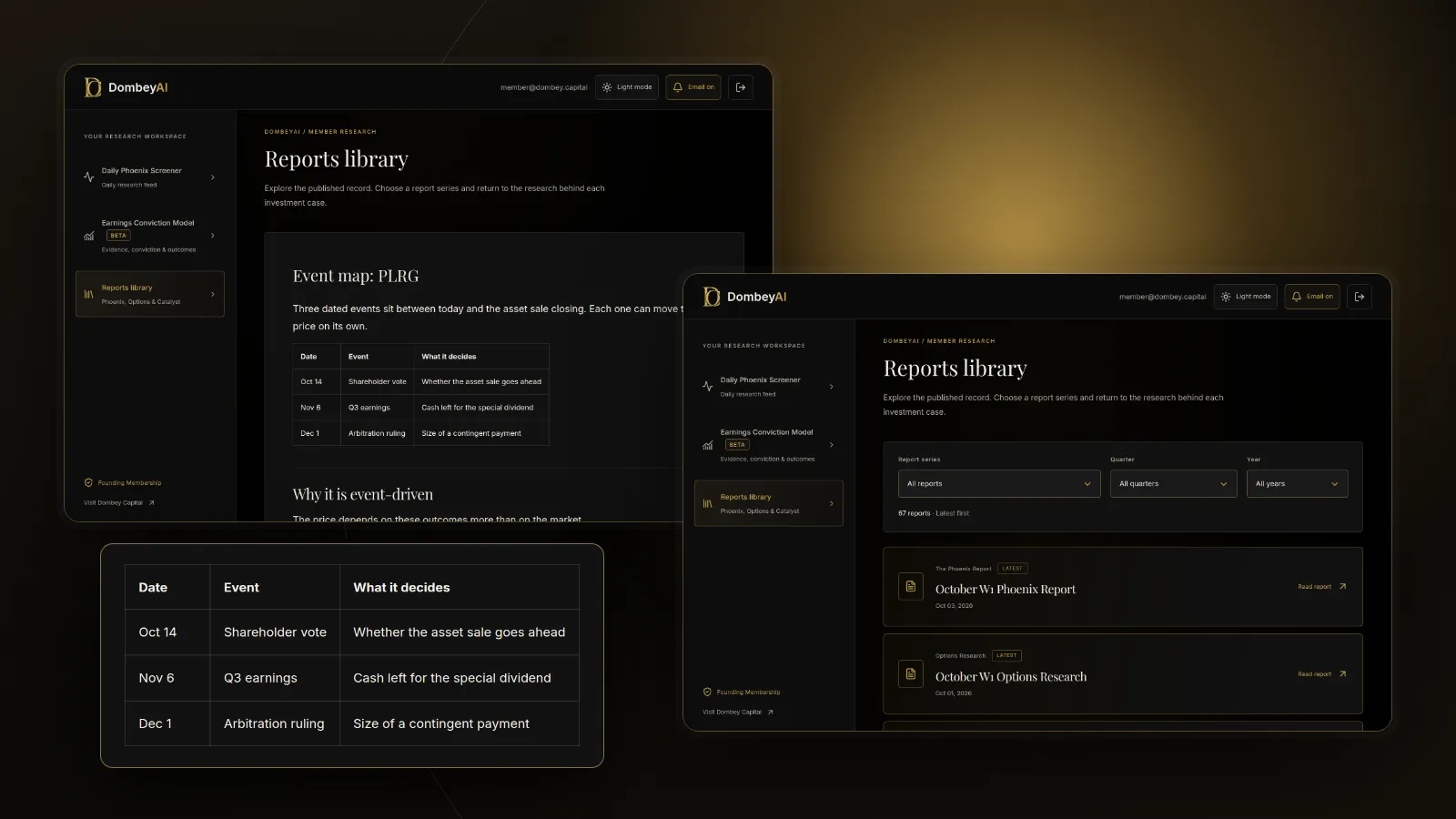
What counts as an event
An event is any discrete development that can change a security's value independent of the wider market. The common feature is a clear before and after. Many event-driven positions are also called special situations, and the terms overlap heavily.
The event is the stock catalyst: the thing that forces the market to reprice the security. Without a catalyst, a cheap stock can stay cheap for years. With one, the gap between price and value has a mechanism and a timeline for closing.
The main event types
Mergers and acquisitions
When a company agrees to be acquired, its stock usually trades below the offer price until the deal closes. The difference is the spread, which compensates for the risk the deal fails and for the time until closing. Merger arbitrage is the practice of analyzing and holding that spread. Larger US deals must file under the Hart-Scott-Rodino Act, which imposes a 30-day initial waiting period before closing.
Earnings releases
Quarterly results are scheduled events. The stock often moves sharply on the day. Event-driven analysis here focuses on what the market already expects and how large a move is priced in, which can be estimated from options. See our guide on how to estimate an earnings move from options.
Spin-offs
A parent company separates a division into a new public company and distributes its shares to existing holders. The new company files a Form 10 registration statement with the SEC, which contains its financials and plans. Index funds and parent-company holders often sell shares they did not choose to own, which can create temporary mispricing. Our article on spin-off investing covers this in detail.
Restructurings and bankruptcies
Companies under financial stress may refinance, sell assets, exchange debt for equity or file for bankruptcy. Each path changes what different securities are worth. Analysis requires understanding the capital structure and which claims get paid first.
Legal rulings
Patent cases, antitrust suits, product liability trials and appeals can shift a company's value significantly. Court dockets are public, and hearing dates are often known in advance, though the decision date may not be.
Regulatory approvals
Drug approvals, merger clearances, licenses and rate decisions are regulatory events. Some agencies publish target dates. Others do not, and timing becomes part of the uncertainty.
Index inclusions and deletions
When a stock is added to or removed from a major index, funds that track the index must buy or sell. Announcements usually come a few days before the effective date. The flows are predictable in direction but often anticipated by the market.
Buybacks and tender offers
A company can return capital through open-market repurchases or a tender offer, where it offers to buy a set number of shares at a stated price or within a price range. Under SEC rules, a tender offer must stay open at least 20 business days. A tender at a premium can create a defined short-term opportunity, subject to proration if more shares are tendered than the company will buy.
Hard vs soft catalysts
Not all events are equally reliable. The most useful distinction is between hard and soft catalysts.
A hard catalyst has a defined mechanism and usually a defined date. A signed merger at a fixed cash price, a tender offer with an expiry date, or a scheduled shareholder vote are hard catalysts. If the event occurs, the outcome for shareholders is largely known.
A soft catalyst depends on judgment, perception or management discretion. A new CEO, an announced strategic review, an activist investor's letter or an expected rerating after a business improves are soft catalysts. They may happen, but neither the timing nor the result is fixed.
| Feature | Hard catalyst | Soft catalyst |
|---|---|---|
| Example | Cash merger, tender offer, court ruling date | Strategic review, new management, activist campaign |
| Timing | Known or narrowly bounded | Open-ended |
| Outcome | Defined if the event occurs | Uncertain even if the event occurs |
| How it is priced | Often closely priced; small spreads | Often ignored or doubted; wider discounts |
| Main risk | Event fails or is delayed | Event never arrives |
| Analysis focus | Probability and timing | Whether the catalyst is real |
Hard catalysts are easier to analyze but attract more capital, so pricing tends to be tighter. Soft catalysts can offer larger discounts but carry the risk of waiting indefinitely.
Dating an event
Time is a cost. A 10% gain over three months is very different from the same gain over two years. Dating the event is part of the analysis, not an afterthought.
Sources for dates include:
- Merger agreements and proxy statements. These set out the expected closing timeline, required approvals and the outside date after which either party may terminate.
- Regulatory filings. HSR filings start a 30-day initial waiting period. A second request from the FTC or DOJ extends review, often by months.
- Court calendars. Trial dates and hearing schedules are public, though rulings can come later.
- Form 10 filings. For spin-offs, these give the expected distribution date and record date.
- Tender offer documents. These state the expiration date, which can be extended.
- Earnings calendars. Companies typically announce reporting dates a few weeks ahead.
When a date is uncertain, model a range. Assign rough probabilities to early, expected and late resolution, and calculate the annualized return in each case.
Sizing outcomes
Most events have more than two outcomes. The method is to list them, value the security under each, and estimate a probability for each.
A worked example, with illustrative numbers only:
Company A has agreed to be acquired for $50 per share in cash. The stock trades at $46. Before the announcement it traded at $36.
- Deal closes on time (in six months): value $50. Probability 80%.
- Deal closes late (in 12 months): value $50, but the return is spread over twice the time. Probability 10%.
- Deal breaks: the stock falls to around $36, or lower if the business has weakened. Probability 10%.
Expected value: (0.90 x $50) + (0.10 x $36) = $45.00 + $3.60 = $48.60.
At $46, the expected gain is $2.60, or about 5.7%, over roughly six to seven months. The downside if the deal breaks is $10, about 22%. The ratio of upside to downside is roughly 1 to 2.5 per share, which is acceptable only if the 10% break probability is accurate. If the true break probability were 20%, expected value would fall to $47.20 and the trade would offer much less.
The key output is not a single number. It is the sensitivity: how much the result changes as you move each probability and date. Dombey's published research sets out these outcome tables before each catalyst; see the research archive.
Risks: deal breaks, delays and crowded trades
Deal breaks. The largest single risk in merger-related positions. Causes include antitrust challenges, financing failures, a buyer walking away, shareholder rejection or a material adverse change. Losses from a break are usually several times the gain from a successful close.
Delays. Extended regulatory reviews, litigation or financing problems can push closing out by months. Even if the deal eventually closes, the annualized return falls sharply.
Unexpected terms. A deal may be renegotiated at a lower price. A spin-off may carry more debt than expected. A court may rule partially in a company's favor.
Already priced in. Popular events attract capital. If the price already reflects the likely outcome, there is little left to earn.
Correlated risk. Many event-driven positions are sensitive to the same factors: credit markets, antitrust policy and general risk appetite. In a market stress, spreads can widen across many positions at once.
Liquidity. Small companies with pending events can be hard to exit quickly at a fair price.
How it differs from momentum and value investing
Momentum investing buys securities that have been rising and sells those that have been falling, based on the tendency of trends to persist. It does not need a specific event or a view on fundamental value. Event-driven investing does not care about recent price trends except as information about what the market expects.
Value investing buys securities priced below estimated intrinsic value and waits for the gap to close. It often has no defined timeline. Event-driven investing adds the mechanism: a specific event expected to force or reveal the value within a window. A stock trading below net cash per share is a value idea; the same stock with an announced liquidation is an event-driven idea.
The strategies combine well. A cheap stock with a hard catalyst has both a margin of safety and a reason for the gap to close.
Where this goes wrong
- Overconfidence in probabilities. Assigning 95% to a deal closing feels precise but is a judgment. Small errors matter a lot when the downside is several times the upside.
- Ignoring time. A position that takes twice as long as expected can turn an acceptable return into a poor one.
- Confusing announcements with outcomes. A strategic review is not a sale. An activist letter is not a board change.
- Missing the downside value. If the business has deteriorated since the deal was announced, the break price may be well below the pre-announcement price.
- Concentration. One break in a concentrated portfolio can wipe out gains from many successful positions.
The bottom line
Event-driven investing builds positions around specific events that should change a security's value, from mergers and spin-offs to court rulings and tender offers. The work is to identify the event, date it, value each outcome and weigh them by probability. Hard catalysts are easier to analyze but tightly priced; soft catalysts offer more room but may never arrive. The strategy fails mainly through deal breaks, delays and probabilities that were set too high, so position sizes should allow for the bad outcome.