

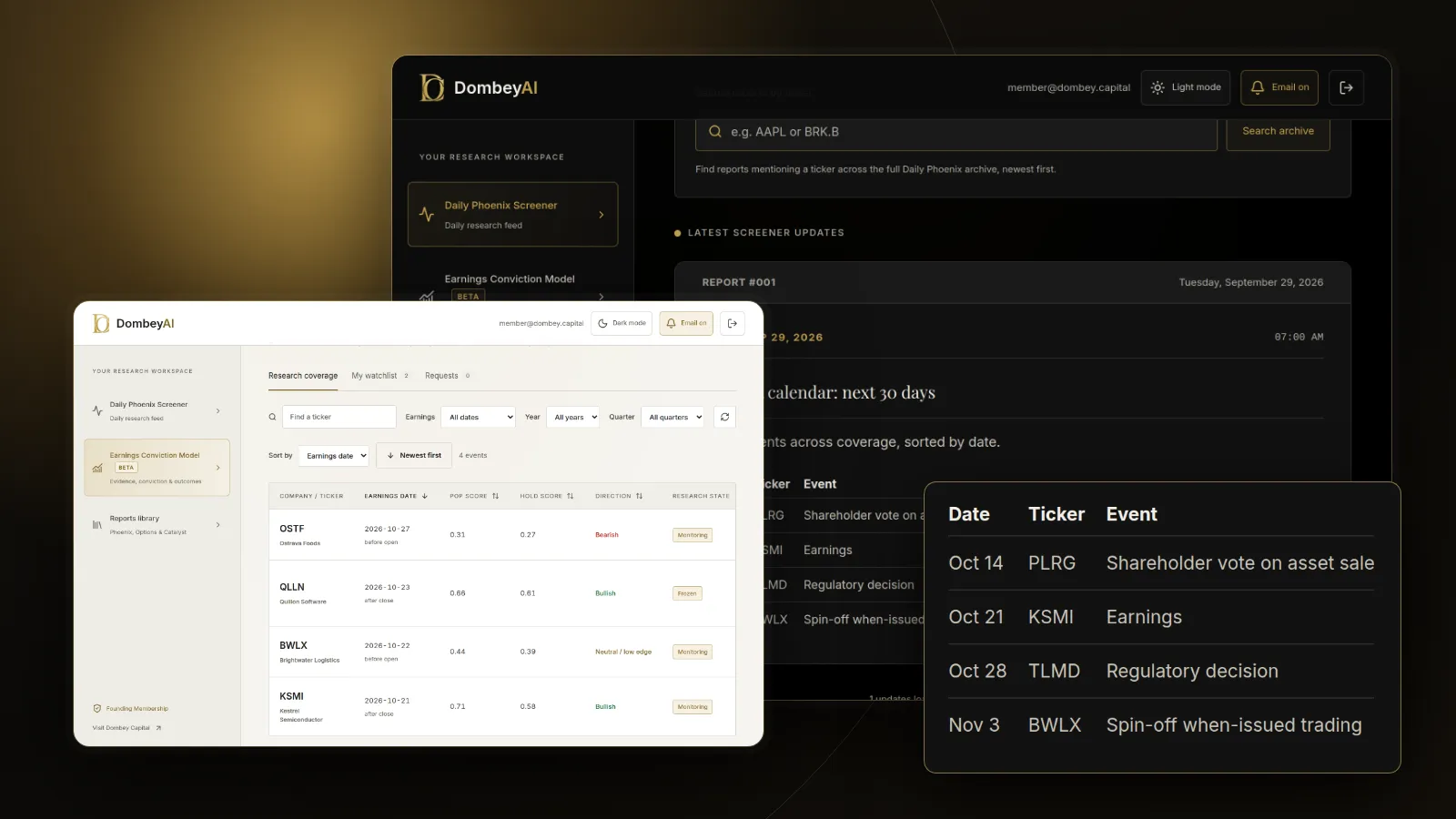
What a catalyst actually does
A share price is a weighted bet on several possible futures. When one of those futures becomes much more or much less likely, the weights change and so does the price.
A catalyst works through one of three mechanisms:
- New information. Earnings, guidance or a trial readout tells investors something they did not know.
- A forced decision. A court, regulator or shareholder vote settles a question with a yes or no.
- A change in who owns the stock. Index additions, deletions, lockup expiries and spin-offs move shares between holders who buy or sell for reasons unrelated to value.
The third type is often the most useful, because the price move comes from mechanics rather than opinion. A fund that must sell does not care whether the price is fair.
Types of stock catalysts
Earnings and guidance
Quarterly results and changes to management's forecast are the most common catalysts. They are dated, frequent and heavily watched, which means they are usually the most efficiently priced. The useful edge is rarely in guessing the headline number. It is in spotting a change the market has not modeled, such as a cost program ending, a large contract rolling off, or a balance sheet change visible in the 10-Q.
FDA and other regulatory decisions
For drug and device companies, an FDA approval decision can decide whether the company has a product at all. The agency sets a target action date for many applications, and companies usually disclose it. Other regulators matter too: antitrust reviews of mergers, utility rate cases, licensing decisions and export approvals.
Court rulings
Patent cases, contract disputes, appraisal actions and government enforcement cases can each be worth more than a small company's market value. Rulings follow a docket with hearing and trial dates, though judges can and do take longer than scheduled.
Shareholder votes
Mergers, reverse splits, charter changes and proxy contests are settled by a vote at a meeting with a set date. The proxy statement explains what is being voted on and what happens if it fails.
Deal closings
Once a merger is signed, the remaining gap between the deal price and the market price reflects the risk the deal does not close and the time until it does. Closing collapses that gap. See merger arbitrage explained for how that spread is priced.
Debt maturities
A large bond or loan maturity forces a company to refinance, repay, or restructure. For a company with weak credit, the maturity date is the deadline for the equity. A successful refinancing can remove a large overhang. A failed one can leave little for shareholders.
Index changes
When a stock is added to or removed from a major index, funds that track it must buy or sell close to the effective date. Index providers announce changes in advance, usually a few days to a few weeks ahead.
Lockup expiries
After an IPO, insiders and early investors typically agree not to sell for a period, commonly 90 to 180 days. When the lockup ends, a large block of shares can become sellable at once. The date is stated in the IPO prospectus.
Spin-offs and other corporate actions
Spin-offs, tender offers, buybacks, asset sales and liquidations each come with dates and documents. Spin-offs are a classic example because index funds and institutions often sell the new shares for reasons unrelated to value.
Quick reference: catalyst types and where to find the date
| Catalyst | Typical date source | Dated or undated | Main risk |
|---|---|---|---|
| Earnings | Company IR calendar, press release | Dated | Already priced in |
| Guidance change | Earnings release, 8-K | Often undated | Comes without warning |
| FDA decision | Company disclosure of target action date | Dated, can slip | Delay or rejection |
| Court ruling | Court docket | Loosely dated | Ruling later than expected, appeals |
| Shareholder vote | Proxy statement (DEF 14A) | Dated | Vote fails or is postponed |
| Deal closing | Merger agreement, 8-K, proxy | Window with outside date | Regulatory block, financing |
| Debt maturity | 10-K and 10-Q debt notes | Dated | Refinancing fails |
| Index change | Index provider announcement | Dated once announced | Move happens before effective date |
| Lockup expiry | IPO prospectus | Dated | Selling already anticipated |
| Spin-off | Form 10, 8-K | Dated once declared | Forced selling lasts longer than expected |
Dated vs undated catalysts
A dated catalyst has a known day or a narrow window: a vote, a scheduled ruling, a maturity, an announced index change. You can measure the cost of waiting and plan around it.
An undated catalyst is something you expect to happen without knowing when: a strategic review that may end in a sale, an activist who may push for change, a turnaround that may show up in results. Undated catalysts can be large, but time works against you. A 30 percent gain over one year is a very different result from the same gain over four years.
Many investors treat undated catalysts as reasons to hold and dated catalysts as reasons to act. A stock trading well below net cash with no dated event can stay there. The same stock with a shareholder vote on a liquidation in three months is a different situation.
Hard and soft catalysts
A related split is hard versus soft. Hard catalysts have a defined outcome: approved or not, closed or not. Soft catalysts are gradual: improving margins, a new CEO, better capital allocation. Soft catalysts are real, but they are easier to talk yourself into.
Where to find catalyst dates
Most dates are public. The work is in reading the documents rather than headlines.
- Form 8-K. Companies file an 8-K for material events, including agreements, completed acquisitions, changes in officers and vote results. Search EDGAR for the company and read recent 8-Ks in full, including exhibits.
- Proxy statements. The definitive proxy (DEF 14A, or DEFM14A for mergers) sets the meeting date, the record date and what is being voted on.
- Merger agreements. Filed as exhibits, they state conditions to closing, required regulatory approvals and the outside date after which either side can walk away.
- 10-K and 10-Q. Debt footnotes list maturities. Legal proceedings sections describe pending cases. Subsequent events notes flag what happened after the period ended.
- Court dockets. Federal cases are on PACER. Many state courts and the Delaware Court of Chancery publish dockets. Scheduling orders set hearing and trial dates.
- Company investor relations pages. Earnings dates, conference presentations and annual meeting dates usually appear here first.
- Index provider announcements. Index additions and deletions are published by the index provider with an effective date.
Dombey's published research records the source document and date for each catalyst it tracks; see the research archive.
How to judge whether a catalyst is priced in
A known event is not an edge. The question is whether the current price reflects the likely outcomes correctly.
- List the outcomes. Keep it to two or three: approved or rejected, deal closes or breaks, refinanced or not.
- Value the stock under each outcome. Use cash, book value, comparable deals or a simple earnings multiple. Be specific about the downside.
- Work out the implied probability. Compare the current price with the outcome values.
- Compare with your own estimate. If the market implies 80 percent and you think 80 percent, there is no trade, however good the company.
- Check options pricing. Implied volatility around the date shows the size of move the market expects. See how to estimate an earnings move from options.
Worked example (illustrative numbers)
Company A, a hypothetical drug developer, has a target FDA action date in two months. It holds $4 per share in net cash. Approval would make the shares worth about $20. Rejection would leave roughly the cash, less two months of spending, call it $3.50. The stock trades at $14.
The implied probability of approval is (14 minus 3.50) divided by (20 minus 3.50), which is about 64 percent. If your reading of the trial data and the agency's history with similar drugs suggests something near 64 percent, the event is priced in. If you have a specific, documented reason to think the odds are materially different, there may be a mispricing. Either way, a rejection costs about 75 percent of the position, which sets the sizing.
These numbers are illustrative and do not describe any real company.
Where this goes wrong
- Delays. FDA dates slip, judges take longer, regulators extend reviews and votes get adjourned. A delay can cost as much as a bad outcome if you were paying for time.
- Outcomes nobody modeled. A partial approval, a settlement, a remand or a deal renegotiated at a lower price falls between your scenarios.
- Crowded positions. When many event-driven investors hold the same stock, the move after the event can be smaller than expected, or reverse as they exit.
- Priced in early. Index changes and lockup expiries are widely known. Much of the effect can occur before the date.
- Confusing a story with a catalyst. "Management will unlock value" is not a catalyst. Look for a document with a date.
- Ignoring the downside. A catalyst cuts both ways. If you have not valued the bad branch, you do not know the risk.
The bottom line
A stock catalyst is a specific event that forces the market to reprice a stock, and the most useful ones have a date and a document behind them. Find the date in the filing, value each outcome, and work out what the current price already assumes. The event only helps you if the market has the odds wrong. Size every position for the case where the catalyst arrives late or goes the other way.