

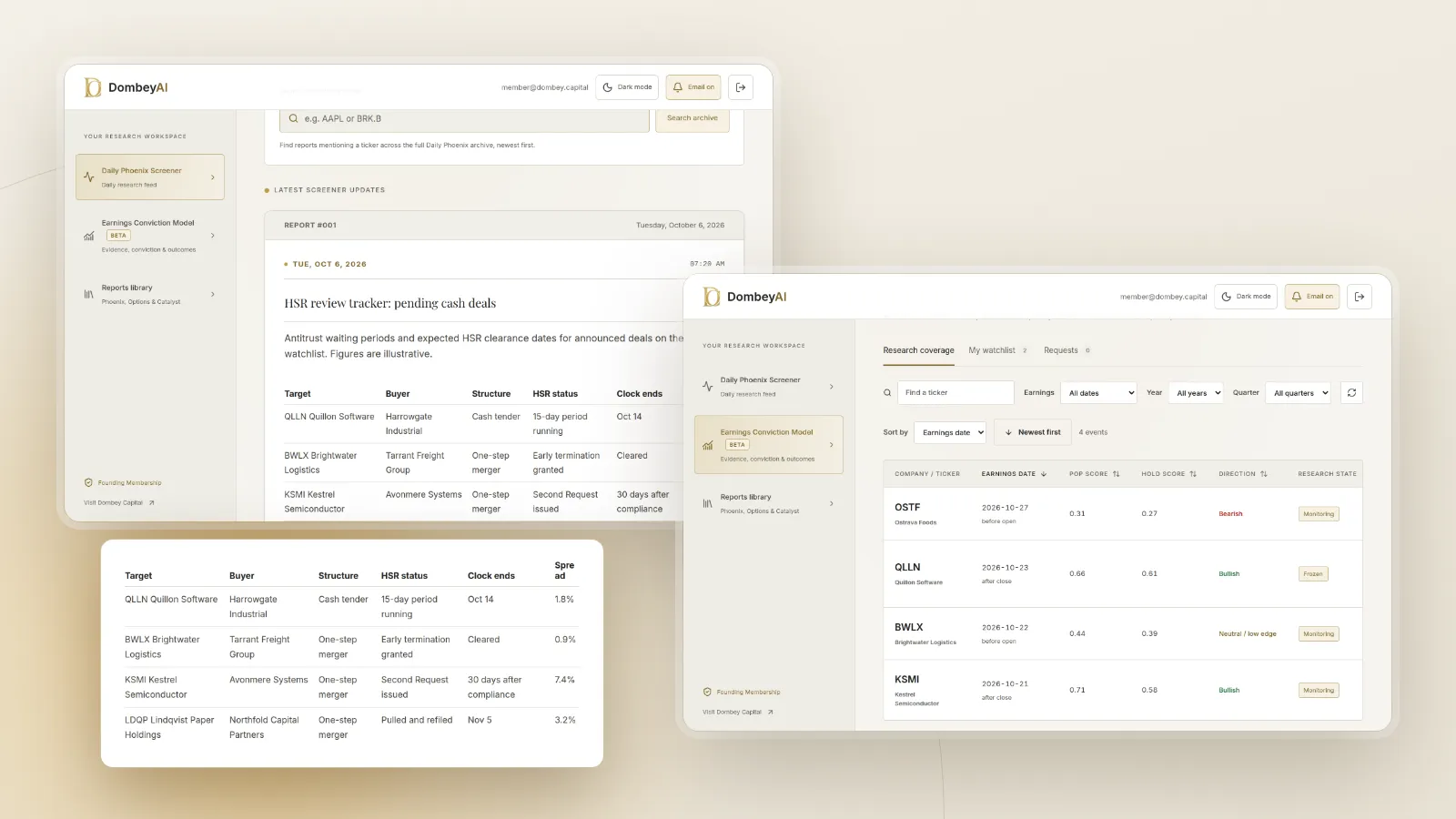
How the HSR process works
The Hart-Scott-Rodino Antitrust Improvements Act of 1976 requires parties to larger mergers and acquisitions to notify the antitrust agencies before closing. The point is to let the FTC and the Justice Department's Antitrust Division review a deal while it can still be stopped, rather than trying to unwind it afterward.
The sequence runs like this:
- The parties sign a deal. This can be a merger agreement, an asset purchase or a tender offer.
- Both sides file. Each party submits a notification form, and the buyer pays the filing fee.
- The waiting period starts. Once the filings are complete, the 30-day clock, or 15-day clock, begins.
- The agencies decide who reviews. The FTC and the Justice Department split cases by industry experience through a clearance process. Only one agency investigates a given deal.
- The review ends one of three ways. Early termination, expiration of the waiting period, or a Second Request.
The FTC is clear about what the end of the period means: unless the agency takes some action that results in a court order stopping the merger, the parties can close their deal at the end of the waiting period. It is a clearance to close under the HSR Act, not a ruling that the deal is lawful.
The 2026 thresholds and filing fees
Not every deal needs a filing. The thresholds are adjusted each year for changes in gross national product. The 2026 figures took effect on February 17, 2026.
- Size of transaction. A deal generally must exceed $133.9 million to be reportable.
- Size of person. For deals between $133.9 million and $535.5 million, the parties also have to meet size-of-person tests, which in 2026 use figures of $26.8 million and $267.8 million in sales or assets.
- Large deals. Above $535.5 million, the size-of-person tests do not apply.
Exemptions exist for certain asset types and ordinary-course purchases, so the rules decide each case. For a reader, the practical point is that most acquisitions of listed companies clear the threshold easily.
The filing fee rises with deal size. The FTC states that the acquiring person pays it at filing, though the parties may agree to share it.
| Transaction value (2026) | Filing fee |
|---|---|
| Less than $189.6 million | $35,000 |
| $189.6 million to under $586.9 million | $110,000 |
| $586.9 million to under $1.174 billion | $275,000 |
| $1.174 billion to under $2.347 billion | $440,000 |
| $2.347 billion to under $5.869 billion | $875,000 |
| $5.869 billion or more | $2,460,000 |
One more 2026 change matters for timing. A federal district court vacated the expanded HSR form on February 12, 2026, and the vacatur took effect after the Fifth Circuit denied a stay on March 19, 2026. The FTC says the agencies now accept filings on the form in place before February 10, 2025. The shorter form takes less time to prepare, which can pull filing dates closer to signing.
The waiting period, step by step
Here is the full HSR timeline at a glance.
| Stage | Length | What to check |
|---|---|---|
| Filing | Set by the merger agreement, often within a few weeks of signing | The filing deadline in the agreement; the press release announcing the filing |
| Initial waiting period | 30 days; 15 days for a cash tender offer or bankruptcy | The date the period is due to expire |
| Early termination | Any time before expiration, if granted | The FTC's early termination notices page |
| Pull and refile | A new initial waiting period | A press release or 8-K saying the buyer withdrew and refiled |
| Second Request | Until both parties substantially comply | Disclosure in the proxy, a 10-Q or a press release |
| Post-compliance review | Typically 30 days; 10 days for a cash tender offer or bankruptcy | Any timing agreement with the agency |
| Outcome | Close, consent decree, or court challenge | The agency's press release and court filings |
Early termination
The parties can ask the agencies to end the waiting period before the 30 days run out. The agencies may grant the request if they determine the deal is unlikely to substantially lessen competition. Grants are published on the FTC's early termination notices page, which lists notices as recently as late September 2026. A grant is a small signal that the agencies saw no reason for a closer look.
Expiration
Most filings end without any announcement from the agencies. The period simply runs out, and the parties are free to close under the HSR Act. Companies usually say so in a press release or a filing, often in a sentence such as "the waiting period under the HSR Act expired on" a given date.
Pull and refile
When an agency needs more time near the end of the initial period, the buyer may withdraw its filing and file again. This starts a fresh waiting period and can avoid a Second Request. It adds weeks rather than months, but it does tell you the agency has questions.
Second Request
A Second Request is a formal request for additional information and documents. It extends the waiting period until both parties have substantially complied, which can take months because the requests cover internal documents, data and sales records. Once both have complied, the FTC says the agency typically has another 30 days to review, or 10 days for a cash tender offer or bankruptcy. The parties and the agency often sign a timing agreement that sets a longer schedule in exchange for advance notice before closing.
At the end, the agency can close the investigation, negotiate a consent agreement, such as a divestiture of overlapping businesses, or go to court to seek a preliminary injunction.
Why tender offers move faster
A cash tender offer gets a 15-day initial waiting period and a 10-day post-compliance period, against 30 days for both in a merger. Combined with the 20-business-day minimum offer period, this lets a buyer close a friendly cash deal in roughly a month if the antitrust review is quick. That is one reason buyers who want speed choose a tender offer; see what a tender offer is for the offer-side rules.
A worked example
The filings are complete on March 2. The initial waiting period would run 30 days, to about April 1. Three paths follow:
- If the agency grants early termination in mid-March, the HSR condition is satisfied two weeks early. Closing then depends on the shareholder vote and any foreign reviews.
- If the period expires on schedule, the HSR condition is satisfied in early April.
- If the agency issues a Second Request, closing moves out by months. Suppose the parties take four months to substantially comply and the agency then uses its 30 days. The HSR condition would not be met until around August, assuming no challenge.
Now suppose Company B trades at $40.50 after the announcement. The spread is $1.50, or about 3.7%. If the deal closes in April, that is a short holding period. If it closes in August, the same $1.50 is earned over roughly five months. The dollar spread is the same, but the annualized figure drops sharply, and the risk of a challenge rises. This is why the HSR timeline is central to merger arbitrage math.
How investors track an HSR review
The agencies do not publish a list of pending filings. Investors piece the timeline together from company disclosures:
- The merger agreement. It sets the filing deadline, the outside date by which the deal must close, and any reverse termination fee owed if antitrust approval fails. It is usually attached to an 8-K.
- The proxy statement. The "Regulatory approvals" section describes the HSR status and any other reviews. See how to read a proxy statement.
- Press releases and 8-Ks. Companies typically announce expiration, early termination, pull and refile, or a Second Request.
- The FTC's early termination notices. These show grants by name.
- EDGAR full-text search. Searching for a company name with "Hart-Scott-Rodino" or "Second Request" finds mentions across filings; see how to search SEC EDGAR filings.
Each milestone is a dated event. Putting the expected expiration date, the outside date and any timing agreement on a catalyst calendar makes it clear when a deal should move and when silence is itself a signal. Dombey's published research tracks these dated steps for event-driven situations; see the research archive.
Where this goes wrong
- Treating expiration as approval. The end of the HSR period clears the deal under the HSR Act, but the agencies can still sue, and foreign regulators, sector regulators or shareholders may still need to approve.
- Counting only the US review. Large deals often need clearance in several jurisdictions. A foreign review can take longer than the HSR process.
- Ignoring the outside date. If a Second Request runs long, the deal can hit its outside date. Check whether either side can walk away and whether a termination fee applies.
- Reading too much into silence. Expiration is often announced late or only in a later filing. No news is not evidence of a Second Request.
- Assuming the old form and old timelines. Forms, thresholds and fees change. Check the FTC's current pages rather than relying on figures from a prior year.
- Confusing hard and soft steps. The HSR expiration is a hard, dated step; the agency's view of the deal is not. See hard vs soft catalysts.
The bottom line
The HSR waiting period is the 30-day pause, or 15 days for a cash tender offer or bankruptcy, that a reportable deal must observe after filing with the FTC and the Justice Department. It can end early, expire, or stretch into a Second Request that adds months. For 2026, the main threshold is $133.9 million and fees run from $35,000 to $2,460,000. For investors in a pending deal, the HSR milestones set the timeline, and the timeline drives the annualized return on the spread.