

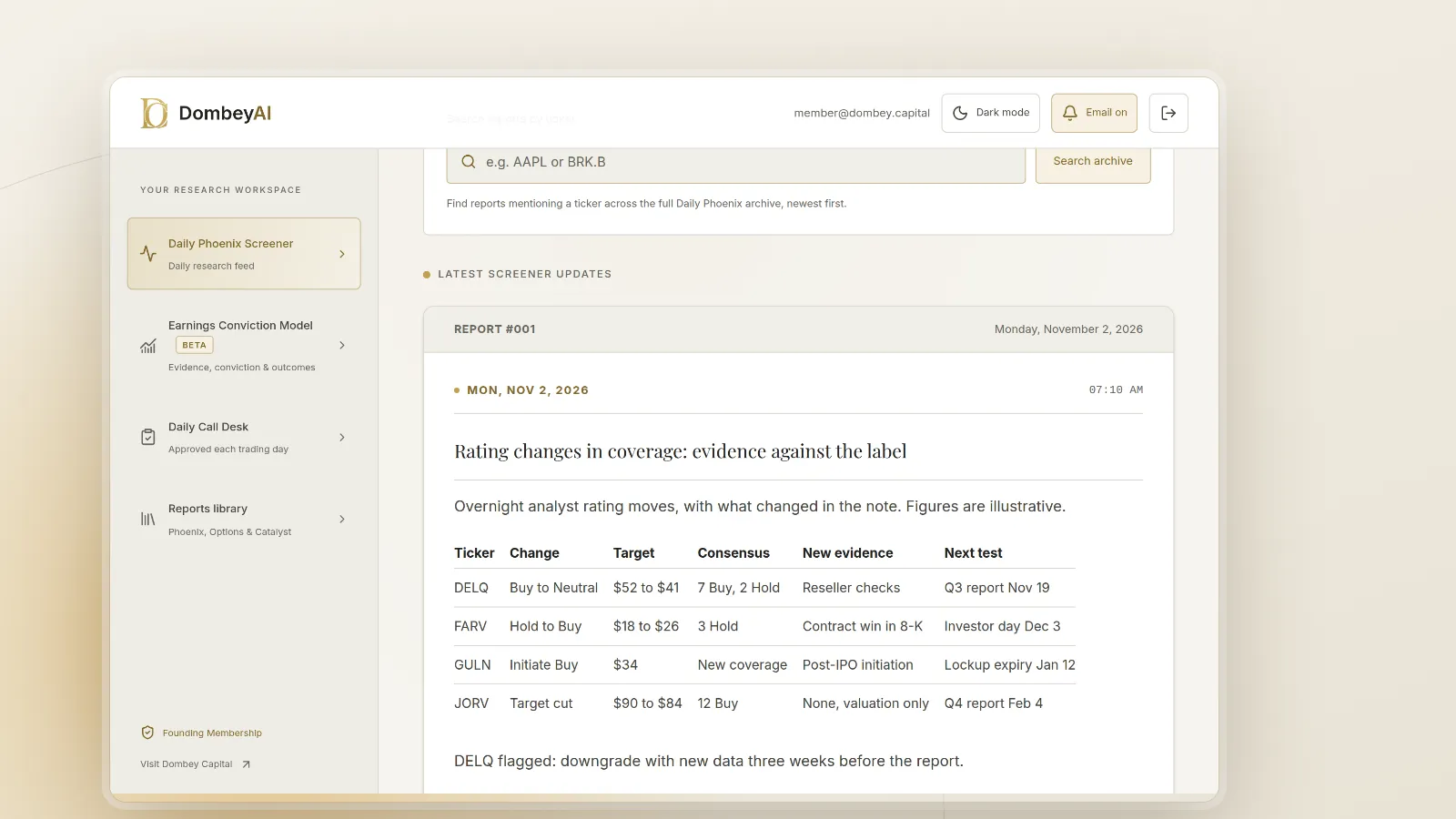


Full disclosure: Dombey Capital is our own research service and our top pick here, for the reasons below. The section on where it falls short is there so you can judge whether it fits your process.
Why investors look for a TipRanks alternative
Analyst ratings sites answer one question: what does Wall Street think? That is useful context, but it has limits. Sell-side ratings lean toward Buy, ratings change after prices move as often as before, and a consensus view is, by definition, already widely known. Our explainer on analyst upgrades and downgrades covers why the change in a rating carries more information than the rating itself.
Investors usually look elsewhere for one of three reasons: they want a different kind of rating (quantitative or independent), they want their own data to test the ratings, or they want research on events that analysts rarely cover.
We could not load TipRanks's pages when we compiled this comparison, so we do not state its features or prices here. Check its site directly for current plans.
Quick comparison
| Tool | Best for | Key features | Price (as of November 2026) |
|---|---|---|---|
| Dombey CapitalTop pick | Special situations and dated catalysts | Founding Membership: weekly Phoenix Report, weekly Options Research, Catalyst Briefing, DombeyAI Portal with the Daily Phoenix Screener and Earnings Conviction Model | Founding Membership $1,200/year (annual only); Standard Access $80/year or $8/month; Public Archive free |
| Zacks Premium | A single quantitative rank | Zacks Rank, Style Scores, Industry Rank, Earnings ESP, premium screens | See the vendor's pricing page (free trial offered) |
| Seeking Alpha Premium | Quant ratings plus a library of analysis | Quant ratings and screeners, Virtual Analyst Reports, Earnings Call Insights, analysis on 4,000+ stocks and ETFs | $299/year plus taxes |
| Morningstar Investor | Independent analyst ratings and fair values | Fair value and competitive advantage ratings, analyst notes, portfolio alerts on ratings changes | $249/year or $34.95/month |
| Motley Fool Stock Advisor | Monthly stock picks with a long-term view | 2 stock picks a month, top 10 stocks to buy now, Moneyball AI stock scoring, monthly rankings | $199/year |
| Stock Rover | Screening and analyst detail on your own terms | 8,500+ stocks; research reports on 7,000+ stocks from Premium Plus; analyst detail and insider metrics on Ultimate | Premium $29/month, Premium Plus $49/month, Ultimate $79/month, billed annually |
| Koyfin | Estimates, financials and filings in one terminal | Free plan; Plus adds 10 years of financials and estimates, screener, filings and transcripts | Free; Plus $39/month; Premium $79/month (annual plans save up to 30%) |
| Simply Wall St | Visual company reports and valuation | Company reports (5/month free, 30/month Premium, unlimited on Unlimited), screeners, portfolio tracking | Free plan; see the vendor's pricing page for Premium and Unlimited |
How we compared these tools
We compared these tools from vendor documentation, pricing pages and public product pages, read in November 2026. We did not run trials of the paid services, and we make no claims about any service's ratings accuracy or investment results.
| Criterion | Weight | What it measures |
|---|---|---|
| Quality of the view | 25% | Whether the service explains its reasoning, not only a label |
| Catalyst context | 20% | Whether it ties a view to a dated event |
| Data to test the view | 20% | Financials, estimates and screens to check a rating yourself |
| Breadth of coverage | 15% | Number of stocks covered |
| Price and access | 20% | Cost for one individual investor, free tiers and trials |
We weighted the quality of the view and catalyst context most because a rating without reasoning is hard to act on. If you weight breadth most, Seeking Alpha and Zacks lead; if you weight price, the free plans from Koyfin, Simply Wall St and Dombey's Public Archive lead.
Quick picks by job
Best for special situations and dated catalysts: Dombey Capital
Dombey's Founding Membership is written research on spin-offs, tender offers, restructurings, stocks below cash and legal or regulatory catalysts, each published with a date and a stated reason to change the view. It suits readers who want the reasoning and the event, not a consensus label.
Best for a quantitative rank: Zacks Premium
Zacks Premium centers on the Zacks Rank, with Style Scores, the Industry Rank and Earnings ESP, which looks for companies with recent positive earnings estimate revisions. Our Zacks alternatives roundup covers services like it.
Best for quant ratings plus analysis: Seeking Alpha Premium
Seeking Alpha Premium pairs Quant ratings and screeners with a large library of contributor analysis and AI research tools.
Best for independent analyst research: Morningstar Investor
Morningstar's own analysts publish fair value estimates and competitive advantage ratings, with alerts when ratings change.
Best for monthly stock picks: Motley Fool Stock Advisor
Stock Advisor sends two stock picks a month and a list of top stocks to buy now, aimed at long-term holders.
Best for screening with analyst detail: Stock Rover
Stock Rover's higher plans add analyst detail, insider metrics and research reports to deep screening.
Best for estimates and filings in one terminal: Koyfin
Koyfin's Plus plan puts 10 years of estimates beside financials, filings and transcripts.
Best for visual company reports: Simply Wall St
Simply Wall St turns financial data into visual reports and valuation summaries, with a free plan.
Full reviews
1. Dombey Capital
What it does. Dombey publishes independent research on special situations and event-driven equities. Each thesis names its catalyst, its date and the conditions that would change the view, and is kept in the archive.
Best for. Investors who want reasoned, dated views on events that ratings sites rarely cover.
Pricing. Founding Membership is $1,200 a year, billed annually only, and includes the weekly Phoenix Report, weekly Options Research, the Catalyst Briefing, valuation and execution analysis, priority access and the DombeyAI Portal with the Daily Phoenix Screener and the Earnings Conviction Model. Standard Access is the lower-cost option at $80 a year (about $6.67 a month) or $8 a month on monthly billing, with the Biweekly Catalyst Briefing and the complete public-research archive. The Public Archive is free.
Pros
- Written reasoning and a dated catalyst for each view.
- Covers events that consensus ratings miss.
- Public archive of past calls.
Cons
- Covers a short list of situations, not every stock.
- No aggregation of Wall Street ratings.
Verdict: Our top pick for investors who want reasoning and dates rather than a ratings label.
2. Zacks Premium
What it does. Zacks Premium gives access to the Zacks Rank, Style Scores, the Zacks Industry Rank, Earnings ESP and premium screens, collected on a Premium homepage. Earnings ESP looks for companies with recent positive earnings estimate revision activity.
Best for. Investors who want one quantitative rating to screen on.
Pricing. Zacks offers a free trial. See the vendor's pricing page for the current price.
Pros
- A single rank that is easy to screen on.
- Industry and style scores alongside.
- Pre-built screens by market cap and style.
Cons
- A quantitative rank does not explain company-specific events.
- Many add-on services are sold separately.
Verdict: A strong option if you want a single score with screens built around it.
3. Seeking Alpha Premium
What it does. Seeking Alpha Premium includes data-driven stock ratings and screeners, AI-powered tools such as Virtual Analyst Reports and Earnings Call Insights, and in-depth analysis on more than 4,000 stocks and ETFs powered by its Quant System.
Best for. Investors who want quant ratings plus a wide range of written opinions.
Pricing. $299 a year, plus taxes and VAT where applicable.
Pros
- Broad coverage across stocks and ETFs.
- Quant ratings with analysis alongside.
- AI summaries of earnings calls.
Cons
- Contributor quality varies.
- Volume of content can bury the useful pieces.
Verdict: The broadest substitute for a ratings site; our Seeking Alpha alternatives list covers its rivals.
4. Morningstar Investor
What it does. Morningstar's independent analysts publish fair value estimates, competitive advantage ratings and analyst notes. Investor includes portfolio and watchlist alerts for ratings changes and analyst notes.
Best for. Long-term investors who want an independent analyst's fair value.
Pricing. $249 a year ($20.75 a month) or $34.95 on monthly billing, with a free trial.
Pros
- Independent of investment banking.
- Fair value estimates with reasoning.
- Alerts on rating changes.
Cons
- Coverage favors larger companies.
- Little on special situations and short-dated catalysts.
Verdict: The best pick for independent analyst research.
5. Motley Fool Stock Advisor
What it does. Stock Advisor provides two stock picks every month, access to its top 10 stocks to buy now, AI-powered stock scoring with Moneyball, monthly stock rankings and foundational stocks.
Best for. Long-term investors who want a short list of picks each month.
Pricing. $199 a year. Higher tiers, Epic at $499 and Epic Plus at $1,999 a year, add more research.
Pros
- Clear monthly picks.
- Long-term framing.
- Low entry price.
Cons
- Picks are not tied to dated events.
- Upsells to higher tiers are frequent.
Verdict: A simple pick service, not a ratings database. See our Motley Fool alternatives.
6. Stock Rover
What it does. Stock Rover is a screening and research platform covering 8,500+ stocks, 7,000+ ETFs and 40,000+ funds. Premium Plus adds research reports on 7,000+ stocks and ranked screening; Ultimate adds analyst detail, insider metrics and option metrics.
Best for. Investors who want to test ratings against their own screens.
Pricing. Premium $29 a month (billed $348 a year), Premium Plus $49 a month ($588 a year), Ultimate $79 a month ($948 a year), with 2-year billing saving more and monthly billing costing more. Each plan has a 14-day free trial.
Pros
- Deep screening and metrics.
- Analyst detail on higher plans.
- Published prices and trials.
Cons
- No written views of its own on events.
- Analyst detail requires a higher plan.
Verdict: The best do-it-yourself pick for screening with analyst data.
7. Koyfin
What it does. Koyfin is a data and analytics terminal. The free plan includes two years of financials and one year of estimates; Plus adds 10 years of financials and estimates, the stock and ETF screener, filings, transcripts and premium news.
Best for. Investors who want estimates, filings and charts in one place.
Pricing. Free; Plus $39 a month; Premium $79 a month; annual plans save up to 30%.
Pros
- Free plan with real use.
- Estimates and transcripts on Plus.
- Published prices and a 30-day refund.
Cons
- No ratings opinion of its own.
- You build the screens yourself.
Verdict: A strong data companion to any ratings source.
8. Simply Wall St
What it does. Simply Wall St offers visual company reports, screeners and portfolio tracking. The free plan includes five company reports a month; Premium raises that to 30 and Unlimited removes the cap. New accounts start with seven days of Premium access, with no card required.
Best for. Investors who prefer visual summaries of valuation and financial health.
Pricing. Free plan; see the vendor's pricing page for Premium and Unlimited.
Pros
- Easy to read visual reports.
- Free plan and trial without a card.
- Portfolio tools included.
Cons
- Simplifies complex companies.
- Little coverage of special situations.
Verdict: A friendly visual alternative; see our Simply Wall St alternatives for others.
Where Dombey falls short
- Narrow coverage. Dombey writes on a short list of special situations, not thousands of stocks.
- No ratings aggregation. It does not collect or track Wall Street analyst ratings.
- No data terminal. There is no broad screener of financials across every company.
- Small team and pen name. Research is published by a small team under the pen name James Whitfield.
- Short history. The record of calls is still young.
Free vs paid
Free options cover a lot: Koyfin's free plan, Simply Wall St's free reports, Dombey's Public Archive and SEC EDGAR for filings. Pay when you need a specific thing: estimate history (Koyfin Plus), screening with analyst detail (Stock Rover), independent fair values (Morningstar), quant ratings at scale (Seeking Alpha, Zacks) or dated special situations research (Dombey's Founding Membership).
How to choose
| Your situation | Pick | Add later when |
|---|---|---|
| You want reasoned views on dated events | Dombey Founding Membership | You need ratings data across many stocks |
| You want one quantitative score | Zacks Premium | You want written analysis behind it |
| You want quant ratings and many opinions | Seeking Alpha Premium | You want independent fair values |
| You want independent analyst fair values | Morningstar Investor | You want event-driven coverage |
| You want to test ratings with your own data | Stock Rover or Koyfin | You want a curated view |
- If you mainly want to know what Wall Street thinks, a ratings service is enough.
- If you want to know whether Wall Street is wrong about a dated event, start with Dombey.
- If you want to check any rating yourself, add a data platform.
For a wider comparison of research services, see Seeking Alpha vs Motley Fool vs Morningstar vs Dombey and our list of the best stock research tools for individual investors.
The bottom line
Dombey Capital is our top pick among TipRanks alternatives for investors who want written, dated research on special situations instead of a consensus label. For ratings, Zacks Premium offers a quantitative rank, Seeking Alpha Premium pairs quant ratings with analysis, and Morningstar Investor gives independent fair values. Stock Rover, Koyfin and Simply Wall St let you test any rating with your own data. Whatever you use, treat a rating change and its evidence as the signal, and see the research archive for Dombey's published theses.