

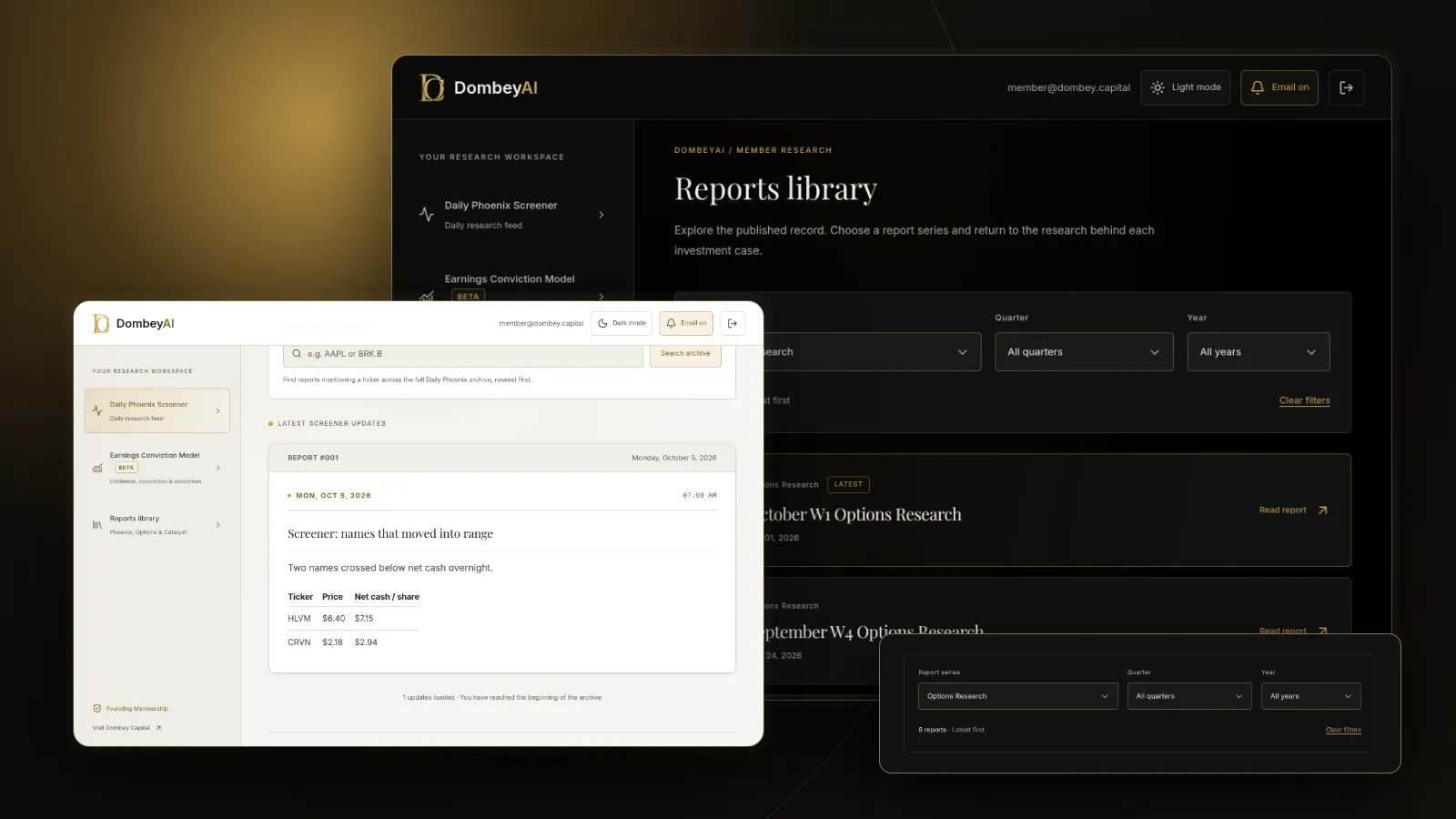


Full disclosure: Dombey Capital is our own research service and our top pick here, for the reasons below. The section on where it falls short is there so you can judge whether it fits your process.
What Seeking Alpha Premium offers
Before replacing a tool, it helps to know what you are paying for. Seeking Alpha's own help center describes Premium as its "flagship investment research service" and lists four things:
- Data-driven stock ratings and screeners.
- AI-powered research tools, such as Virtual Analyst Reports and Earnings Call Insights.
- In-depth stock analysis on more than 4,000 stocks and ETFs.
- Tools powered by its Quant System, the model behind its quant ratings.
The listed price is $299 per year, plus applicable taxes and VAT. Most of the analysis on the site is written by outside contributors rather than staff analysts, which is the main reason people either love it or leave it. Some readers value the range of views. Others find the volume hard to filter and want a single, accountable house view, deeper raw data, or coverage of a niche the platform treats only in passing.
So the useful question is which part of Seeking Alpha you want to replace: the ratings, the data and screens, the articles, or the ideas.
Quick comparison
| Tool | Best for | Key features | Price (as of October 2026) |
|---|---|---|---|
| Dombey CapitalTop pick | Special situations and dated catalysts | Catalyst briefing, weekly Phoenix Report, archive | Free archive; $6.67/month; $1,200/year |
| Morningstar Investor | Independent ratings and portfolio analysis | Analyst ratings, screeners, portfolio insights | $34.95/month or $249/year |
| Koyfin | Market data and charting | 10-year financials (Plus), screener, portfolio analytics (Premium) | Free; Plus $39/month, Premium $79/month billed annually |
| Stock Rover | Deep screening and portfolio tracking | 400 to 800+ metrics, research reports, brokerage sync | From $29/month billed annually ($348/year) |
| TIKR | Global fundamentals and transcripts | Global data, transcripts, guru fund holdings | Free; paid plans $24.95 to $119.95/month |
| Motley Fool Stock Advisor | A short monthly list of stock picks | Two picks a month, top 10 rankings | $199/year |
| Zacks Premium | Earnings revision ratings | Zacks Rank, Earnings ESP filter, Premium Screens | See the vendor's pricing page |
| Simply Wall St | Visual summaries for newer investors | Snowflake reports, fair value, portfolio tracking | Free plan; see the vendor's pricing page |
| TipRanks | Tracking analysts and insiders | Smart Score, analyst ratings, insider activity | See the vendor's pricing page |
| Value Line | One-page reports with long histories | Investment Survey reports, Ranking system | See the vendor's pricing page |
| GuruFocus | Following well-known investors' holdings | Guru portfolio data | See the vendor's pricing page |
| Substack newsletters | Single-writer analysis | Varies by writer | Set by each writer |


How we compared these tools
We compared these tools from vendor documentation, pricing pages and public product pages, read on October 5, 2026. We did not use paid accounts for this article. Each tool was judged on five criteria:
- Fit for the job it replaces. Ratings, data, articles or ideas.
- Depth of data. Years of financial history, global coverage, transcripts and filings.
- Transparency. Whether the method behind a rating or pick is explained, and whether past calls stay visible.
- Price and entry point. Whether a free plan or trial exists and what the paid tiers cost.
- Focus. Whether the tool is broad or built for a specific style of investing.
| Criterion | Weight | What it measures |
|---|---|---|
| Fit for the job it replaces | 30% | How well it replaces the ratings, data, articles or ideas |
| Depth of data | 20% | Financial history, global coverage, transcripts and filings |
| Transparency | 20% | Whether the method is explained and past calls stay visible |
| Price and entry point | 15% | Free plan or trial, and paid tier prices |
| Focus | 15% | Broad platform or built for a specific style |
We make no claims about any service's returns or the accuracy of its ratings. Several vendors publish performance figures on their own pages; we did not verify them and do not repeat them.
Where a vendor's pricing page would not load or did not show a price, the table says "See the vendor's pricing page" rather than quoting a figure from a third party.
Quick picks by job
Best for special situations and dated catalysts: Dombey Capital
Dombey covers a narrow set of event-driven situations such as spin-offs, mergers and stocks priced below cash, each tied to a dated catalyst, and keeps every thesis in a dated archive. Pair it with a data tool if you also want broad coverage.
Best broad replacement: Morningstar Investor
If you used Seeking Alpha for a mix of ratings, screening and portfolio checks, Morningstar Investor covers the same ground with a single house view instead of thousands of contributors. It is also $50 a year cheaper at list price.
Best for data and charting: Koyfin
Koyfin's free plan is usable on its own, and Plus adds 10 years of financials and estimates, a stock and ETF screener and unlimited watchlists. It replaces the data side of Seeking Alpha, not the opinions.
Best for screening: Stock Rover
Stock Rover lists 400 metrics on its entry plan and up to 800-plus on higher tiers, with brokerage integration for portfolio tracking. It suits investors who build their own lists.
Best for global fundamentals on a budget: TIKR
TIKR's free plan covers U.S. stocks; paid plans add full global data, longer financial history and transcript archives.
Best for a short list of stock picks: Motley Fool Stock Advisor
At $199 per year, Stock Advisor delivers two recommendations a month and a top 10 ranking. It is a picks service, not a research platform.
Full reviews
1. Dombey Capital
What it does. Dombey Capital publishes independent research on special situations and event-driven equities: stocks priced below cash or book, spin-offs, mergers and other legal or corporate catalysts. Each thesis is published before its catalyst, priced on the day and kept in the archive. If the category is new to you, start with what a special situation is and how stock catalysts work.
Best for. Readers who follow event-driven situations with a specific date attached and want a documented archive of past theses.
Pricing. Founding Membership is $1,200 per year and includes the weekly Phoenix Report, weekly Options Research, the Biweekly Catalyst Briefing, the DombeyAI Portal with the Daily Phoenix Screener and the Earnings Conviction Model, valuation and execution analysis, and priority access. Standard Access is the lower-cost option at $6.67 per month and includes the Biweekly Catalyst Briefing and the complete public-research archive. The Public Archive is free.
Pros
- A focus on situations that broad platforms treat only as news.
- Each thesis is tied to a dated catalyst.
- The original case stays in the research archive so it can be compared with what happened next.
Cons
- Not a substitute for a data platform or a broad ratings service.
- Narrow coverage from a small team; the full list is in the section on where Dombey falls short.
Verdict: Our top pick for readers who follow special situations and dated catalysts. Keep a data tool alongside it for everything else.
2. Morningstar Investor
What it does. Morningstar Investor is Morningstar's subscription for individual investors. Its product page groups the service into three parts: analysis and ratings ("independent, transparent analysis and powerful yet uncomplicated ratings"), investment screening, and portfolio insights tailored to your holdings.
Best for. Investors who want one accountable house view on stocks and funds, plus tools to check their own portfolio.
Pricing. $34.95 per month, or $249 per year (which Morningstar shows as $20.75 per month). New users get a seven-day free trial.
Pros
- A single, consistent rating method instead of contributor opinions.
- Fund and ETF coverage alongside stocks.
- The annual plan costs less than Seeking Alpha Premium.
Cons
- Fewer articles and less day-to-day commentary than Seeking Alpha.
- Long-term ratings give traders little to act on.
Verdict: The closest broad replacement for readers who used Seeking Alpha for ratings, screening and portfolio checks.
3. Koyfin
What it does. Koyfin is a market data and charting platform. Its pricing page lists a Free plan, Plus, Premium and two Advisor plans.
Best for. Investors who want financial data, charts and screens and are happy to form their own view.
Pricing. Free at $0. Plus is $39 per month, with 10-year financials and estimates, ETF holdings, a stock and ETF screener, unlimited watchlists and screens, and snapshots of more than 100,000 global companies. Premium is $79 per month and adds advanced portfolio analytics, unlimited custom data and formulas, and ETF valuation. Annual billing saves up to 30%. Advisor Core is $209 per month and Advisor Pro $299 per month.
Pros
- A real free tier.
- Deep history on paid plans and flexible dashboards for comparing companies.
Cons
- No ratings or written analysis, so it replaces only half of what Seeking Alpha does.
Verdict: The pick for readers who want data and charts and will form their own view.
4. Stock Rover
What it does. Stock Rover is a research, screening and portfolio management platform covering more than 8,500 stocks, 7,000 ETFs and 40,000 funds, according to its plans page.
Best for. Investors who build their own screens and track portfolios across brokerages.
Pricing. Four tiers. Billed annually: Premium $29 per month ($348 per year), Premium Plus $49 per month ($588 per year), Ultimate $79 per month ($948 per year) and Ultimate Pro $149 per month ($1,788 per year). Monthly billing is $34, $70, $99 and $199 respectively, and two-year billing is cheaper again. Every plan has a 14-day free trial.
Pros
- Premium includes 400-plus metrics, five years of fundamentals, 300-plus screening metrics and brokerage integration.
- Premium Plus adds research reports on more than 7,000 stocks, historical screening and up to 30 custom metrics.
- Ultimate adds fund reports, 30-year dividend history and options metrics.
Cons
- No permanent free plan.
- The volume of metrics takes time to learn, and it is a tool, not a source of opinions.
Verdict: The deepest screening and portfolio tracking option here for readers who build their own lists.
5. TIKR
What it does. TIKR is a fundamentals and transcripts platform with global coverage on paid plans.
Best for. Investors who read financial statements and earnings calls and want global coverage at a lower price than most data terminals.
Pricing. Free covers U.S. stocks with five years and eight quarters of financial history and 90 days of transcripts. On monthly billing, Plus is $24.95, Pro $54.95 and Ultimate $119.95 per month; annual billing is lower. New users get a 14-day money-back guarantee.
Pros
- Full global data on every paid plan.
- Transcript history from one year on Plus to full history on Ultimate.
- Pro and Ultimate show holdings of more than 10,000 funds.
Cons
- No ratings or editorial analysis.
- The free plan is U.S. only.
Verdict: A low-cost choice for readers of statements and earnings calls who need global coverage.
6. Motley Fool Stock Advisor
What it does. Stock Advisor is The Motley Fool's entry-level stock-picking service. Members receive two stock recommendations a month, one from its Hidden Gems team and one from its Rule Breakers team, plus a monthly top 10 ranking.
Best for. Long-term investors who want a short list of ideas and do not want to screen for themselves.
Pricing. $199 per year, with a 30-day membership fee refund if you cancel. The higher tiers, Epic at $499 per year and Epic Plus at $1,999 per year, add more picks, model portfolios and full access to its FoolIQ research tool.
Pros
- A clear, low-volume format with entry strategies for cautious, moderate and aggressive investors.
- Limited access to FoolIQ and the GamePlan planning hub.
Cons
- No deep screeners or raw data; coverage is limited to the stocks its teams recommend.
- The Fool suggests a portfolio of $25,000 or more.
Verdict: Replaces the ideas side of Seeking Alpha for long-term investors, not the research tools.
7. Zacks Premium
What it does. Zacks Premium is the paid tier of Zacks Investment Research. The Zacks site groups it around the Zacks Rank, which is based on earnings estimate revisions, the Earnings ESP (Expected Surprise Prediction) filter, a library of Premium Screens across value, growth, momentum and income, and Zacks Equity Research.
Best for. Investors who want a rating driven by analyst estimate changes and like ready-made screens.
Pricing. See the vendor's pricing page. The Zacks page we read did not display a price.
Pros
- A single, explained input (estimate revisions) behind its main rating.
- Many prebuilt screens.
Cons
- The rating rests on one family of signals, which can move quickly.
- Less long-form analysis than Seeking Alpha.
Verdict: A fit for readers who used Seeking Alpha's ratings and want an estimate-driven alternative.
8. Simply Wall St
What it does. Simply Wall St turns company data into visual reports. Its homepage describes the Snowflake summary, fair value estimates, community "narratives" for building a thesis, and coverage of 120,000 stocks across 90 markets using data from S&P Global Market Intelligence.
Best for. Newer investors who want a visual overview before reading filings.
Pricing. A Free plan includes one portfolio of 10 holdings and five company reports a month. Premium raises that to 30 reports and three portfolios of 30 holdings, and Unlimited removes the caps. The plans page we read did not display prices, so see the vendor's pricing page.
Pros
- Very easy to read, with broad global coverage.
- A permanent free plan.
Cons
- Visual scores compress a lot of judgment into a shape.
- Report limits on lower plans can be tight for active researchers.
Verdict: A good first stop for newer investors.
9. TipRanks
What it does. TipRanks says it tracks and ranks more than 96,000 financial experts based on the measured accuracy of their past predictions. Its site features the Smart Score, daily analyst ratings, top analyst profiles and insider trading activity.
Best for. Investors who want to see what Wall Street analysts and insiders are doing in one place.
Pricing. TipRanks lists Plus, Premium and Ultimate plans. Its pages did not show prices when we checked, so see the vendor's pricing page.
Pros
- Aggregates other people's opinions with a track record attached.
- Insider and analyst data in one view.
Cons
- No original analysis.
- Analyst consensus can lag events.
Verdict: Useful for tracking what analysts and insiders are doing, not for original research.
10. Value Line
What it does. Value Line publishes The Value Line Investment Survey, known for one-page reports on roughly 1,600 stocks with current and historical financial data and three-to-five-year price and earnings projections. It sells print, digital and combined subscriptions, plus Selection Services with monthly stock and ETF recommendations.
Best for. Investors who want a consistent, long-history snapshot of each company in a fixed format.
Pricing. Value Line's subscription pages direct readers to individual product pages and a free trial. See the vendor's pricing page.
Pros
- A uniform layout that makes companies easy to compare.
- Long histories on one page and its own Ranking system.
Cons
- Coverage of about 1,600 stocks in the flagship reports is narrower than the platforms above.
- Updates on a schedule, not in real time.
Verdict: Suits investors who want a consistent long-history snapshot of each company.
11. GuruFocus
What it does. GuruFocus is known for tracking the portfolios of well-known investors. Its website blocked our requests on October 5, 2026, so we could not confirm its current feature list or plans from its own pages.
Best for. Investors whose main interest is following the holdings of named investors.
Pricing. See the vendor's pricing page.
Pros
- A specialist focus on investor holdings, a different angle from contributor articles.
Cons
- We could not read its current product pages, so check them directly before deciding.
- Holdings data from quarterly filings is backward-looking, and TIKR's Pro and Ultimate plans cover some of the same ground.
Verdict: Worth a look only if following named investors is your main interest.
12. Substack investing newsletters
What it does. Many independent analysts now publish paid newsletters on Substack. Each writer sets their own price and frequency. Substack says writers keep 90% of revenue, minus credit card fees.
Best for. Readers who want one writer's sustained view on a sector or style, which is closest to following a favorite Seeking Alpha contributor.
Pricing. Set by each writer.
Pros
- Depth on a niche and a direct relationship with the writer.
- Free posts let you sample before paying.
Cons
- Quality and accountability vary widely, and few keep a complete, dated record of past calls.
- Not one product, so you have to judge each writer on its own.
Verdict: Closest to following a favorite contributor, if you vet the writer first.
Where Dombey falls short
Dombey is built for depth on a narrow set of situations, not breadth. Its limits are specific:
- Narrow coverage. It covers special situations and dated catalysts only. If you want an opinion on a large, stable company with no event ahead, it will not have one.
- No data terminal. There is no broad stock screener or financial database for the general market. You would still want a tool like Koyfin, Stock Rover or TIKR, or SEC EDGAR, for your own work. Our guide to reading a 10-Q for special situations covers the filings you would check.
- Small team. The research comes from a small team, so the number of situations covered at any time is limited.
- Pen-name author. The research is published under a pen name, which some readers prefer not to rely on.
- Short history. The archive is young compared with Value Line, Morningstar or Zacks, so there is less record to examine.
Free vs paid
You can get a long way without paying. Koyfin, TIKR and Simply Wall St all have free plans, though each caps history, reports or screens. Dombey's Public Archive is free, and so are many Substack posts. SEC EDGAR, where companies file their 10-Qs, 10-Ks and proxy statements, is free and is the primary source for every service in this list.
Paying makes sense when a limit gets in your way. Common triggers:
- You need more than five years of history or global coverage (TIKR, Koyfin, Stock Rover).
- You want a consistent outside rating to check your own view against (Morningstar, Zacks).
- You want a curated list of ideas rather than building your own (Motley Fool, specialist newsletters).
- You follow a niche, such as stocks priced below net cash per share, that broad tools do not organize for you (Dombey).
Before paying, use the free plan or trial for at least one full research cycle, from screen to filing to decision.
How to choose
Start with what you used Seeking Alpha for.
| Your situation | Pick | Add later when |
|---|---|---|
| You read Seeking Alpha for special situations and event ideas | Dombey CapitalTop pick | You want your own screens: add Koyfin or Stock Rover |
| You used the quant ratings | Morningstar Investor | You want estimate-driven ranks: add Zacks Premium |
| You used the screeners and data | Stock Rover | You need global history and transcripts: add TIKR |
| You read the articles for long-term ideas | Motley Fool Stock Advisor | You want a sector view: add a Substack writer |
| You are new to investing | Simply Wall St (free plan) | You want a house view and portfolio tools: add Morningstar Investor |
- If you used the quant ratings, look at Morningstar Investor or Zacks Premium. Read how each rating is built before you trust it.
- If you used the screeners and data, look at Stock Rover or Koyfin. Pick Stock Rover for depth of metrics and portfolio sync, Koyfin for charts and dashboards.
- If you read the transcripts and earnings tools, look at TIKR.
- If you read the articles for ideas, pick one or two sources with a clear focus: Motley Fool for a short list of long-term picks, a Substack writer for a sector, or Dombey for event-driven situations.
- If you are new to investing, start with Simply Wall St's free plan and Morningstar's trial.
Avoid paying for two services that do the same job. One data tool plus one opinion source covers most needs.
The bottom line
Dombey Capital is our top pick for Seeking Alpha readers who follow special situations with dated catalysts, with Founding Membership at $1,200 a year for the weekly Phoenix Report, Options Research and the DombeyAI Portal, and Standard Access at $6.67 a month as the lower-cost option. Seeking Alpha Premium costs $299 a year for quant ratings, screeners, AI tools and a large body of contributor analysis. Morningstar Investor is the closest broad replacement, and it is cheaper at $249 a year. Koyfin, Stock Rover and TIKR replace the data side, often with a free starting point, and stock-pick services and newsletters replace the ideas. Choose by the job, not by the brand.