

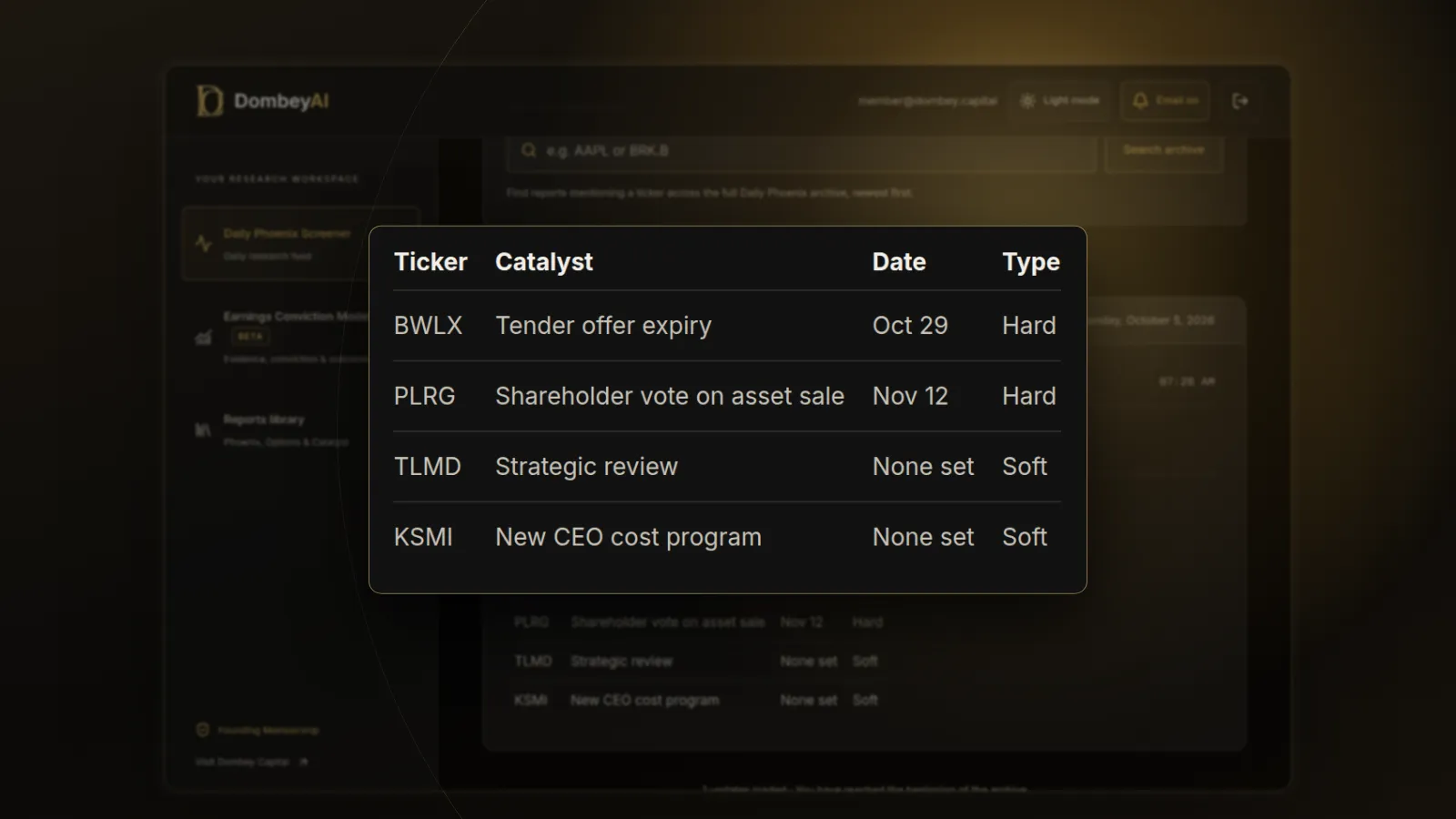
What makes a catalyst hard
A hard catalyst passes three tests.
- It has a date. The date is set, or bounded by rule or contract. A tender offer must stay open at least 20 business days. A merger agreement has an outside date. A court sets a hearing.
- The outcome is defined. You can list the results: approved or rejected, closed or terminated, paid or not paid. Each result has a value you can estimate.
- It forces the price. The event changes what a shareholder receives, not just what the market might think. A cash merger that closes pays the deal price. A liquidating distribution pays cash. Nobody has to be persuaded.
A soft catalyst usually fails at least two of the three. A new management team has no date by which results must appear, the outcome is a range, and the price only moves if investors come to believe the story.
Quick reference: common catalysts sorted
| Catalyst | Date | Outcome | Forces price? | Type |
|---|---|---|---|---|
| Cash merger closing | Bounded by outside date | Close or terminate | Yes | Hard |
| Tender offer expiry | Set, at least 20 business days | Tendered or not | Yes | Hard |
| Shareholder vote | Set in the proxy | Approve or reject | Usually | Hard |
| Court ruling | Hearing set, ruling often not | Win, lose, settle | Often | Hard to mixed |
| Liquidating distribution | Set by the board | Paid amount | Yes | Hard |
| Spin-off completion | Set by the board | Distributed or not | Partly | Hard to mixed |
| Earnings report | Set | A range of results | No | Mixed |
| Strategic review | None | Sale, no sale, partial | No | Soft |
| New chief executive | None | Gradual | No | Soft |
| Cost-cutting program | Targets only | Gradual | No | Soft |
| Buyback authorization | None | Depends on execution | Partly | Soft |
Two entries need a note. A court ruling has a hearing date but often no ruling date, so it is hard on outcome and softer on timing. An earnings report has a hard date and a soft outcome. Our article on earnings catalysts covers how to prepare for one.
Why the difference changes the math
The same expected gain is worth very different amounts depending on how long it takes. Annualizing makes the point.
The downside differs too. If Company A's deal breaks, you can estimate where the stock trades without it, using the price before the announcement and what has changed since. If Company B's program disappoints, there is no single date on which you find out, and the stock can drift lower for a long time.
That is why event-driven investors often accept a smaller gain on a hard catalyst over a larger one on a soft catalyst. They are paying for certainty of timing and a defined downside, not just for the upside.
How to tell them apart in practice
Run these checks on any catalyst you are relying on.
- If you cannot write down a date, or a latest date, the catalyst is soft on timing.
- If you cannot list the possible outcomes in one line each, the catalyst is soft on outcome.
- If the price only moves when investors change their minds, rather than when a payment or a vote happens, the catalyst is soft on mechanism.
- If the catalyst depends on a document that does not exist yet, such as a signed agreement, a filed tender offer or a set record date, it is soft until that document is filed.
- If a filing on EDGAR sets the date and terms, such as a definitive proxy, a Schedule TO or a merger agreement attached to an 8-K, it is very likely hard.
The last point is the practical one. Hard catalysts leave paper. A shareholder vote has a definitive proxy with a meeting date; see how to read a proxy statement. A tender offer has a Schedule TO with an expiry; see what a tender offer is. A merger has an agreement with an outside date and conditions; see merger arbitrage explained. A soft catalyst usually lives in a press release, a conference call or an investor letter.
Finding the hard event inside a soft story
Many good situations start soft and harden. The research work is watching for the conversion and being early to recognize it.
| Soft starting point | What hardens it | Where it shows up |
|---|---|---|
| Activist letter | Director nomination with a meeting date | Schedule 13D amendment, proxy filings |
| Strategic review announced | Signed agreement or tender offer | 8-K with the agreement, Schedule TO |
| Plan to sell a division | Purchase agreement with closing conditions | 8-K, later a proxy if a vote is needed |
| Intent to spin off a unit | Form 10 effective, record and distribution dates set | Form 10, 8-K |
| Talk of returning capital | Declared special dividend with a record date | 8-K, press release |
| Plan to wind down | Plan of dissolution approved by vote | Proxy, then distributions |
A spin-off shows the pattern clearly. The announcement is soft: the board intends to separate a business, subject to conditions. The Form 10 filing makes it firmer. The record date and distribution date make it hard.
Where this goes wrong
Calling a soft catalyst hard. A strategic review, a "commitment to unlock value" or an analyst day is not a hard catalyst, however confident the language. Until there is a signed document and a date, you are relying on a story.
Trusting dates that move. Outside dates get extended, regulators issue second requests, hearings get postponed and tender offers get extended. A hard date is a boundary, not a promise. Build the annualized return on the date that is likely, not the date that is hoped for.
Ignoring the downside of a hard catalyst. Binary outcomes cut both ways. A merger spread is small because most deals close, and the loss when one breaks can be several times the spread.
Dismissing soft catalysts entirely. Some of the largest changes in value come from soft catalysts: a new owner who reallocates capital, or a cost base that resets over two years. They are harder to time, not worthless. Size them for the uncertainty and expect a longer wait.
Stacking soft catalysts. Three soft catalysts are not one hard one. A new chief executive, a cost program and a buyback authorization can all be true and the stock can still go nowhere for years.
Common mistakes
- Starting from the cheapness and then looking for a catalyst. The catalyst you find after you like the stock is usually soft. Start with the event when you can.
- Using the announced date without reading the conditions. A closing date that depends on regulatory approval or financing is a target.
- Forgetting the record date. For votes and distributions, the record date decides who participates. Buying after it can mean owning the stock without the event.
- Not writing down what would make the catalyst fail. Every hard catalyst has a failure path. List it before the event, not after.
Putting every hard date and its conditions in one place helps; see how to build a catalyst calendar. Dombey publishes each thesis before its catalyst and keeps it in the archive; see the research archive.
The bottom line
A hard catalyst has a date, a defined outcome and a mechanism that forces the price; a soft catalyst has a direction but leaves timing and size open. The difference matters because time is part of the return and a defined outcome makes the downside measurable. Hard catalysts leave paper on EDGAR, so look for the filing that sets the date. Treat soft catalysts as possible, size them for the wait, and watch for the moment they harden.