

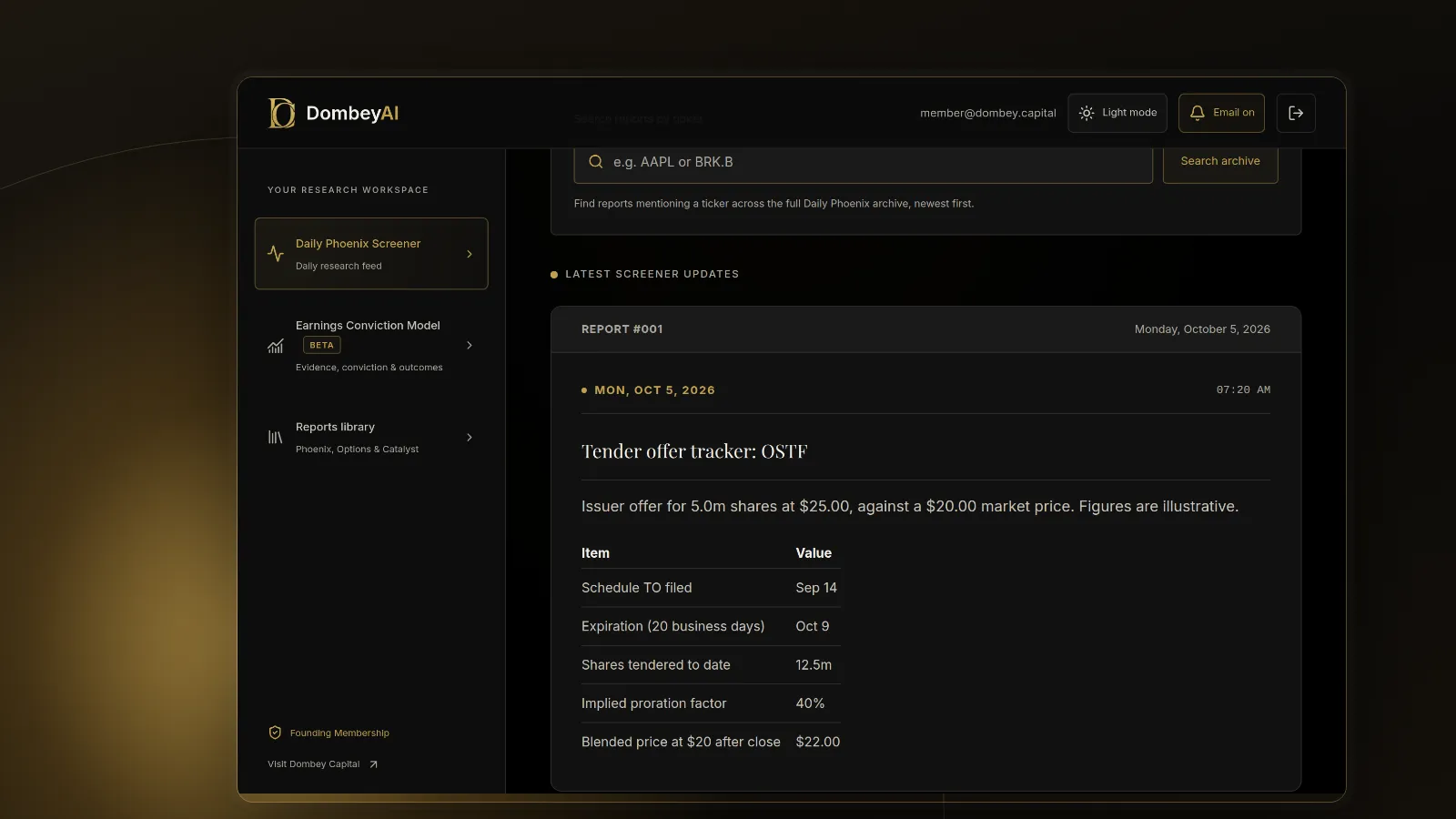
How a tender offer works
The buyer launches the offer by filing a Schedule TO with the SEC and sending holders an Offer to Purchase and a Letter of Transmittal. The Offer to Purchase is the document that matters. It sets out:
- The price and form of payment. Cash, shares of the buyer, or a mix.
- The number of shares sought. All outstanding shares, or a fixed number or percentage.
- The expiration date. At least 20 business days after launch.
- The conditions. What must happen for the buyer to accept shares.
- Proration and priority rules. How shares are accepted if the offer is oversubscribed.
- Withdrawal rights. How and until when a holder can take tendered shares back.
In a third-party offer, the target company must tell holders within 10 business days whether its board recommends accepting, rejecting or remaining neutral. It does this on a Schedule 14D-9, which also explains the board's reasoning and any conflicts.
Holders who want to sell instruct their broker to tender. Shares tendered through a broker usually stay in the account but cannot be sold while tendered. Brokers often set their own deadline a day or more before the official expiration.
The tender offer timeline
The SEC rules set a minimum structure. The dates below show a typical sequence for an offer that runs to its first expiration.
| Business day | Event | What to check |
|---|---|---|
| Day 1 | Offer starts; Schedule TO filed | Price, shares sought, conditions, expiration date |
| By day 10 | Target files Schedule 14D-9 (third-party offers) | Board recommendation and reasons |
| Throughout | Withdrawal rights apply | Your broker's internal deadline |
| Any change to price or amount sought | Offer must stay open at least 10 more business days | New expiration date |
| Day 20 or later | Scheduled expiration | Whether conditions are met or the offer is extended |
| By 9:00 a.m. Eastern, next business day | Extension, if any, must be announced | Number of shares tendered so far |
| Promptly after expiration | Payment for accepted shares | Final proration factor |
| Optional | Subsequent offering period | No withdrawal rights; no proration in this period |
Two points cause most of the confusion. First, the count is in business days, not calendar days, so a holiday pushes the date. Second, extensions are common. A buyer waiting for a regulatory approval or for the minimum condition to be met will usually extend in short increments rather than let the offer lapse.
For third-party cash offers above the Hart-Scott-Rodino threshold, the antitrust waiting period is 15 days rather than the 30 days for a merger. That is one reason buyers use tender offers when they want to close quickly, as covered in merger arbitrage explained.
Terms and conditions to read
Most of the risk in a tender offer sits in the conditions. Common ones:
- Minimum tender condition. The buyer need not accept any shares unless a set amount is tendered, often a majority of shares outstanding. This is the key condition in an acquisition.
- Regulatory condition. Antitrust clearance or other approvals.
- Financing condition. Less common in friendly deals with committed financing, but worth checking.
- No material adverse change. The buyer can walk away if the target's business deteriorates beyond a defined threshold.
- Market conditions. Some issuer offers can be terminated if markets fall sharply during the offer.
In a friendly acquisition, a successful tender offer is usually followed by a second-step merger that converts the remaining shares into the same consideration. Under Delaware law, a merger after a qualifying tender offer can be completed without a separate shareholder vote, which makes the timeline shorter than a one-step merger.
How proration works
Proration applies when the buyer seeks a fixed number of shares and holders tender more. The SEC's rules require the buyer to purchase on a pro rata basis from everyone who tendered during the offer period, so early tenders get no advantage.
The proration factor is shares sought divided by shares tendered. Issuer offers commonly give priority to odd-lot holders, those with fewer than 100 shares, who are bought in full before proration is applied to everyone else.
This is why oversubscribed offers are judged on the blended outcome. The more shares tendered, the lower the factor and the more the result depends on where the stock trades afterward. Some holders estimate the likely proration factor from the shares held by insiders and long-term holders who are unlikely to tender.
Dutch auction tender offers
In a modified Dutch auction, the issuer sets a price range, such as $22 to $25, and a number of shares or a dollar amount it wants to buy. Holders state the lowest price within the range at which they will sell, or tender at whatever price the auction sets.
The company then finds the lowest single price that lets it buy the full amount, and pays that price to every holder whose shares are accepted. Holders who asked for more than that price have their shares returned. If the offer is still oversubscribed at the clearing price, proration applies to the shares tendered at or below it.
A Dutch auction tells you something about holders: the clearing price shows how much premium they needed to sell.
Tender offer types at a glance
| Type | Made by | Shares sought | Main risk for holders |
|---|---|---|---|
| Third-party offer for all shares | Outside buyer | All | Conditions not met; offer withdrawn |
| Partial third-party offer | Outside buyer | A fixed amount | Proration and the price of returned shares |
| Fixed-price issuer offer | The company | A fixed amount | Proration |
| Dutch auction issuer offer | The company | A dollar amount or share count | Clearing price at the low end; proration |
| Exchange offer | Buyer or company | Varies | Value of the securities offered |
| Mini-tender offer | Anyone | Less than 5% | Price below market; fewer protections |
Mini-tender offers
An offer for less than 5% of a company's shares is not subject to most of the rules above, including the disclosure and proration requirements. The SEC's investor guide on mini-tender offers warns that some are made at prices below the market and that holders sometimes tender without noticing. Several of these offers also allow the bidder to extend repeatedly while tendered shares are locked up.
If you receive one, compare the offer price with the current market price, check whether you can withdraw, and read who is making the offer.
Where this goes wrong
- Treating the offer price as the exit. In a partial offer, part of your position comes back to you, often into a lower market price once the buyer stops bidding.
- Missing the broker deadline. Brokers often close instructions a day or more before the official expiration. A holder who waits until the last day can miss the offer.
- Ignoring conditions. A hostile or contested offer can be extended for months and then withdrawn if the minimum condition is not met or the target adopts defenses.
- Underestimating tenders. When the premium is large, nearly every holder tenders and proration factors fall. Assuming a high factor overstates the blended price.
- Mini-tender traps. Below-market offers rely on holders not checking the price.
- Tax surprises. Proceeds from a tender are usually taxed as a sale. Issuer offers can have different treatment depending on how much of a holder's position is bought.
Dombey's published research tracks the dated steps of event-driven situations like these, from launch to expiration; see the research archive. For how tender offers fit with other dated events, read what a stock catalyst is and what a special situation is. A rights offering is a related corporate action that runs in the other direction; see what a rights offering is.
The bottom line
A tender offer is a public bid to buy shares directly from holders at a stated price for at least 20 business days, made by an outside buyer or by the company itself. The Offer to Purchase sets the price, conditions and proration rules, and those terms decide what you actually receive. In a partial or oversubscribed offer, the real exit price blends the offer price on accepted shares with the market price on returned shares. Read the Schedule TO and, for third-party offers, the Schedule 14D-9 before deciding what to do.