

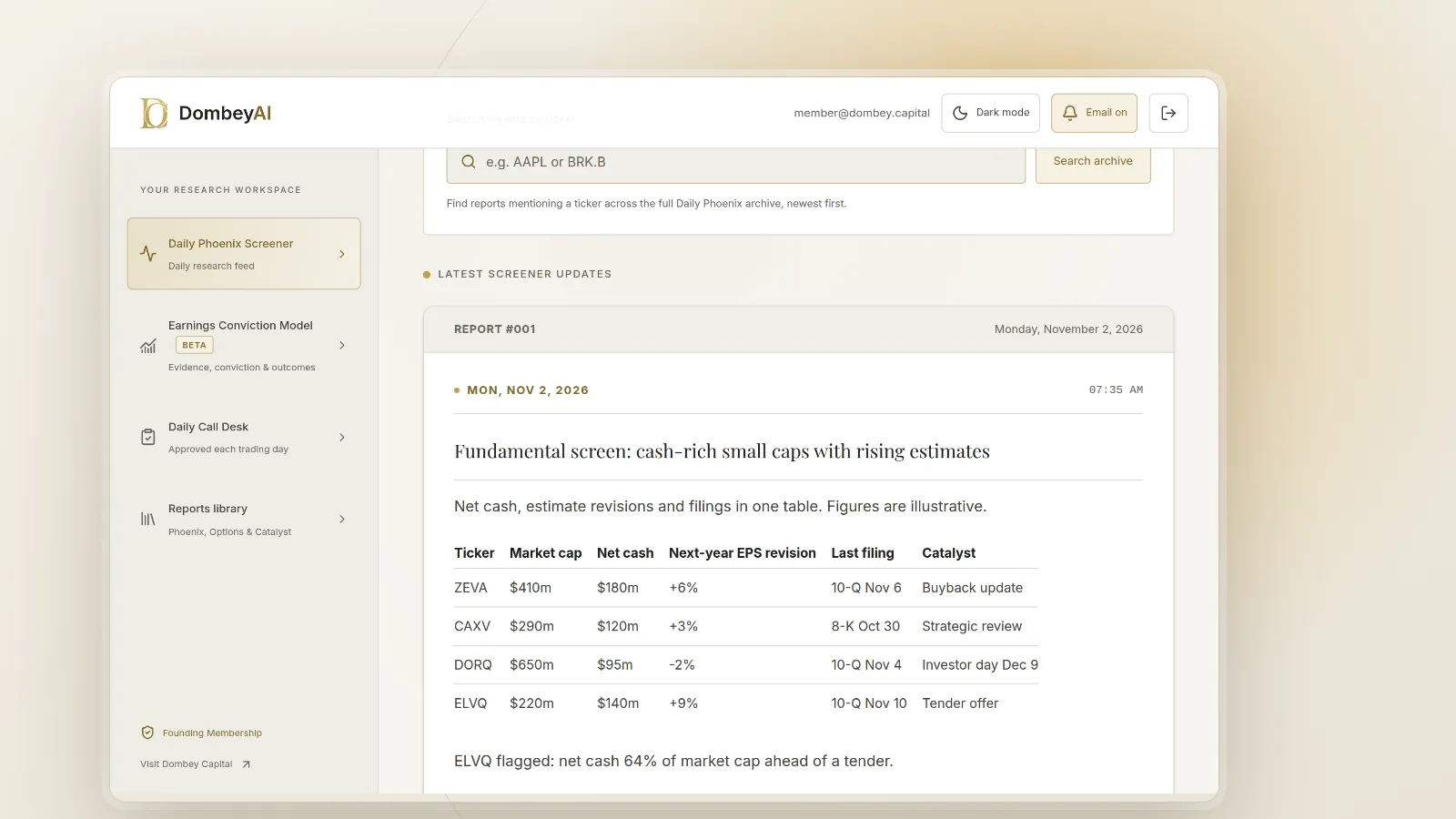


Full disclosure: Dombey Capital is our own research service and our top pick here, for the reasons below. The section on where it falls short is there so you can judge whether it fits your process.
Quick comparison
| Tool | Best for | Key features | Price (as of November 2026) |
|---|---|---|---|
| Dombey Founding MembershipTop pick | Written research on special situations and dated catalysts | Weekly Phoenix Report, weekly Options Research, Catalyst Briefing, DombeyAI Portal with the Daily Phoenix Screener and Earnings Conviction Model | Founding Membership $1,200/year (annual only); Standard Access $80/year or $8/month; Public Archive free |
| Koyfin | Self-serve fundamental research at a published price | Free plan; Plus adds 10 years of financials and estimates, ETF holdings, stock and ETF screener, filings, transcripts and premium news; Premium adds custom data, formulas and templates | Free; Plus $39/month; Premium $79/month; Advisor Core $209/month; Advisor Pro $299/month (annual plans save up to 30%) |
| YCharts | Advisors who need research and client proposals in one platform | Stock screener across 20,000+ equities and 4,500 metrics, fundamental charts, scoring models, dashboards and alerts, proposals and model portfolios on higher tiers | See the vendor's pricing page (quoted through sales; free trial) |
How we compared these tools
We compared these tools from vendor documentation, pricing pages and public product pages, read in November 2026. We did not run trials of either paid service, and we make no claims about the accuracy of any dataset.
| Criterion | Weight | What it measures |
|---|---|---|
| Fundamental data depth | 25% | Years of financials, estimates, filings and transcripts |
| Screening and comparison | 20% | Screen filters, ranking and tables across companies |
| Catalyst and event context | 20% | Whether the tool helps identify which event matters and when |
| Price transparency and cost | 20% | Published prices and cost for one individual user |
| Workflow fit | 15% | Charts, dashboards, alerts, exports and client tools |
We weighted data depth, screening and catalyst context most because they decide how quickly you can test a special situations idea. If you weight client reporting most, YCharts moves ahead; if you weight cost, Koyfin's free and Plus plans lead.
Quick picks by job
Best for special situations and dated catalysts: Dombey Founding Membership
Founding Membership is written research: the weekly Phoenix Report, weekly Options Research, the Catalyst Briefing, valuation and execution analysis and the DombeyAI Portal with the Daily Phoenix Screener and Earnings Conviction Model. It suits readers who want an analyst's view on which spin-off, tender offer or restructuring matters, published before the event.
Best for self-serve fundamental research: Koyfin
Koyfin's Plus plan puts 10 years of financials and estimates, filings, transcripts and a stock and ETF screener behind a published monthly price. It is a good fit for investors who want to build their own screens and dashboards. Our Koyfin alternatives roundup covers similar platforms.
Best for advisors who also need client reporting: YCharts
YCharts combines research tools with proposals, model portfolios and firm-wide sharing on its Presenter, Professional and Enterprise tiers. Its Analyst tier is the research-only option for individual investors.
Full reviews
1. Dombey Founding Membership
What it does. Dombey publishes independent research on special situations and event-driven equities: spin-offs, tender offers, restructurings, stocks below cash and legal or regulatory catalysts. Each thesis is dated, priced and kept in the archive.
Best for. Readers who want the conclusion and the dated catalyst, not a data platform to work through.
Pricing. Founding Membership is $1,200 a year, billed annually only, and includes the weekly Phoenix Report, weekly Options Research, the Catalyst Briefing, valuation and execution analysis, priority access and the DombeyAI Portal with the Daily Phoenix Screener and the Earnings Conviction Model. Standard Access is the lower-cost option at $80 a year (about $6.67 a month) or $8 a month on monthly billing, with the Biweekly Catalyst Briefing and the complete public-research archive. The Public Archive is free.
Pros
- Written theses with dated catalysts and stated invalidation conditions.
- Covers situations data platforms do not flag, such as tender offers and post-bankruptcy equities.
- Archive lets you compare each call with what followed.
Cons
- Not a data terminal; you will still want a platform for financials across many companies.
- Coverage is a short list of situations.
Verdict: Our top pick for special situations and dated catalysts. Pair it with a data platform if you screen broadly.
2. Koyfin
What it does. Koyfin is a financial data and analytics platform with financial statements, estimates, charts, screens, dashboards and portfolio tools. The free plan includes two years of financials and one year of estimates, advanced charting, market and macro dashboards, two watchlists and two screens. Plus adds 10 years of financials and estimates, ETF holdings, the stock and ETF screener, unlimited watchlists, screens and dashboards, snapshots for 100,000+ global companies, and press releases, filings, transcripts and premium news. Premium adds advanced portfolio analytics, unlimited custom data and formulas, custom financial templates and ETF valuation.
Best for. Individual investors who want a self-serve research terminal at a published price.
Pricing. Free; Plus $39 a month; Premium $79 a month; Advisor Core $209 a month and Advisor Pro $299 a month for advisors, with annual plans saving up to 30%. Koyfin offers a full refund within 30 days.
Pros
- Free plan with real research use.
- Published prices and a 30-day refund.
- Filings, transcripts and estimates in one place on Plus.
Cons
- No view on which events matter; you build the screens yourself.
- Mutual fund data only on the advisor plans.
- Custom formulas require Premium.
Verdict: The better of the two for most individual investors doing fundamental research.
3. YCharts
What it does. YCharts is a financial research and proposal platform aimed mainly at advisors, large RIAs, banks and asset managers, with a page for individuals and educators. Its stock screener covers 20,000+ equities with 4,500 quantitative and qualitative metrics and 24+ pre-built templates, with alerts when securities enter or leave results. It offers fundamental charts, time-series analysis, comparison tables, scoring models with custom weights, dashboards, watchlists and economic indicators. The Analyst tier is described for research and analysis, market monitoring, evaluating securities and idea generation for individual investors, with screeners and tables, dashboards, watchlists, alerts and charting. Higher tiers add proposals, model portfolios, report building and firm-wide sharing, and an Excel add-in is available as an add-on.
Best for. Financial advisors who want research and client proposals in one platform.
Pricing. YCharts does not publish prices on its plans page. It asks buyers to call or schedule a conversation, and offers a free trial. See the vendor's pricing page.
Pros
- Deep screening with scoring models and alerts.
- Strong advisor workflow: proposals, model portfolios and reports.
- Economic data alongside company data.
Cons
- No published price, so comparing cost takes a sales conversation.
- Many features are built for advisors, not individual research.
- No catalyst context for special situations.
Verdict: A strong choice for advisors; individual investors should compare its quote with Koyfin's published plans.
Where Dombey falls short
- Narrow coverage. Dombey writes on a short list of special situations, not every stock in the market.
- No data terminal. There is no broad screener of financial statements across thousands of companies like the ones Koyfin and YCharts offer.
- Small team. Research comes from a small team, published under a pen name, James Whitfield.
- Short history. The public record of calls is still young.
Free vs paid
Koyfin's free plan is enough to look up financials, chart prices and run two screens. Paying for Plus makes sense when you need 10 years of history, estimates and transcripts. YCharts offers a free trial rather than a free plan. Dombey's Public Archive is free; Standard Access at $80 a year adds the Biweekly Catalyst Briefing, and Founding Membership adds the full research and portal. EDGAR remains the free primary source for filings; our guide to searching SEC EDGAR shows how.
How to choose
| Your situation | Pick | Add later when |
|---|---|---|
| You want dated research on special situations | Dombey Founding MembershipTop pick | You screen broadly and need a data platform |
| You research companies yourself on a budget | Koyfin free or Plus | You need custom formulas (Premium) |
| You are an advisor who builds client proposals | YCharts | You want written catalyst research alongside |
| You compare many platforms first | Our best stock research tools list | You know which features you use most |
For a three-way comparison of research services, see Seeking Alpha vs Motley Fool vs Morningstar vs Dombey. If charting matters as much as fundamentals, our comparison of TradingView vs Koyfin covers that trade-off.
- If you want to know which event matters and when, start with Dombey.
- If you want to build your own screens at a published price, start with Koyfin.
- If you need client proposals, ask YCharts for a quote and a trial.
The bottom line
Dombey's Founding Membership is our top pick for special situations and dated catalysts, because it gives you written research rather than another dataset. Between the two platforms, Koyfin suits most individual investors, with a free plan, published prices and deep fundamentals on Plus. YCharts is the stronger choice for advisors who need proposals and client reporting, but its prices are quoted through sales. Many investors pair a data platform with written research; see the research archive for Dombey's published theses.