

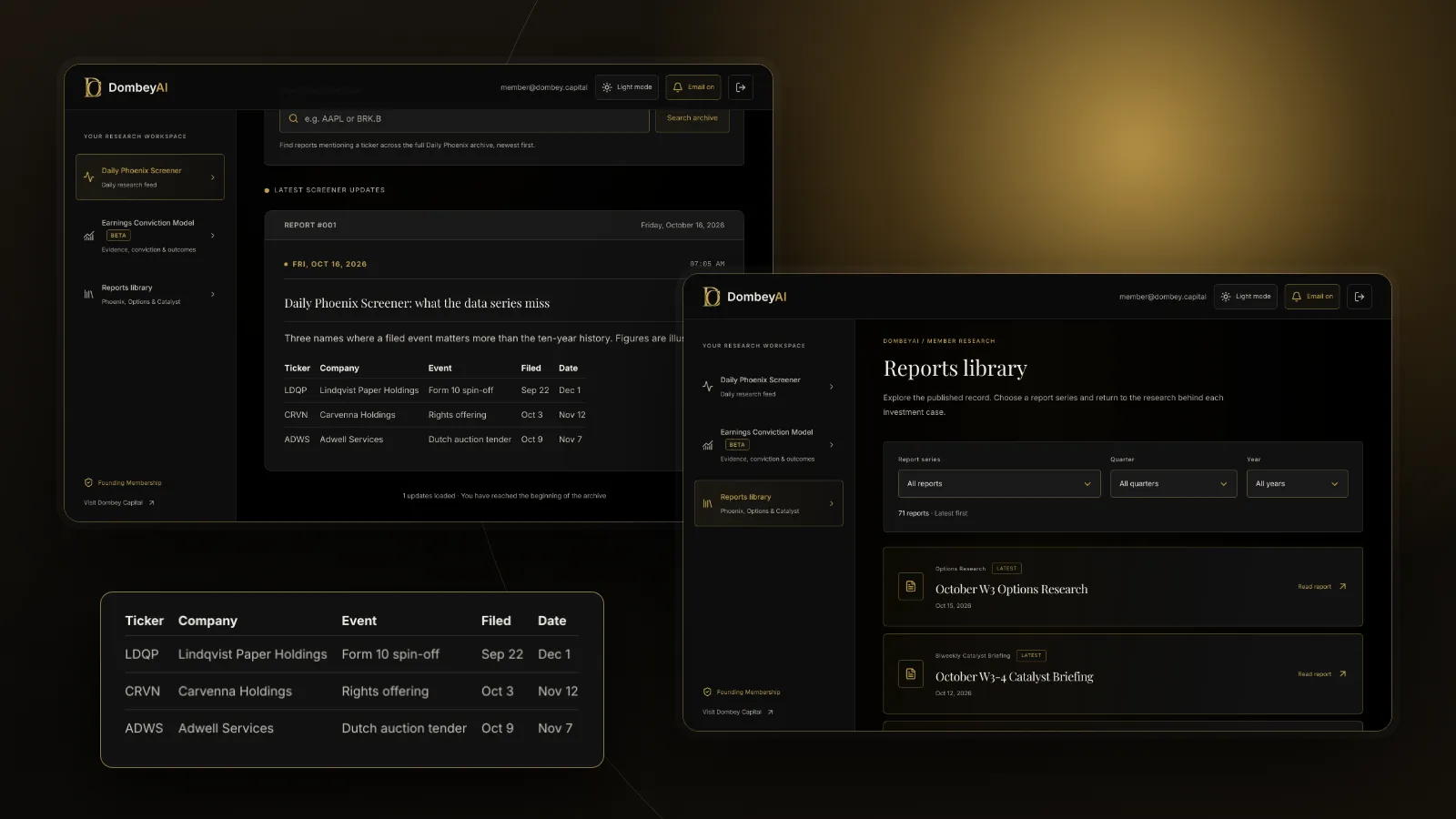


Full disclosure: Dombey Capital is our own research service and our top pick here, for the reasons below. The section on where it falls short is there so you can judge whether it fits your process.
What Koyfin does well, and why people look elsewhere
Koyfin is a market data and charting platform. Its pricing pages list:
- A free plan with 2 years and 12 quarters of financial statements, 1 year of estimates, 2 watchlists, 2 screens and 2 custom dashboards.
- Paid plans (Plus, Premium, Advisor Core and Advisor Pro) with 10 years and 40 quarters of financials, 10 years of estimates on Plus, full transcript history, and global company snapshots of more than 100,000 companies on Plus.
- Advisor plans that add mutual fund data, and Advisor Pro adds separately managed accounts to the screener.
That is a lot for the price, and for many readers the honest answer is to stay. People usually look elsewhere for one of five reasons: they want a longer history than 10 years, deeper screening with portfolio tracking, better technical charting, a cheaper fast screener, or an analyst's opinion on top of the data. Each of those has a better tool, listed below.
| What you want beyond Koyfin | Closest tool here | What you give up |
|---|---|---|
| A longer financial history | TIKR | Koyfin's dashboards and macro views |
| Deeper screening and portfolio tracking | Stock Rover | Koyfin's charting style and transcripts on lower plans |
| Technical charting and alerts | TradingView | Koyfin's focus on fundamentals |
| A fast, cheap US screener | Finviz | Global coverage and long histories |
| Analyst ratings | Morningstar Investor | Charts and dashboards |
| Quant ratings | Seeking Alpha Premium | Custom formulas and dashboards |
| Research on dated events | Dombey CapitalTop pick | Any data platform at all |

If you are comparing the data platforms head to head, our Koyfin vs TIKR vs Stock Rover comparison and TradingView vs Koyfin for fundamental research go deeper.
Quick comparison
| Tool | Best for | Key features | Price (as of October 2026) |
|---|---|---|---|
| Dombey CapitalTop pick | Special situations and dated catalysts | Founding Membership: weekly Phoenix Report, weekly Options Research, Catalyst Briefing, DombeyAI Portal with the Daily Phoenix Screener and Earnings Conviction Model; Standard Access: Biweekly Catalyst Briefing and public-research archive | Founding Membership $1,200/year; Standard Access $80/year or $8/month; Public Archive free |
| TIKR | The longest financial history | Up to 30 years of financials, full transcript history and 5 years of analyst estimates on Ultimate; global data on paid plans | Free plan; Plus $24.95, Pro $54.95, Ultimate $119.95 a month; 14-day money-back guarantee |
| Stock Rover | Deep screening and portfolio tracking | 400+ to 800+ metrics, up to 20 years of fundamentals, brokerage links, fund reports on Ultimate | Premium $348/year or $34/month; up to Ultimate Pro $1,788/year; 14-day trial |
| TradingView | Charting and alerts | Charting, screeners, 20 years of annual financials on charts on paid plans, alerts | Basic free; Essential $12.95, Plus $29.95, Premium $59.95, Ultimate $199.95 a month billed annually |
| Finviz | Fast US screens | Screener, maps, charts; Elite adds real-time data, 8 years of statements, alerts and export | Free; Elite $39.50/month or $299.50/year |
| Morningstar Investor | Analyst ratings | Fair value and moat ratings, analyst reports, screener with 200+ data points, portfolio tools | $249/year or $34.95/month; 7-day free trial |
| Seeking Alpha Premium | Quant ratings | Quant ratings and screeners, analysis on 4,000+ stocks and ETFs, Virtual Analyst Reports | $299/year plus taxes |
| SEC EDGAR | The primary filings | Every 10-K, 10-Q and 8-K; full-text search | Free |

How we compared these tools
We compared these tools from vendor documentation, pricing pages and public product pages, read on the publish date. We did not subscribe to each tool for this article.
| Criterion | Weight | What it measures |
|---|---|---|
| Fit for dated events | 20% | Whether the tool helps when a stock's value depends on a spin-off, deal, vote or filing date |
| Fundamental data depth | 25% | Years of financials, estimates, transcripts and coverage |
| Screening and analysis | 20% | How far you can filter, chart and track a portfolio |
| Judgment on top of data | 10% | Whether ratings or written research sit alongside the numbers |
| Price and terms | 25% | List price, free plans, trials and refunds from the vendor's own pages |
The weights give data depth and price the most room, because those are why most people use Koyfin. On data depth alone, Koyfin and TIKR lead and Dombey scores low. If you weight dated events lightly, Dombey drops out of the order and TIKR moves to the top.
Quick picks by job
Best for special situations and dated catalysts: Dombey Capital
Dombey does not compete with Koyfin on data. It starts from an event with a date, such as a spin-off distribution, a shareholder vote or a tender offer deadline, and publishes a written thesis before it, priced on the day. Use it next to a data tool, not in place of one. If you want fundamental data, keep Koyfin or move to TIKR.
Best for the longest financial history: TIKR
TIKR's Ultimate plan lists 30 years of financials, full transcript history and five years of forecasted analyst estimates, three times Koyfin's history. Its free US plan has 5 years of financials.
Best for deep screening and portfolio tracking: Stock Rover
Stock Rover's screeners filter on up to 800+ metrics, its top plans hold 20 years of fundamentals, and it tracks portfolios with brokerage links.
Best for charting and alerts: TradingView
TradingView is built for charts, with paid plans showing 20 years of annual financials on charts and a free Basic plan. It suits readers who used Koyfin's charts more than its financials.
Best for fast US screens: Finviz
Finviz's free screener is quick and familiar, and Elite adds real-time data, 8 years of statements, alerts and export for $299.50 a year.
Best for analyst ratings: Morningstar Investor
Morningstar adds what no data tool here has: an analyst's fair value estimate and moat rating on each covered stock. Investors who want a judgment on top of the data are better served here than by Koyfin or Dombey.
Best for quant ratings: Seeking Alpha Premium
Quant ratings and screeners across a wide list of stocks, with a library of contributor analysis behind them.
Best free primary source: SEC EDGAR
Every figure in these tools comes from filings, and EDGAR has them for free. Our guide on how to search SEC EDGAR filings shows how.
Full reviews
1. Dombey Capital
What it does. Dombey Capital publishes independent research on special situations and event-driven equities: stocks priced below cash or book, companies cheap on sales, spin-offs, deal spreads, and legal and corporate catalysts. Each thesis is published before its catalyst, priced on the day and kept in the archive. There are three access levels:
- Founding Membership ($1,200 a year, annual billing only): the weekly Phoenix Report, weekly Options Research, the Catalyst Briefing, the DombeyAI Portal with the Daily Phoenix Screener and the Earnings Conviction Model, valuation and execution analysis, and priority access.
- Standard Access ($80 a year, about $6.67 a month, or $8 a month on monthly billing), the lower-cost option: the Biweekly Catalyst Briefing and the complete public-research archive.
- Public Archive (free): published executive theses and public research.
Best for. Investors whose process starts from a dated event. If you are new to the style, what is a stock catalyst covers the basics.
Pricing. Founding Membership $1,200 a year. Standard Access $80 a year or $8 a month. Public Archive free. See the subscription options.
Pros
- Research tied to an event with a date, so you can check later whether the case held.
- Tells you which date and which filing matter, which a data tool does not.
- Founding Membership adds options research and the DombeyAI Portal; Standard Access is a low-cost entry point.
Cons
- Not a data platform: no financial histories, charts, dashboards or general screener.
- Narrow coverage of special situations.
- Costs more than Koyfin's paid plans at the Founding level.
Verdict: Our top pick for special situations and dated catalysts. For fundamental data depth, Koyfin or TIKR is the better buy, and most event-driven investors use one of them alongside Dombey.
2. TIKR
What it does. TIKR is a financial data platform. Its pricing page lists a free US plan with 5 years and 8 quarters of financials and 90 days of transcripts; Plus with global data, 10 years of financials and 1 year of transcripts; Pro with 10 years of transcripts and 4 years of estimates; and Ultimate with 30 years of financials, full transcript history and 5 years of forecasted analyst estimates.
Best for. Investors who want more history than Koyfin offers.
Pricing. Free plan; Plus $24.95, Pro $54.95 and Ultimate $119.95 a month as listed, with a 14-day money-back guarantee for new users.
Pros
- Up to 30 years of financials.
- Transcripts, audio and slides on the higher plans.
- A free plan to test it.
Cons
- Fewer dashboard and macro tools than Koyfin.
- The full history is on the top plan.
Verdict: The best data replacement for Koyfin if history is what you need.
3. Stock Rover
What it does. Stock Rover is a research, screening and portfolio platform. Its plans page lists 5 years of fundamentals and 400+ metrics on Premium, 10 years and 700+ on Premium Plus, and 20 years and 800+ on Ultimate and Ultimate Pro, with portfolio tracking and brokerage links on every paid plan. Every plan has a 14-day free trial.
Best for. Investors who want to screen deeply and track a portfolio in one tool.
Pricing. Premium $348 a year or $34 a month, Premium Plus $588 a year or $70 a month, Ultimate $948 a year or $99 a month, Ultimate Pro $1,788 a year or $199 a month.
Pros
- Screening on hundreds of metrics.
- Portfolio tracking with brokerage integration.
- Up to 20 years of fundamentals.
Cons
- The longest histories are on the expensive plans.
- Research reports are a separate subscription, per its FAQ.
Verdict: The best Koyfin alternative for screening and portfolios.
4. TradingView
What it does. TradingView is a charting platform with screeners, alerts and fundamental data. Its pricing page lists 7 years of annual financial data on charts on the free Basic plan and 20 years on paid plans, with more financials per chart as you move up.
Best for. Readers who used Koyfin mainly for charts.
Pricing. Basic free. Essential $12.95, Plus $29.95, Premium $59.95 and Ultimate $199.95 a month, listed as special prices on annual billing.
Pros
- Strong charting and alerts.
- A usable free plan.
- 20 years of annual financials on charts on paid plans.
Cons
- Built for technical analysis first.
- Fewer fundamental dashboards than Koyfin.
Verdict: The best Koyfin alternative for charting.
5. Finviz
What it does. Finviz is a US stock screener with maps and charts. The free version has delayed data, basic filters and 3 years of financial statements. Elite adds real-time data, 8 years of statements, advanced filters, alerts and export to Excel and CSV.
Best for. Investors who want a fast first screen on US stocks.
Pricing. Free. Elite $39.50 a month or $299.50 a year; refunds are available within the first 30 days on written request.
Pros
- Fast, simple screening.
- A free version that covers the basics.
Cons
- Shorter histories than Koyfin's paid plans.
- US focus.
Verdict: The best low-cost screener. See the best free stock screeners for more.
6. Morningstar Investor
What it does. Morningstar Investor lists analyst coverage of thousands of securities, fair value and competitive advantage ratings, fund ratings, a screener with more than 200 data points for US-based securities, portfolio tools and alerts.
Best for. Investors who want an analyst's judgment on top of the data.
Pricing. $249 a year or $34.95 a month, with a seven-day free trial.
Pros
- Analyst ratings Koyfin does not have.
- Fund ratings and portfolio tools.
Cons
- Less flexible charting and data than Koyfin.
- A shorter screener field list than the data platforms.
Verdict: The best pick for analyst ratings. Readers who want an opinion, not only data, are better served here than by Koyfin or Dombey. See our Morningstar alternatives for the other direction.
7. Seeking Alpha Premium
What it does. Seeking Alpha's help center describes Premium as quant ratings and screeners, AI research tools such as Virtual Analyst Reports and Earnings Call Insights, and analysis on more than 4,000 stocks and ETFs.
Best for. Readers who want a rating and contributor views on the stocks they chart.
Pricing. $299 a year, plus taxes where applicable.
Pros
- Quant ratings on a wide list of stocks.
- A large library of analysis.
Cons
- No custom dashboards or long histories of Koyfin's kind.
- Contributor articles vary in quality.
Verdict: The best pick for quant ratings next to your data tool.
8. SEC EDGAR
What it does. EDGAR is the SEC's database of company filings, with full-text search.
Best for. Checking any figure at its source.
Pricing. Free.
Pros
- The primary source behind every tool here.
- Filings appear as they are filed.
Cons
- No charts, screens or summaries.
Verdict: Free and necessary alongside any data tool.
A worked example: what data shows and what it misses
Data tools are the right place to find and compare companies. They are the wrong place to learn which date matters. Our guides on spin-off investing and how to analyze a spin-off Form 10 cover the method.
Where Dombey falls short
- Not a data platform. Dombey has no financial histories, charts, dashboards or general screener. For fundamental data depth, Koyfin and TIKR are far better.
- Narrow coverage. Dombey covers special situations and catalyst-driven stocks, not the whole market.
- No free data tier. The free Public Archive holds research, not data; Koyfin, TIKR, TradingView and Finviz all have free data plans.
- Small team and short history. Output is limited by how many situations a small team can research properly, and the public record is young.
- Pen-name author. Research is published under the name James Whitfield, a pen name. Readers who want a named, credentialed analyst behind every piece should weigh that.
Free vs paid
The free tiers here are strong. Koyfin's free plan, TIKR's free US plan, TradingView Basic, free Finviz and EDGAR together cover a lot of research for nothing. Dombey's Public Archive is free research, not data.
What paid plans add:
- Longer histories (TIKR Ultimate, Stock Rover Ultimate plans).
- Deeper screens and portfolio tracking (Stock Rover).
- Real-time data and alerts (Finviz Elite, TradingView).
- Ratings (Morningstar Investor, Seeking Alpha Premium).
- Dated catalyst research and options work (Dombey Founding Membership, with Standard Access as the lower-cost option).
How to choose
| Your situation | Pick | Add later when |
|---|---|---|
| You invest around spin-offs, deals, votes and other dated events | Dombey CapitalTop pick | You need data on the names: add Koyfin or TIKR |
| You want the most data for the price | Stay with Koyfin | You need more than 10 years: add TIKR |
| You need long histories | TIKR | You want dashboards: keep Koyfin's free plan |
| You screen and track a portfolio | Stock Rover | You want transcripts: add TIKR or Koyfin |
| You mainly chart | TradingView | You want deeper fundamentals: add Koyfin |
| You want a quick US screen | Finviz | You want global data: add Koyfin or TIKR |
| You want an opinion on top of the data | Morningstar Investor | You start holding event-driven positions: add Dombey Founding Membership, or Standard Access as the lower-cost option |
For research services rather than data tools, see our Seeking Alpha vs Motley Fool vs Morningstar vs Dombey comparison and the 12 best stock research tools for individual investors. Dombey's published research is in the research archive.
The bottom line
Dombey Capital is our top pick for special situations and dated catalysts, because it tells you which event and which filing set the price, but it is not a data platform and does not replace Koyfin. For fundamental data depth per dollar, Koyfin itself remains a strong choice, and TIKR is the closest replacement when you need longer histories. Choose Stock Rover for screening and portfolios, TradingView for charts, Finviz for quick US screens, and Morningstar Investor or Seeking Alpha Premium when you want ratings on top of the data. Confirm each price on the vendor's own page before you subscribe.