

Nov 3, 2026: sales pass $1 billion and Ingrezza guidance goes up
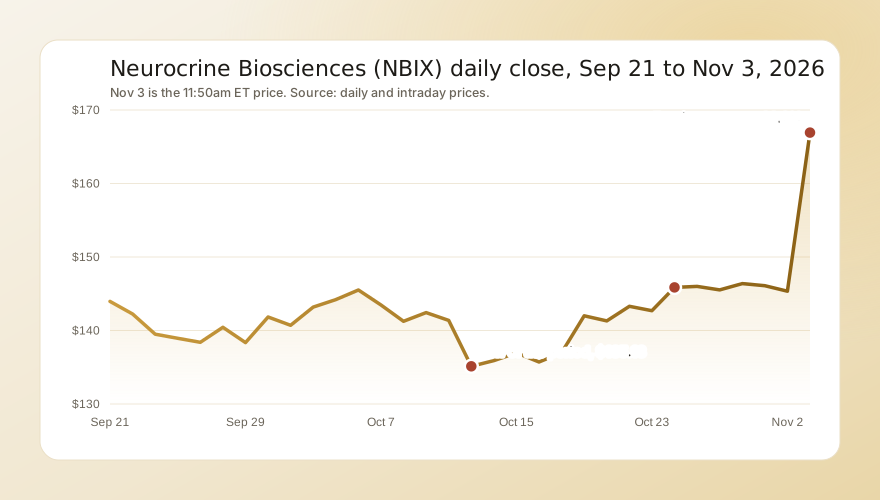
Neurocrine closed Nov 2 at $145.35, little changed over the prior week. It reported after that close, and premarket trading ranged from $157.00 to $159.04. The stock opened at $159.00, its low of the session was $157.91 in the first minute, and it rose steadily to $168.47 at 11:25am. At 11:50am it was $166.92, up 14.8%, on about 1.8 million shares.
What moved the stock:
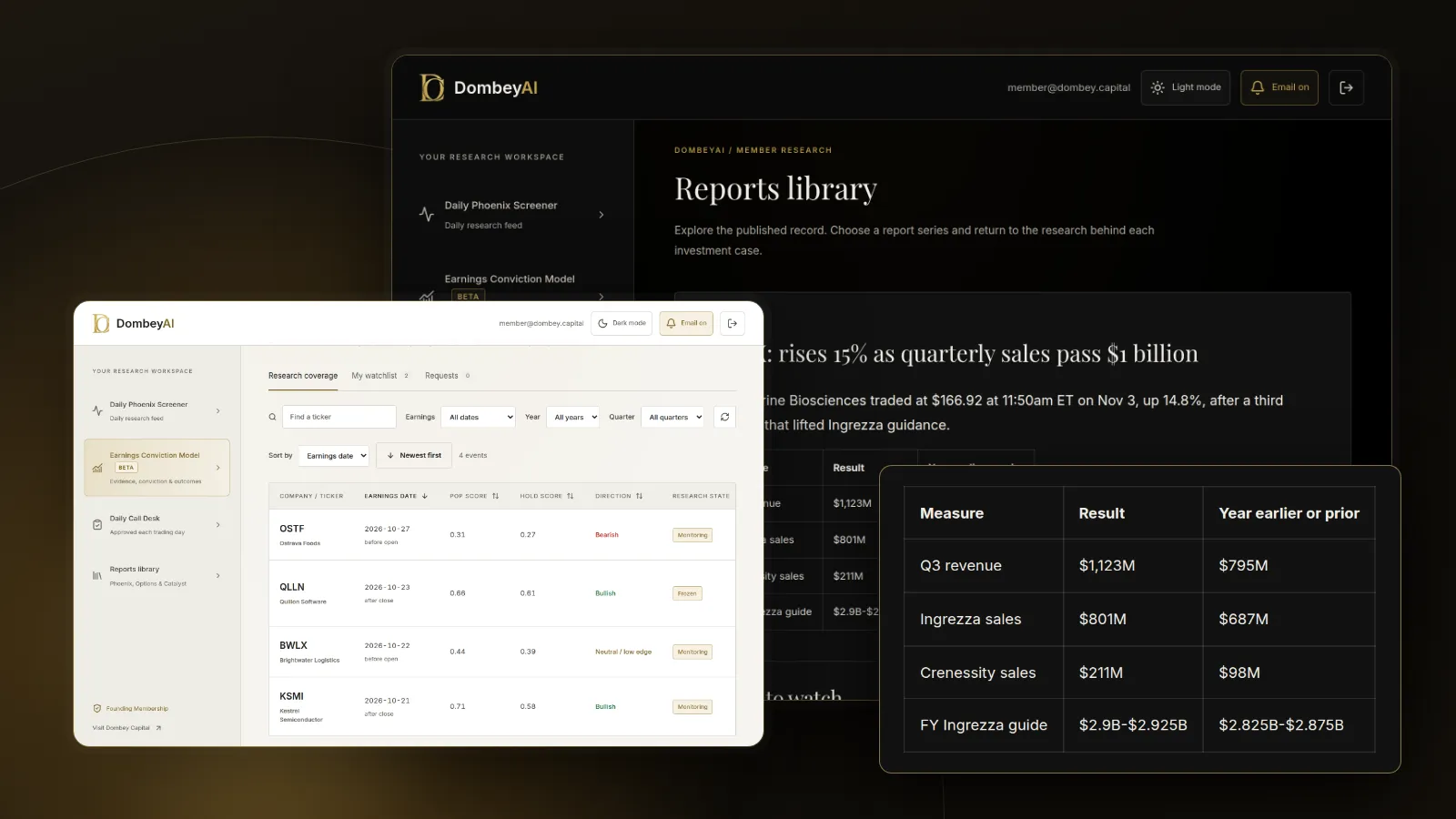
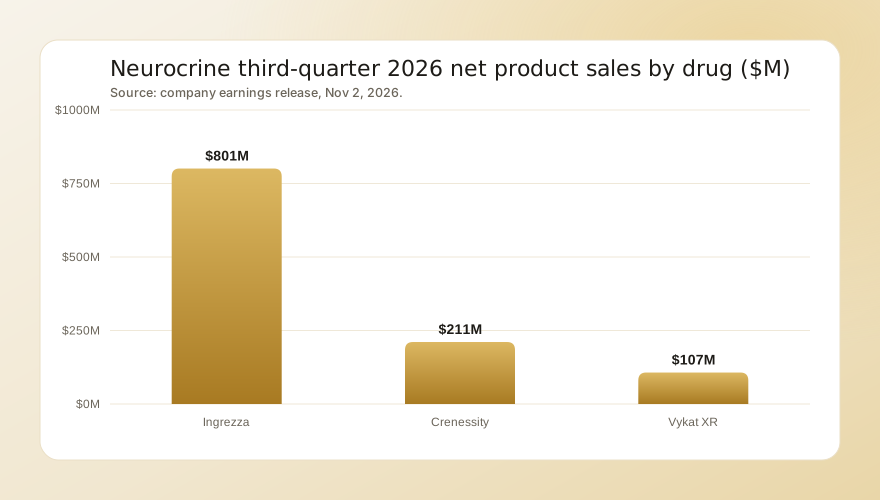
- The guide for the largest drug went up. Ingrezza, which treats tardive dyskinesia and Huntington's chorea, sold $801 million, up 17%, with double-digit volume growth and record total and new prescriptions. Full-year guidance rose to $2.9 billion to $2.925 billion from $2.825 billion to $2.875 billion, about $60 million higher at the midpoint.
- The second and third drugs are now large. Crenessity, for congenital adrenal hyperplasia, sold $211 million, up from $98 million, with about 80% of dispensed prescriptions reimbursed. Vykat XR sold $107 million.
- Earnings grew faster than revenue. Non-GAAP earnings were $3.29 a share against $2.17 a year earlier. GAAP earnings were $1.96 against $2.04, because of Soleno acquisition costs and amortization.
- The group helped a little. The SPDR S&P Biotech ETF was up 2.4%, Acadia up 1.4% and Teva, which sells the rival tardive dyskinesia drug Austedo, up 4.3% late in the morning.
At 11:50am RSI(14) was 78, overbought, and the stock was 16.9% above its 20-day average, 14.0% above its 50-day and 13.3% above its 200-day average. The 52-week high is $186.12.
The numbers
| Measure | Q3 2026 | Year earlier | Change |
|---|---|---|---|
| Total revenue | $1,123 million | $795 million | +41% |
| Ingrezza net sales | $801 million | $687 million | +17% |
| Crenessity net sales | $211 million | $98 million | +115% |
| Vykat XR net sales | $107 million | none | new |
| Non-GAAP diluted EPS | $3.29 | $2.17 | +52% |
| GAAP diluted EPS | $1.96 | $2.04 | -4% |
| Cash and securities | $790 million | $2,543 million at Dec 31, 2025 | -69% |
Expenses rose with the larger business. Total operating expenses were $791.4 million against $555.9 million, and non-GAAP selling, general and administrative expense rose to $327 million from $259 million, after the company expanded its Ingrezza and Crenessity sales teams in the first quarter and took on Soleno's commercial staff. Research spending rose as the osavampator Phase 3 program in major depressive disorder and the direclidine Phase 3 program in schizophrenia advanced. The Soleno deal put about $2.2 billion of Vykat XR intellectual property on the balance sheet, which will be amortized over 16 years and will keep GAAP earnings below non-GAAP earnings for a long time.
The bull case
Neurocrine used to be a one-drug company, and that was the main worry about it. It is not anymore. Ingrezza is about 72% of product sales and still growing, while Crenessity and Vykat XR add about $1.3 billion a year at their third-quarter run rates. Our guide to why guidance changes move stocks explains why a raise in the second half of the year, when the company has most of the year's data, tends to carry more weight than one in the spring.
The pipeline is the second part of the case. Neurocrine is running two Phase 3 programs in large psychiatric markets, and the R&D Day on Dec 15 is the next chance to hear their timelines. Our page on how Phase 3 readouts move stocks covers why the run-up to a pipeline event can matter as much as the data itself. Even after a 15% gain the stock is 10% below its 52-week high.
The risks
Part of the quarter will not repeat. MarketBeat's summary of the call says management flagged about $20 million of benefit from order timing that it expects to reverse in the fourth quarter, so the next report will look slower than this one. Cash and securities fell by about $1.75 billion in nine months, mostly to buy Soleno, which leaves less room for another deal without borrowing.
Ingrezza also faces competition from Teva's Austedo in tardive dyskinesia, and the drug's growth will slow as it ages. A one-day gain of this size often gives some of it back before the next catalyst, and our page on post-earnings announcement drift explains when a gap tends to keep going and when it fades.
What comes next
The next dated event is the R&D Day in New York on December 15, 2026, followed by the fourth-quarter report, which analysts expect around February 10, 2027, with earnings of about $2.05 a share on $1.091 billion of revenue. Between now and then, the signals that matter are weekly Ingrezza prescription trends, any update on the Phase 3 timelines, and whether the stock holds the $158 level where it opened. Our page on what an investor day is explains what companies usually disclose at these events, and the rest of the session's movers are in today's biggest stock moves.