

What happens at an investor day
A typical investor day runs for several hours, in person and on a webcast. The chief executive sets out the strategy, the chief financial officer presents the financial framework, and heads of business units describe their markets and plans. A question-and-answer session follows.
The content usually includes:
- Medium-term targets for revenue growth, margins, earnings per share or free cash flow.
- Capital allocation: investment plans, dividends, buybacks, acquisitions and leverage targets.
- Segment detail, sometimes more than the company has ever disclosed.
- Structural announcements, such as a spin-off, an asset sale or a new reporting structure.
Under Regulation FD, a company cannot share material information selectively with some investors. So material content is made public at the same time, through the webcast and slides, and many companies furnish the slides on Form 8-K. Our guide on how to read an 8-K for catalysts covers where to find them.
Why investor days move stocks
The move comes from the gap between what the company says and what investors expected.
| What the company announces | Likely market reading | What to check |
|---|---|---|
| Targets above consensus | Upside to estimates | Assumptions behind the targets |
| Targets below consensus | Estimates come down | Whether the reset is final |
| Higher capital spending | Lower near-term free cash flow | Return on the new investment |
| New buyback or dividend policy | Cash returned to holders | Funding source and leverage |
| Spin-off or breakup | Value unlocked if parts are worth more | Separation costs and timing |
| New segment disclosure | Hidden value or hidden losses | Profit by segment against peers |
| No new targets | Uncertainty | Why management held back |
When an investor day confirms what was already expected, the stock may barely move, even if the targets look strong on their own. When a company with a new chief executive holds its first investor day, the gap can be large in either direction, because the new team often resets targets. Our explainer on CEO departures covers that sequence.
How to read the targets
Multi-year targets need translating into numbers you can compare.
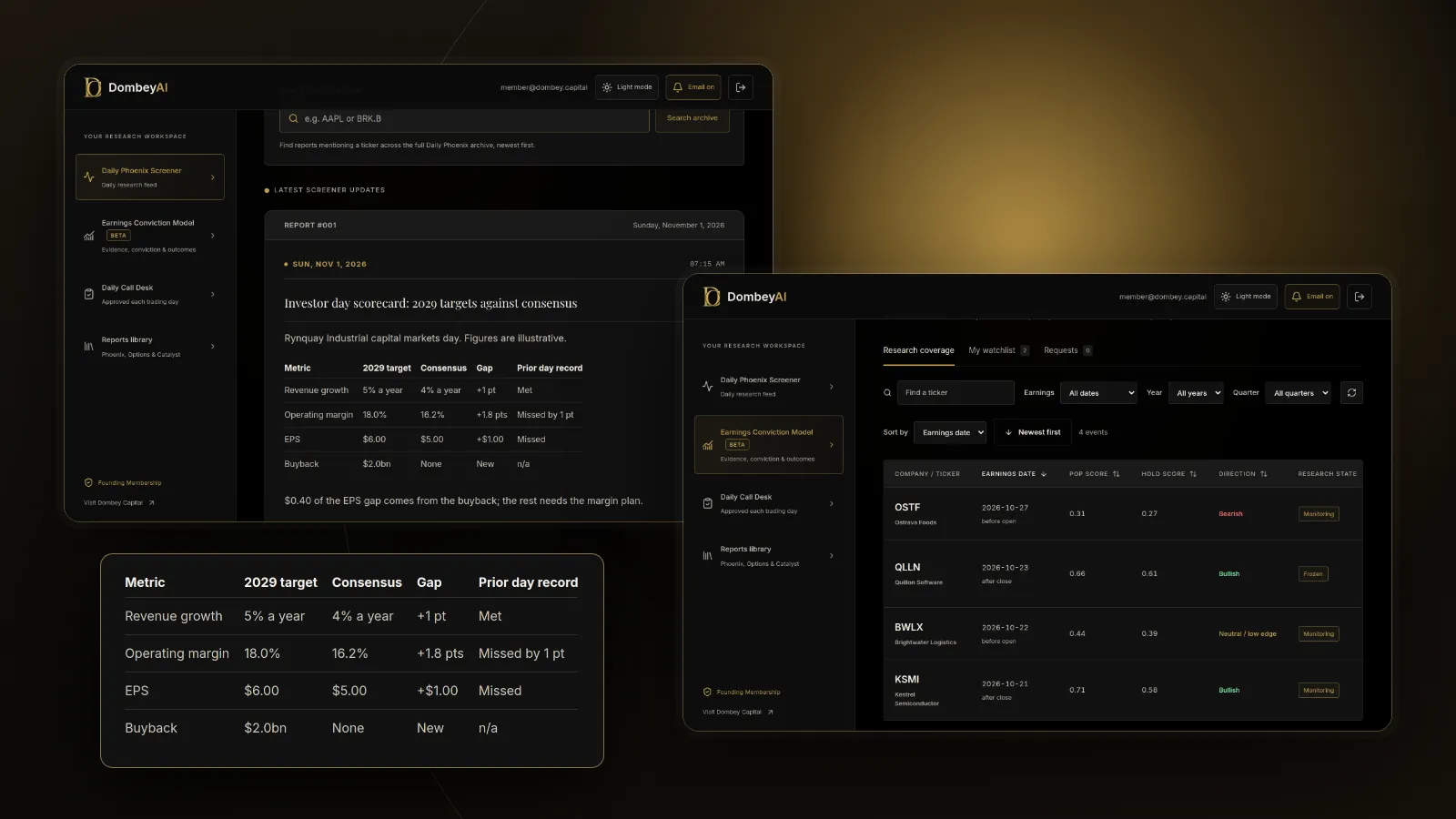
- Convert to a year. Turn "mid-single-digit growth and 200 basis points of margin expansion by 2029" into revenue and operating profit for 2029.
- Compare with consensus. Look at analyst estimates for the same year. The difference is what the market has to price. See why estimate revisions move stocks.
- Check the assumptions. Separate organic growth from acquisitions, and pricing from volume. Targets that need acquisitions depend on deals not yet found.
- Follow the cash. Margin targets can rise while free cash flow falls if capital spending rises faster.
- Read the definitions. Many targets use adjusted figures. Check what is excluded. Our explainer on adjusted EBITDA covers the common adjustments.
- Check the record. Find the previous investor day's slides and compare those targets with what happened.
Preparing before the event
- Note the date and time, and whether the slides will be filed.
- Collect consensus estimates for the target years, not only the next year.
- Find the previous investor day's targets and the company's record against them.
- Read the last two earnings call transcripts for hints about what management will emphasize.
- Write down what would change your view: a number, an announcement or an omission.
- Check the options market. The implied move for the week of the event shows how much the market expects.
Put the event on your catalyst calendar with the questions you want answered.
After the event: the scorecard
Multi-year targets create a scorecard. Each quarterly report after the investor day is a chance to check progress against the plan. Record the targets in a table with the year, the metric, the target and the actual result, and update it each quarter. A company that falls behind its targets early often cuts them at the next investor day, and the stock tends to move before that cut is formal.
For daily coverage of stocks moving on investor days, earnings and other events, see Dombey's market coverage.
Investor days in special situations
Some investor days matter more than others. For event-driven investors, the most important are the ones that come with a structural change:
- Before a spin-off. The parent often holds an investor day for the business it is separating, with the first standalone targets. These figures usually reappear in the Form 10 and set the starting point for how the new company is valued.
- After a strategic review. A company that ends a review without a sale may use an investor day to explain its standalone plan. See what happens after a strategic review.
- Under activist pressure. A company facing a campaign often brings forward targets or a capital return plan to win over holders before a vote.
- With new segment reporting. New disclosure can reveal a profitable unit hidden inside a weaker one, which supports a sum-of-the-parts valuation.
In each case, the investor day is one step in a longer sequence, and the dates that follow, such as the spin-off record date or the shareholder meeting, deserve as much attention as the event itself.
Where this goes wrong
- Treating targets as guidance. Multi-year targets are aspirations, and most are not updated quarterly.
- Missing the definitions. An adjusted margin target can exclude restructuring costs that recur every year.
- Ignoring the base year. A growth target from a depressed base can look stronger than it is.
- Overweighting the presentation. Slides are designed to persuade. The numbers that matter are the ones you can check later.
- Forgetting dilution and debt. Buyback-driven earnings growth funded with debt raises risk as well as earnings per share.
The bottom line
An investor day is a dated event where management sets out strategy and multi-year targets, made public under Regulation FD through a webcast and usually an 8-K. It moves a stock when the targets or announcements differ from what consensus expected. Translate the targets into a specific year, compare them with estimates, test the assumptions and check the company's record against its last set of targets. Then keep score each quarter.