

What a Phase 3 readout is
Phase 3 is the last stage of clinical testing before a company files a new drug or biologic application. These trials are larger than earlier ones, often hundreds to thousands of patients, and they are designed to confirm that the drug works and to measure its side effects in the population that would use it. The FDA describes Phase 3 as the stage that provides most of the safety data and tests effectiveness against a comparator.
Each trial names a primary endpoint before it starts: the one measure that decides whether it succeeded. It might be survival, a change on a symptom scale, or the share of patients who reach a target. The readout is the moment the company announces whether that endpoint was met with statistical significance, usually a p-value below a threshold set in the statistical plan.
A readout is a hard catalyst: the event will happen and will produce a clear result, even if the exact day is uncertain. That sets it apart from softer events such as a partnering rumor or a strategic review.
How the data reach the market
Results arrive in stages, and each stage can move the stock.
- Database lock and analysis. The company closes the trial database, unblinds it and runs the prespecified analysis. Insiders learn the result here, which is why companies often impose trading blackouts around this point.
- Topline press release. The company announces whether the primary endpoint was met, the main effect size and a summary of safety. It files the release on a Form 8-K, often before the open or after the close. If the news comes during market hours, the exchange may halt trading until it is out.
- Full presentation. The detailed data, including secondary endpoints, subgroups and adverse event tables, come weeks or months later at a medical conference or in a journal. This second release can move the stock again, in either direction.
Reading the 8-K closely matters because the press release headline is written by the company. The guide to how to read an 8-K for catalysts covers what to look for beyond the first paragraph.
Why the stock moves as much as it does
Three factors set the size of the move.
Concentration. A company with one late-stage drug and no revenue is, in practice, a bet on that drug. A large company with dozens of products may barely react to the same result. The share of enterprise value tied to the program is the first number to estimate.
Surprise. The price before the readout already reflects a blend of outcomes. If the market expected a modest effect and gets a strong one, the stock rises. If it expected a strong effect and gets a modest one, the stock can fall even on a technically positive trial. The move is driven by the gap between result and expectation, not the result alone.
Cash. A failed trial leaves the company with whatever cash it holds and whatever else is in the pipeline. A company holding cash near its market value has a floor that a cash-poor one lacks. The guide on how to estimate cash runway shows how to work out how long that cash lasts.
Quick reference: how readouts tend to land
| Result | What it usually means | Typical market questions |
|---|---|---|
| Clear win | Primary endpoint met, effect at or above expectations, clean safety | Filing timeline, commercial size, financing |
| Narrow win | Endpoint met, smaller effect than hoped | Will doctors use it, will payers cover it, how does it compare |
| Mixed | Primary met, key secondary missed, or a safety signal | Label scope, FDA view, need for another trial |
| Miss | Primary endpoint not met | Cash per share, rest of the pipeline, wind-down risk |
| Stopped early | Data monitoring committee halts for efficacy or futility | Interim data quality, whether the result holds |
Reading beyond the headline
A trial that "met its primary endpoint" can still disappoint. The questions that decide how the market prices it are mostly in the detail.
Effect size. Statistical significance says the result is unlikely to be chance. It does not say the benefit is large enough to matter to doctors, patients or payers. Compare the effect with the standard of care and with competing drugs.
Safety. A serious adverse event pattern, or higher discontinuation rates than the control arm, can narrow the label or invite questions from the FDA. Safety tables often appear only in the full presentation.
Secondary endpoints. These shape what the label can say and how the drug is marketed. A miss on an important secondary can limit the commercial case even when the primary is met.
Population. If the benefit is concentrated in a subgroup, the FDA may approve the drug only for that group, which shrinks the market.
Regulatory path. One positive trial is not always enough. The FDA has historically looked for two adequate and well-controlled trials, though one trial with confirmatory evidence can suffice in some cases. Check what the company says it plans to file and when. The later steps are covered in how PDUFA decision dates work and what an FDA advisory committee meeting is.
Worked example: pricing a single-asset readout
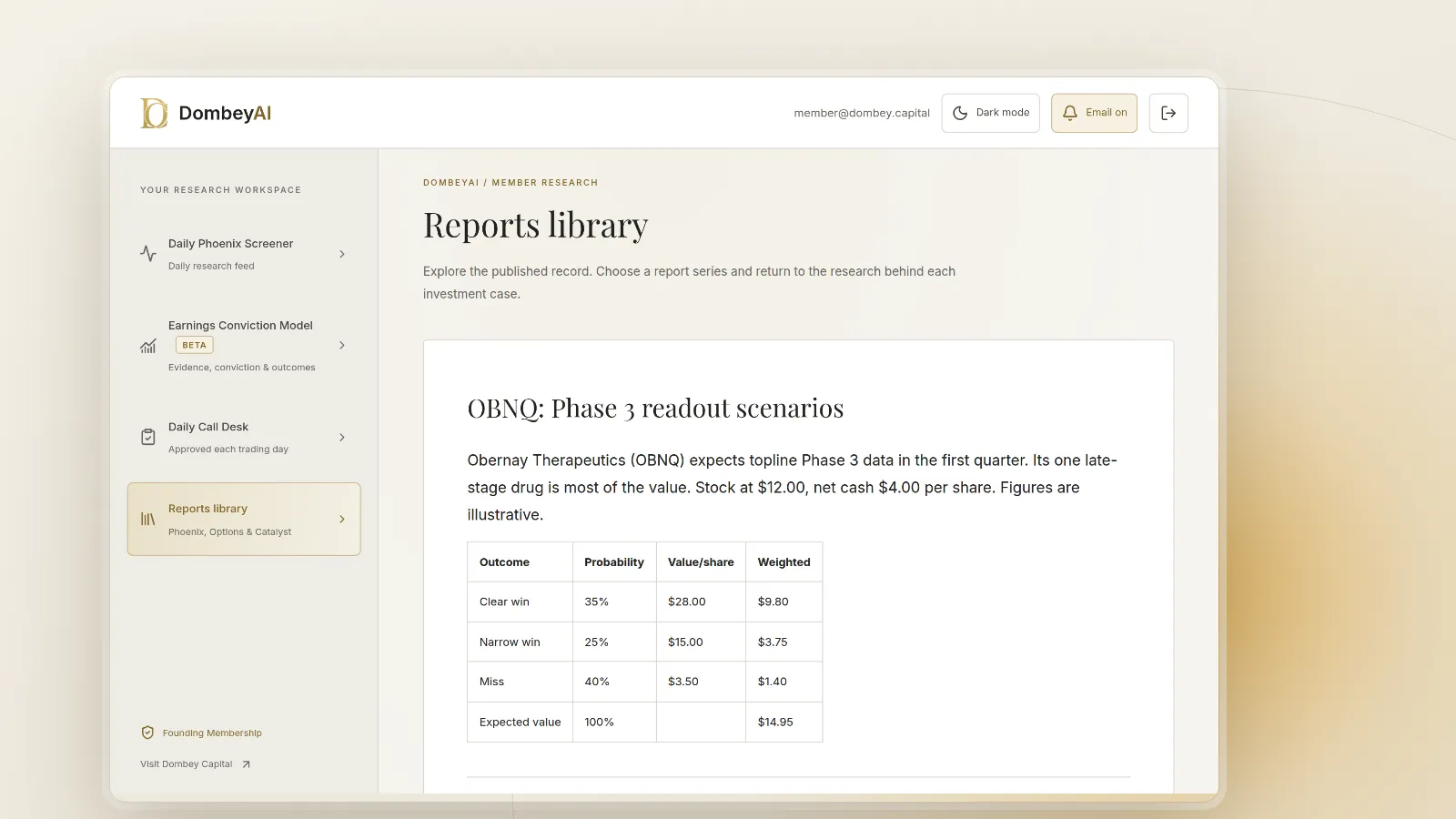
The method is the same as any probability-weighted valuation for a binary event. The useful part is not the final number but what it shows: here the miss case sits close to cash, which limits the downside, and the narrow-win case is worth only a little more than the current price. Most of the value depends on the clear-win case, so the quality of that probability estimate matters most.
The options market gives a second view. Implied volatility usually rises into the date and then collapses after it, the same pattern described in what IV crush is. The price of an at-the-money straddle shows the move traders are pricing in. If your scenarios imply a much larger or smaller move, that gap is the thing to explain before acting on it.
What happens after the readout
The readout starts a new set of events rather than ending the story.
- If the result is positive and the company is short of cash, expect a secondary offering, often within days, priced at a discount to the post-readout price.
- If the trial succeeded, the next dated events are the filing, the FDA's acceptance decision and then the PDUFA date, which can be a year or more away.
- If the trial failed, the stock often trades on cash and the remaining pipeline. Some companies cut staff, pursue a reverse merger or return cash to shareholders.
- If the result is mixed, the full presentation and any FDA meeting become the next catalysts.
A dated list of these follow-on events is the core of event-driven work. Live examples of how real stocks reacted to trial news sit in the market coverage, where each move is dated and cited.
Where this goes wrong
- Treating the guided window as a date. Companies guide to a quarter, then slip. Options bought for a specific expiry can lose value if the data arrive later.
- Reading the headline only. "Met its primary endpoint" can hide a weak effect, a safety signal or a narrow population.
- Ignoring the financing. A positive result followed by a large offering can leave holders with less gain than the headline move suggested.
- Overconfidence in probabilities. Historical success rates for Phase 3 vary widely by disease area and trial design. A single number applied to every trial hides most of what matters.
- Overlooking crowding. When many holders own a stock for the same event, a small disappointment can lead to a large exit, and a halt can leave no chance to adjust.
- Sizing for the expected value only. A favorable expected value does not protect against the loss case. The guide on how to size a position before a binary event covers this.
Tracking readouts
Most readouts are announced months in advance as a guided window in earnings releases, investor presentations and 10-Q filings. ClinicalTrials.gov gives trial design, the primary endpoint and the primary completion date. Calendars collect these into one view; the comparison of FDA calendars and biotech catalyst trackers sets out what each covers. Dombey's published research applies this framework when a readout sits inside a special situation, such as a stock below cash ahead of data; see the research archive.
The bottom line
A Phase 3 readout moves a stock because it settles whether the drug can reach a filing, and the size of the move depends on concentration, surprise and cash. The headline is only the start: effect size, safety, secondary endpoints and the financing that follows decide where the price settles. Building outcome scenarios before the date, anchored on cash per share for the miss case, keeps the analysis honest. Treat the readout as one dated step in a longer chain of events rather than the final answer.