

Nov 4, 2026: revenue beats and the outlook rises
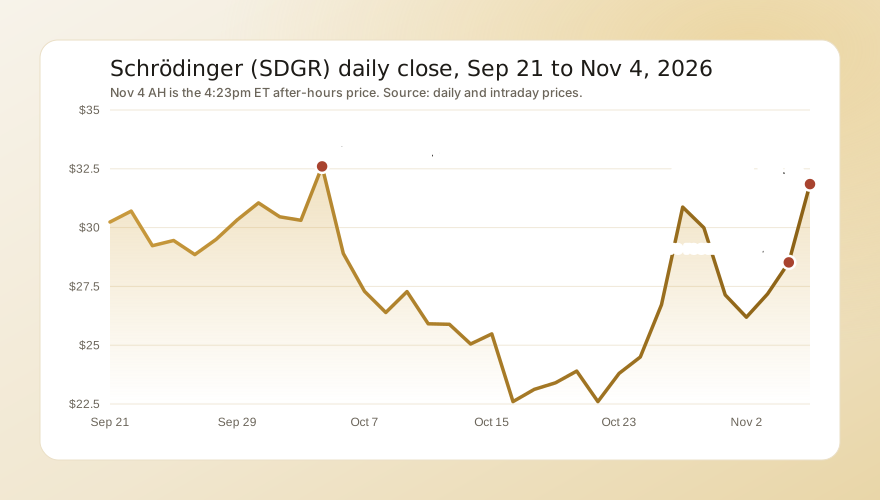
Schrödinger closed Nov 3 at $27.18. Premarket trading was thin, between $26.77 and $28.30. The stock opened at $27.20, slipped to its low of $26.34 at 11:05am and climbed through the afternoon to a high of $28.71 at 3:56pm. It closed at $28.52, up 4.9%, on about 1.85 million shares. That gain came before the report and matched the group: Recursion rose 5.4%, Absci 4.8%, Certara 2.0% and the SPDR S&P Biotech ETF 2.7%. At the close, RSI(14) stood at 56, the shares sat 12.2% above their 50-day average and 68.6% above their 200-day average, volume ran 1.0 times its 20-day average, and the stock was 15.6% below its 52-week high of $33.78.
The release came out at about 4:05pm and the call began at 4:30pm. The stock jumped from $28.72 at 4:01pm to a high of $32.33 at 4:06pm, then settled near $31.85 by 4:23pm. The rest of the session's movers are in today's biggest stock moves.
What moved the stock:
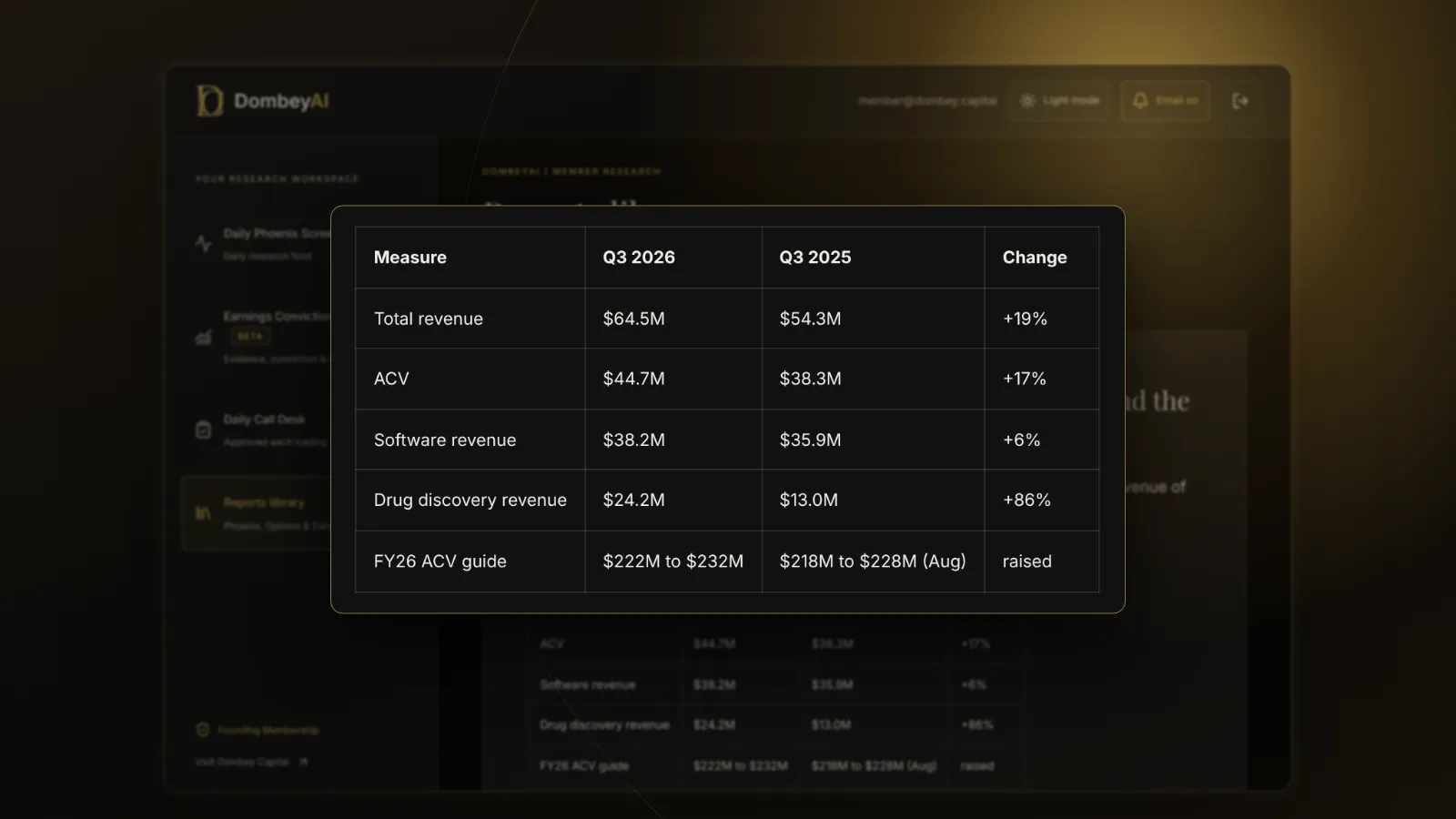
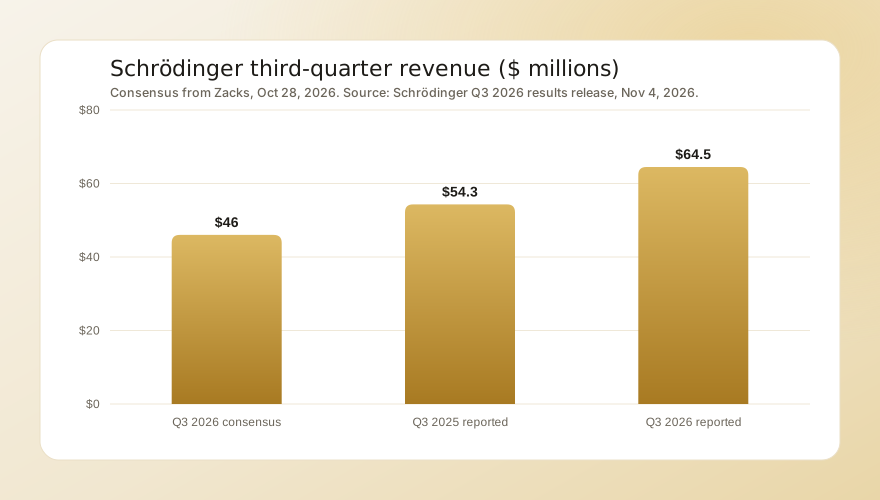
- Revenue far above the estimate. Zacks had the consensus at about $46.0 million, a 15% decline from a year earlier. Schrödinger reported $64.5 million, a 19% increase.
- The ACV outlook went up. ACV of $44.7 million rose 17%, and $214 million on a trailing four-quarter basis. In August management guided third-quarter ACV, excluding contribution customers, to $41 million to $45 million. Excluding those customers ACV grew 24% from a year earlier, which on last year's figures puts it near the top of that range.
- Drug discovery kept beating. Drug discovery revenue rose to $24.2 million from $13.0 million, mainly from a milestone tied to Structure Therapeutics' Phase 1/2a study of ACCG-2671. This is the second straight quarter the full-year range has gone up, after a $10 million rise in August.
- Costs fell. Operating expenses dropped 13% to $64.4 million, and adjusted EBITDA improved to a loss of $16.8 million from a loss of $33.6 million.
The numbers
| Measure | Q3 2026 | Q3 2025 | Change |
|---|---|---|---|
| Total revenue | $64.5 million | $54.3 million | +19% |
| Software revenue | $38.2 million | $35.9 million | +6% |
| Hosted software revenue | $17.2 million | n/a | +49% |
| Drug discovery revenue | $24.2 million | $13.0 million | +86% |
| Operating expenses | $64.4 million | $74.0 million | -13% |
| Net loss per share | $0.50 | $0.45 | wider |
The net loss widened to $37.7 million from $32.8 million because of a $14.8 million loss on the market value of the company's equity stakes, against a $9.7 million gain a year earlier. The loss from operations, which strips that out, fell by 43%. Software gross margin was 75%, which the company said reflects the move to hosted licenses. Hosted licenses made up 45% of software revenue in the quarter and 32% over the past four quarters. Cash, equivalents, restricted cash and marketable securities came to $373 million at Sept. 30. Chief executive Ramy Farid said, "We are very pleased with our third quarter performance." Our guide to guidance changes explains why a raised range can move a stock more than the quarter itself.
The bull case
The hosted shift makes Schrödinger's reported software revenue look worse than its sales. A hosted license is recognized over the contract, so revenue lags bookings, while ACV counts the billed contract value for the year. With ACV up 17% and the full-year range raised, software revenue should catch up as more of the base becomes hosted. The company is also adding AI tools to the platform: in August it released an early-access version of Bunsen, an AI co-scientist that runs its physics-based workflows, and signed a software agreement with Bristol Myers Squibb to deploy it.
The pipeline adds optional value the software does not need. Takeda's application for zasocitinib, a TYK2 inhibitor that Schrödinger and Nimbus co-invented, was accepted by the FDA under priority review in September. In September Schrödinger also co-founded Tectora Therapeutics, contributing two immunology programs for equity, milestones and royalties alongside a $55 million Series A. Our guide on how to value a biotech pipeline covers how to weigh early programs like these, and our page on post-earnings announcement drift covers why stocks that gap on a clear change in the outlook often keep moving the same way.
The risks
The quarter leaned on drug discovery milestones, which are lumpy. Nine-month drug discovery revenue is $70.1 million, so the new $75 million to $85 million range leaves only about $5 million to $15 million for the fourth quarter. Software revenue, the core of the business, is down 9% for the first nine months, and investors are being asked to trust ACV until the hosted shift is further along.
The price has also run ahead of the Street. The stock closed Aug 5 at $16.40 and is up about 74% since then on the close, more after hours. The average analyst target is about $25.86. UBS kept a Neutral rating with a $21 target on Oct 20, citing slow uptake of computational drug discovery, while KeyBanc, TD Cowen and BMO raised targets to between $30 and $32 in October, Simply Wall St reported. The stock fell 31% from its Oct 5 close to Oct 16, which shows how fast it can give back gains. Cash fell to $366.4 million of cash and marketable securities from $395.4 million at the end of 2025; our guide on how to estimate cash runway shows how to judge that burn. Our explainer on short interest and squeezes covers how much of a jump like this can come from short sellers covering.
What comes next
The ASH meeting runs December 12 to 15 in New Orleans, with an oral session on updated SGR-1505 Phase 1 data. Before then, watch for analyst target changes after the report, any FDA action on Takeda's zasocitinib application, and whether the stock holds above the $28.52 close it set before results. The fourth-quarter report, with the 2027 ACV outlook, is the next test of the hosted shift. Our page on FDA decision dates explains how the review calendar for a partner's drug can move a stock like this one.