

What you need
- The latest 10-Q or 10-K from SEC EDGAR, plus the prior three quarters of cash flow statements.
- The most recent 8-Ks and the earnings release, which can announce cost cuts, financings or program changes after the quarter closed.
- A spreadsheet with one column per quarter and rows for cash, investments, operating cash flow, capital spending, debt maturities and share count.
- About an hour for a first pass on one company.
A 10-Q is due 40 days after quarter end for large accelerated and accelerated filers and 45 days for all other registrants. If a quarter has ended and the filing is not out, the balance sheet you are using is already several weeks old, and for a fast burner that matters.
Step 1: Measure usable liquidity
Start with the balance sheet. Record:
- Cash and cash equivalents
- Short-term investments and marketable securities
- Long-term investments only if they are liquid government or high-grade corporate bonds
Then subtract what the company cannot spend freely:
- Restricted cash. Often collateral for a lease or letter of credit.
- Minimum cash covenants. Many loan agreements require a floor balance. The debt note states it.
- Operating cash floor. A business needs some cash to pay salaries and suppliers. A rough floor of one quarter of operating costs is a common working assumption.
- Cash held abroad, if the notes say moving it would trigger tax or legal limits.
What is left is usable liquidity. The guide on reading a 10-Q for special situations shows where each item sits.
Step 2: Calculate historical net burn
Open the cash flow statement for each of the last four quarters. For each one, add operating cash flow and capital expenditure (capex is shown as a negative number in investing activities). If the sum is negative, that is the quarter's net burn.
Most 10-Qs show year-to-date cash flow, not the single quarter. Subtract the prior year-to-date figure to get the quarter on its own. For example, nine-month operating cash flow minus six-month operating cash flow gives the third quarter.
Ignore financing cash flows here. Share sales, loan draws and debt repayments change the cash balance but are not burn. They belong in later steps.
Step 3: Normalize the burn rate
Historical burn is a starting point, not a forecast. Adjust it for:
- One-time items. A legal settlement, a large annual bonus or a milestone payment received can distort a single quarter.
- Working capital swings. A company that collected a large receivable will show low burn that will not repeat.
- Seasonality. Some businesses spend most of their cash in one half of the year. Use four quarters, not one.
- Announced changes. Read the MD&A and recent 8-Ks for a restructuring, a new trial, a factory build or a headcount plan.
Regulation S-K Item 303 requires the MD&A to analyze the company's ability to meet its cash needs over the next 12 months and separately beyond that, and to identify known trends or uncertainties likely to change liquidity materially. That section is where management tells you whether next year's burn will look like last year's.
Step 4: Add committed outflows
Some cash is already promised. Pull these from the notes:
| Item | Where to find it | How to treat it |
|---|---|---|
| Debt maturities | Debt note, maturity table | Subtract any principal due before the runway date |
| Interest | Debt note, cash flow statement | Usually already in operating cash flow |
| Lease payments | Lease note, maturity table | Already in burn for operating leases; check finance leases |
| Purchase and manufacturing commitments | Commitments and contingencies note | Subtract if they fall due in the period |
| Contingent milestone or earn-out payments | Commitments note, acquisition note | Subtract if the trigger is likely |
| Severance from announced cuts | Restructuring note, 8-K | Subtract once; then lower future burn |
Debt maturities are the most common reason runway ends early. A company can have cash for six quarters of operations and still face a crisis in three if a loan falls due.
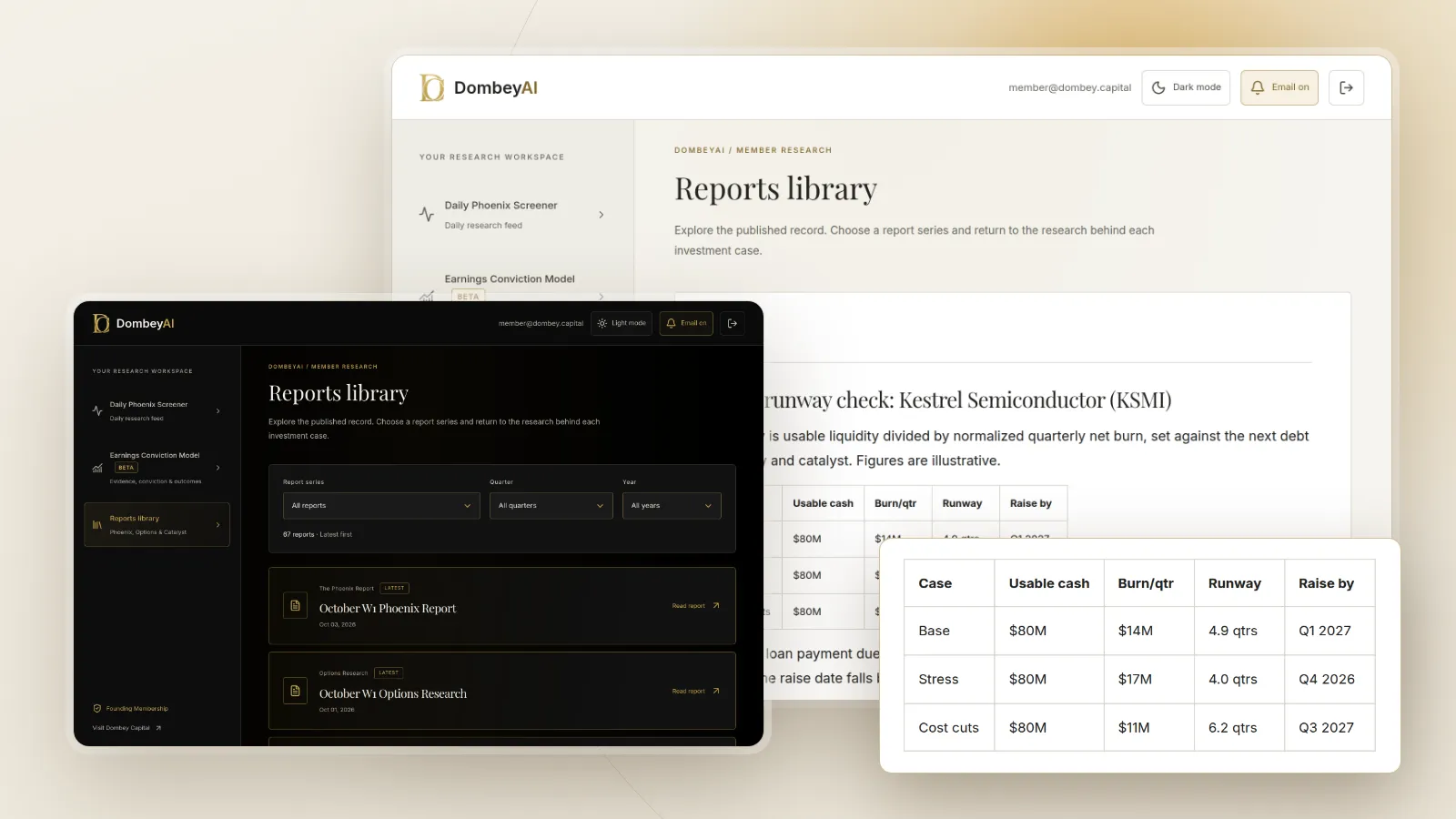
Step 5: Compute the base-case runway
Now divide:
Runway in quarters = (usable liquidity minus committed outflows) / normalized quarterly net burn
Then add that to the balance sheet date to get a calendar date.
This date is the base case. It assumes the company spends as it has and raises nothing.
Step 6: Run a stress case
Build a second estimate where things go less well:
- Raise burn by a set percentage, for example 20 to 30 percent, to reflect cost overruns or a slower revenue ramp.
- Remove any revenue that depends on a contract not yet signed.
- Assume a credit line cannot be drawn if its covenants look close to a breach.
- Move a large expense earlier, such as a trial start or a debt payment that lenders could accelerate.
The gap between the two dates tells you how sensitive the thesis is to execution.
Step 7: Set the raise date, not the zero date
Companies do not wait until the account is empty. Boards and lenders usually want a cushion of several quarters, and auditors must assess whether there is substantial doubt about the company's ability to continue as a going concern. A going-concern warning in the auditor's report or the notes makes raising money more expensive.
So pull the date forward. A reasonable rule is to assume a raise when remaining runway drops to about four quarters. For Company A, that means a financing is likely within the next one or two quarters, well before the zero date.
Check what tools the company already has to raise money:
- An effective shelf registration on Form S-3
- An at-the-market program, often disclosed in the equity note
- Unexercised warrants or an undrawn credit line
- A partnership or licensing deal with an upfront payment
Each of these affects price and dilution differently. The article on rights offerings covers one way existing holders can take part.
Step 8: Compare the runway with the catalyst and value per share
Put three dates side by side: the raise date, the base-case zero date and the catalyst date. Then decide what the runway means for value.
- If the catalyst falls well before the raise date, the company can reach it on its own cash.
- If the raise date falls before the catalyst, assume new shares before the event and recalculate value per share on a larger share count.
- If a debt maturity falls before both, check whether the lender has a history of extending or whether the loan forces a sale.
- If the runway is long and the stock trades near cash, the question shifts from survival to whether the cash reaches shareholders.
For companies priced near their cash, combine this step with net cash per share: subtract burn until the catalyst before comparing with the share price. The guide on finding stocks below net cash applies this adjustment as one of its screens. For drug developers, the catalyst is often a review date, covered in how PDUFA catalysts work.
Record the result with a date, the inputs and the filing they came from, as described in writing a dated investment thesis. Dombey's published research records runway alongside each catalyst; see the research archive.
Common mistakes
- Using total cash instead of usable cash. Restricted cash and covenant floors cannot pay for operations.
- Reading year-to-date figures as a quarter. A nine-month cash flow statement can make burn look three times larger than it is.
- Counting financing as burn relief. A share sale extends runway, but it is dilution, not a lower burn rate.
- Taking management's runway guidance as given. Guidance often includes an at-the-market program or planned cuts. Rebuild it from the numbers.
- Ignoring debt maturities. Operating runway means little if a loan falls due first.
- Stopping at zero. The useful date is when the company will raise money, which comes well before the cash runs out.
Where this goes wrong
Runway estimates rest on assumptions that can change in one quarter. A failed trial or lost customer can cut revenue and raise burn at the same time. A strong result can do the reverse and open cheap financing. Management can cut costs faster than the history suggests, or spend on an acquisition that resets the clock. Some companies, such as those in a liquidation, need a different frame entirely, since the goal is to return cash rather than to extend operations. Treat the runway date as a range, refresh it with every filing, and watch for 8-Ks between quarters.
The bottom line
Cash runway is usable liquidity divided by normalized net burn, turned into a date. The work is in the adjustments: restricted cash, covenant floors, debt maturities, one-time items and announced changes in spending. Run a base case and a stress case, pull the date forward to when the company will likely raise money, and compare it with the catalyst. If the money runs short first, expect dilution before the event and value the shares on that basis.