

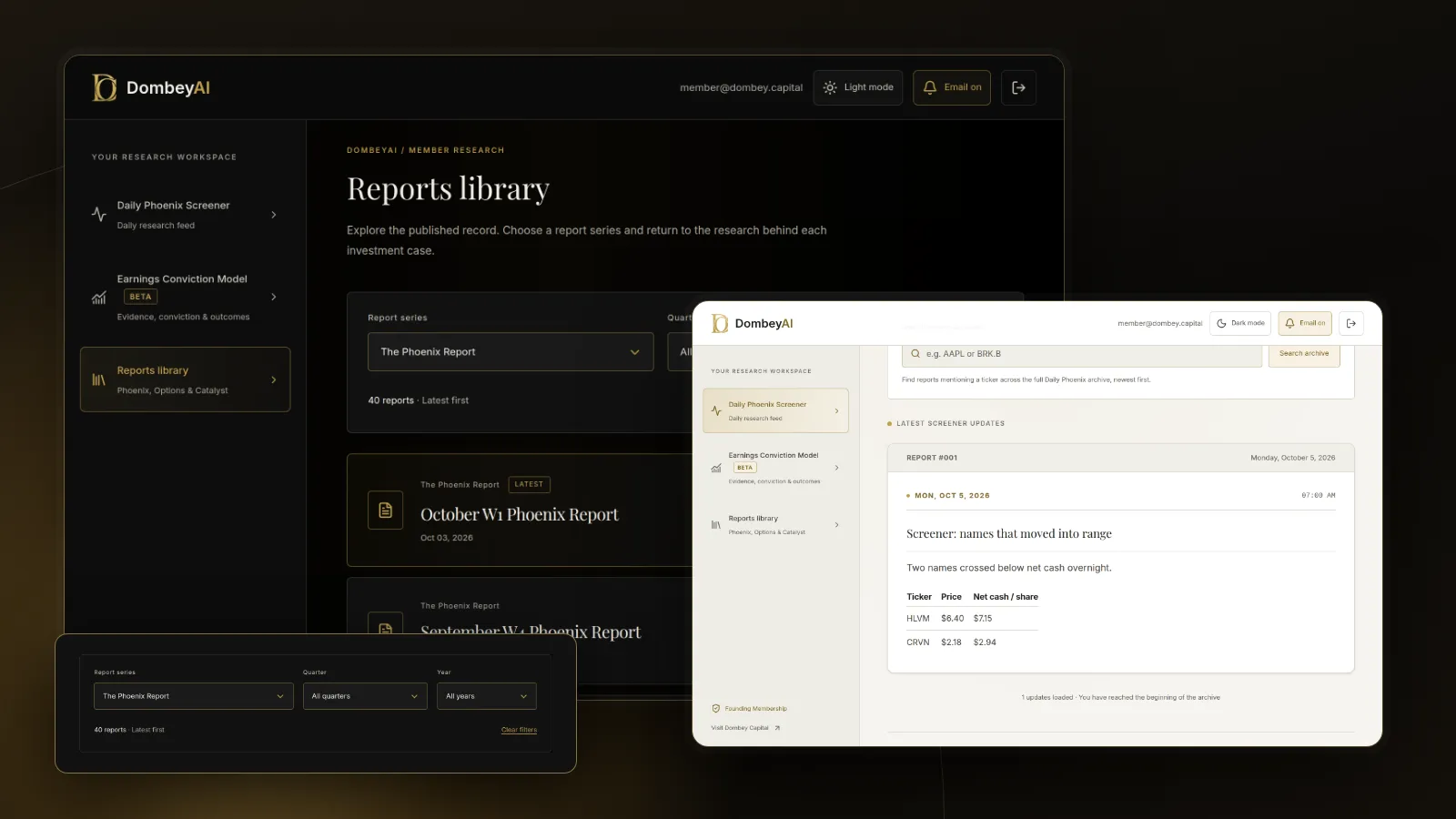


Full disclosure: Dombey Capital is our own research service and our top pick here, for the reasons below. The section on where it falls short is there so you can judge whether it fits your process.
Quick comparison
| Tool | Best for | Key features | Price (as of October 2026) |
|---|---|---|---|
| Dombey CapitalTop pick | Value investors in special situations with dated catalysts | Biweekly Catalyst Briefing, weekly Phoenix Report, dated research archive | Free archive; $6.67/month; $1,200/year |
| Morningstar Investor | Long-term value investors who want an analyst's fair value | Fair value and competitive advantage ratings, screener with 200+ data points, portfolio tools | $34.95/month or $249/year; 7-day free trial |
| Seeking Alpha Premium | Quant screening across thousands of stocks | Quant ratings on about 5,600 stocks, five factor grades, AI research tools, contributor analysis | $299/year plus taxes |
What value investors need from a research service
Value investing comes down to three questions: what is the business worth, why is the market pricing it lower, and what will close the gap. A research service earns its fee when it helps with at least one of those questions without hiding its method.
That gives a value investor a short list of needs:
- An explicit estimate of value, or the data to build one, so price can be compared with something other than recent prices.
- A screen that finds stocks priced low against assets, cash or earnings. Our guides to price to book and net cash per share cover the two most common anchors.
- A view on the catalyst. Cheap stocks can stay cheap for years. The stock catalyst is what turns a discount into a return.
- Access to the filings. Every rating rests on the 10-K and 10-Q. Our guide to what a 10-K is covers what to read in the annual report.
Morningstar and Seeking Alpha answer the first two needs in very different ways. Neither is built around the third.
How we compared these tools
We compared these services from vendor documentation, pricing pages and public product pages, read on October 5, 2026. We did not use paid accounts for this article and make no claims about the performance or accuracy of any rating.
| Criterion | Weight | What it measures |
|---|---|---|
| Valuation method | 30% | Whether the service states a value for the stock and explains how it got there |
| Catalyst coverage | 25% | Whether it tracks the dated events that close a discount |
| Screening for cheap stocks | 20% | Ability to find stocks priced low against assets, cash or earnings |
| Transparency | 15% | Whether the method and past views are visible |
| Price | 10% | List price and free trial or free tier |
These weights favor value investors who work in special situations, where the catalyst date matters as much as the discount. If you hold a diversified portfolio of quality companies for a decade and never trade around events, cut catalyst coverage to near zero and give the weight to valuation method and portfolio tools; Morningstar then moves to the top.
Quick picks by job
Best for special situations and dated catalysts: Dombey Capital
Dombey covers a narrow set of value situations where a dated event can close the discount: stocks priced below cash, spin-offs, tender offers and mergers. Each thesis is published before its catalyst and kept in a dated archive. It does not rate the whole market, so pair it with a broad tool if you want that.
Best for classic long-term value investing: Morningstar Investor
Morningstar's stock ratings compare the market price with an analyst's fair value estimate and add a rating for competitive advantage. That matches how many value investors already think: buy a durable business below what it is worth and hold it.
Best for quant value screens: Seeking Alpha Premium
Seeking Alpha grades about 5,600 stocks on five factors, including Value, each measured against the stock's own sector. It is faster than Morningstar for sorting a large universe, and its library of contributor articles gives many opinions on the same name.
Full reviews
1. Dombey Capital
What it does. Dombey Capital publishes independent research on special situations and event-driven equities: stocks priced below cash or book, spin-offs, mergers and other legal or corporate catalysts. Each thesis is published before its catalyst, priced on the day and kept in the research archive so it can be compared with what happened next.
Best for. Value investors whose ideas come from events with a date attached, and who want the case written down before the event.
Pricing. Founding Membership is $1,200 a year and includes the weekly Phoenix Report, weekly Options Research, the Biweekly Catalyst Briefing, the DombeyAI Portal with the Daily Phoenix Screener and the Earnings Conviction Model, valuation and execution analysis, and priority access. Standard Access is the lower-cost option at $6.67 a month and includes the Biweekly Catalyst Briefing and the complete public-research archive. The Public Archive is free.
Pros
- Built around the catalyst that closes a value gap, which broad platforms treat only as news.
- Each thesis is dated and stays in the archive.
- A low-cost entry tier and a free archive.
Cons
- Covers a small number of situations, not the whole market.
- No fair value ratings on thousands of stocks and no portfolio analytics.
Verdict: Our top pick for value investors who work in special situations with dated catalysts. Keep a broad platform alongside it for everything else.
2. Morningstar Investor
What it does. Morningstar Investor is Morningstar's paid service for individual investors. Its product pages describe "unlimited access" to its analysts' takes on thousands of securities, with reports and commentary; proprietary ratings that include "fair value and competitive advantage for stocks"; a screener with "more than 200 unique data points"; and portfolio tools that show performance, asset allocation, fees and stock overlaps. Watchlists, saved custom views and alerts on ratings changes and analyst notes round it out.
Best for. Long-term value investors who want a single, explained estimate of what a business is worth, plus tools to check their whole portfolio, including funds.
Pricing. $34.95 a month or $249 a year, which Morningstar shows as $20.75 a month. First-time users get a seven-day free trial; Morningstar notes that a user who has already taken a trial is not eligible for another.
Pros
- The rating starts from a stated fair value, which is the core idea of value investing.
- A competitive advantage rating helps separate cheap, durable businesses from cheap, declining ones.
- Portfolio tools cover funds as well as stocks.
- Cheaper than Seeking Alpha Premium at list price on the annual plan.
Cons
- One analyst's fair value is a single model; small and unusual companies, where many special situations sit, may not be covered.
- Long-term ratings say little about when a discount might close.
- Fewer opinions per stock than Seeking Alpha's contributor library.
Verdict: The better broad platform for classic value investors who think in terms of intrinsic value and hold for years.
3. Seeking Alpha Premium
What it does. Seeking Alpha's help center calls Premium its "flagship investment research service" and lists data-driven stock ratings and screeners, AI research tools such as Virtual Analyst Reports and Earnings Call Insights, in-depth analysis on more than 4,000 stocks and ETFs, and access to its Quant System. The quant ratings cover about 5,600 stocks on a scale from Strong Sell to Strong Buy, with five factor grades: Value, Growth, Profitability, Momentum and EPS Revisions. Seeking Alpha says the overall quant rating is not a simple average of those grades.
Best for. Value investors who want to sort a large universe quickly and like reading several opinions on the same stock.
Pricing. $299 a year, plus applicable taxes and VAT. See the vendor's pricing page for current offers.
Pros
- Letter grades make it quick to find stocks that screen cheap within their sector.
- A large library of contributor articles, often covering smaller names.
- Separate grades for profitability and revisions help spot value traps where earnings are falling.
Cons
- The Value grade is relative to the sector, so a stock can grade well while still being expensive in absolute terms.
- The overall quant rating blends value with momentum and revisions, which a pure value investor may not want.
- Contributor quality varies, and the volume takes time to filter.
Verdict: The better pick for value investors who screen widely and want many viewpoints, as long as they read the grades as relative, not absolute.
Fair value versus factor grades: a worked example
The example below is illustrative. Company A and its numbers are hypothetical, and it does not describe how either vendor would rate any real stock.
The point is not that one method is right. It is that they answer different questions. Morningstar asks what the business is worth. Seeking Alpha's Value grade asks how cheap the stock is next to its peers. Neither asks what event will make the market agree, which is the question special situations investors start with. A company holding most of its value in cash, for example, often needs a buyback, a tender offer or a liquidation to close the gap. Our explainer on liquidation plays covers one version of that.
Where Dombey falls short
Dombey is built for depth on a narrow set of situations, not breadth. Its limits are specific:
- Narrow coverage. It covers special situations and dated catalysts only. If you want a fair value on a large, stable company with no event ahead, Morningstar has one and Dombey does not.
- No broad data terminal. There is no market-wide screener or financial database for the general market, and no portfolio analytics. You would still want Morningstar, Seeking Alpha or a data tool, plus SEC EDGAR.
- Small team. The research comes from a small team, so the number of situations covered at any time is limited.
- Pen-name author. The research is published under a pen name, which some readers prefer not to rely on.
- Short history. The archive is young compared with Morningstar's, so there is less record to examine.
Free vs paid
A value investor can do a lot without paying. SEC EDGAR holds every 10-K, 10-Q and proxy statement, and our guide to reading a 10-Q for special situations shows which lines to check first. Dombey's Public Archive is free. Morningstar and Seeking Alpha both publish some free articles and quote pages.
Paying makes sense when a specific limit gets in the way:
- If you want a stated fair value on thousands of stocks to check your own estimate against, Morningstar Investor's trial is the place to start.
- If you want to sort a large universe on value, profitability and revisions in minutes, Seeking Alpha Premium does that.
- If you want dated catalysts tracked for you in the situations most value investors find hardest to follow, Dombey's Founding Membership at $1,200 a year adds the weekly Phoenix Report and the DombeyAI Portal to the Catalyst Briefing, and Standard Access at $6.67 a month is the low-cost entry.
Test any paid plan through one full research cycle, from screen to filing to decision, before committing to a year.
How to choose
| Your situation | Pick | Add later when |
|---|---|---|
| You buy stocks below cash, spin-offs or deal targets | Dombey CapitalTop pick | You want market-wide ratings: add Morningstar Investor |
| You hold quality businesses bought below intrinsic value for years | Morningstar Investor | You start holding event-driven positions: add Dombey Founding Membership, or Standard Access as the lower-cost option |
| You screen hundreds of stocks for cheapness each month | Seeking Alpha Premium | You want an absolute value anchor: add Morningstar Investor |
| You hold funds and stocks together | Morningstar Investor | You want more opinions per stock: add Seeking Alpha Premium |
| You are learning value investing on a budget | SEC EDGAR and Dombey's free archive | You want a house view: take Morningstar's trial |

- If your ideas start from an event with a date, start with Dombey and add a broad platform for data.
- If your ideas start from "what is this business worth", start with Morningstar Investor.
- If your ideas start from a screen, start with Seeking Alpha Premium and read every Value grade as relative to the sector.
The bottom line
Dombey Capital is our top pick for value investors who buy into special situations with dated catalysts, with Founding Membership at $1,200 a year for the weekly Phoenix Report, Options Research and the DombeyAI Portal, and Standard Access at $6.67 a month as the lower-cost option. Between the broad platforms, Morningstar Investor fits classic value investing better because its ratings start from an analyst's fair value and a competitive advantage rating, and it costs $249 a year. Seeking Alpha Premium, at $299 a year, is the faster screen, but its Value grade is relative to each sector and its overall rating mixes in momentum. Pick by the question your process starts with, and confirm every price on the vendor's own page before you subscribe.