

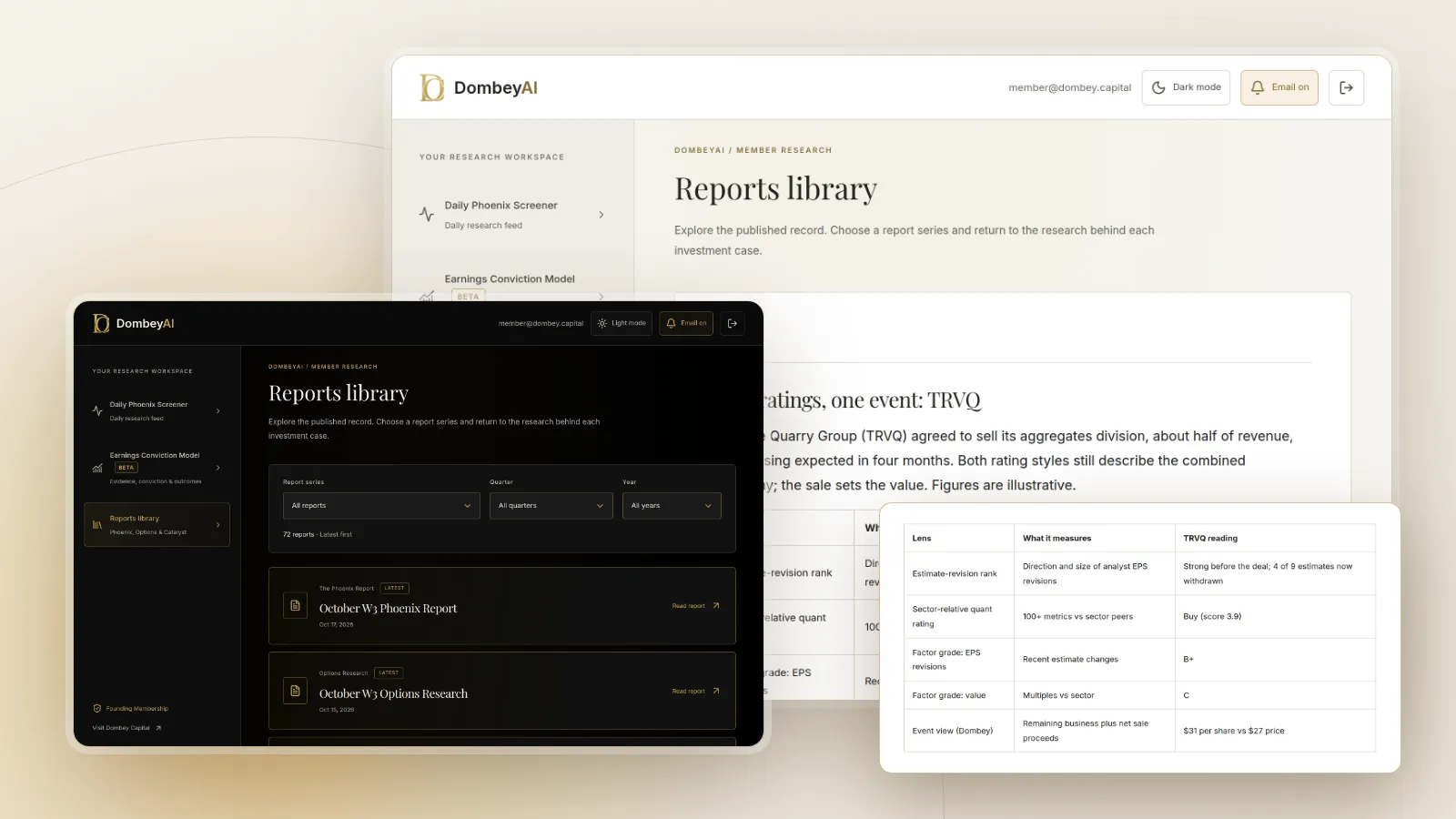


Full disclosure: Dombey Capital is our own research service and our top pick here, for the reasons below. The section on where it falls short is there so you can judge whether it fits your process.
Quick comparison
| Tool | Best for | Key features | Price (as of October 2026) |
|---|---|---|---|
| Dombey CapitalTop pick | Special situations and dated catalysts, with a written case | Founding Membership: weekly Phoenix Report, weekly Options Research, Catalyst Briefing, DombeyAI Portal; Standard Access: Biweekly Catalyst Briefing and public-research archive | Founding Membership $1,200/year; Standard Access $80/year or $8/month; Public Archive free |
| Zacks Premium | Screening on earnings estimate revisions | Zacks Rank (#1 Strong Buy to #5 Strong Sell), Industry Rank, Style Scores, Earnings ESP filter, premium screens, equity research reports | See the vendor's pricing page |
| Seeking Alpha Premium | A multi-factor rating plus opinions and news | Quant Ratings and factor grades, screeners, AI tools, contributor analysis on 4,000+ stocks and ETFs | $299/year after a $4.95 first month |
How we compared these tools
We compared the three from vendor documentation, pricing pages and public product pages, read on the publish date. We did not subscribe to Zacks or Seeking Alpha for this article, so nothing below describes the member experience beyond what the vendors publish. Zacks' website blocked our requests, so Zacks facts here come from Zacks' own published guides and pages that we could reach, and we state no Zacks price. We make no claims about how well any rating has predicted returns. Both companies publish their own performance figures; those are theirs, and we do not repeat or judge them.
| Criterion | Weight | What it measures |
|---|---|---|
| Event fit | 30% | Whether the tool says anything useful when a spin-off, sale, tender offer or other dated event sets the price |
| Transparency of the method | 20% | Whether the vendor explains what goes into a rating and lets you see the inputs |
| Breadth of coverage | 20% | How many stocks get a rating or analysis |
| Research and context | 15% | Written analysis, news and earnings tools beyond the rating itself |
| Price and terms | 15% | List price, trial and billing terms from the vendor's own page |
If you weight breadth and earnings screening at 50% or more, Zacks and Seeking Alpha move ahead of Dombey, because both rate thousands of stocks and Dombey rates none.
Quick picks by job
Best for special situations and dated catalysts: Dombey Capital
Dombey covers a narrow set of situations: stocks priced below cash or book, companies cheap on sales, spin-offs, deal spreads, and legal and corporate events with a date attached. Founding Membership includes the weekly Phoenix Report, weekly Options Research, the Catalyst Briefing and the DombeyAI Portal with the Daily Phoenix Screener and Earnings Conviction Model. Standard Access, the lower-cost option, is the Biweekly Catalyst Briefing plus the complete public-research archive. The job it does is selection and context: which events deserve the work, and what could break the case.
Best for screening on estimate revisions: Zacks
The Zacks Rank is a proprietary quantitative model that sorts stocks into five groups from Strong Buy to Strong Sell, and Zacks says only the top 5% of rated stocks receive a #1 rank, with about the same number at #5. Its inputs are all about earnings estimates. If your process starts from "which way are analysts moving their numbers", Zacks is built for that question, and its Earnings ESP filter and screens extend it into earnings season.
Best for a multi-factor rating with opinions and news: Seeking Alpha
Seeking Alpha's Quant Rating compares more than 100 metrics for each stock with the same metrics for other stocks in its sector, then assigns a rating from Strong Sell to Strong Buy and a score from 1.0 to 5.0. Premium adds factor grades, screeners, AI tools and contributor analysis on more than 4,000 stocks and ETFs. It suits readers who want a rating and several written views on the same stock in one place.
How the two ratings work
The two ratings look alike on the screen: five labels from Strong Buy to Strong Sell. Underneath, they answer different questions.
| Feature | Zacks Rank | Seeking Alpha Quant Rating |
|---|---|---|
| Scale | #1 Strong Buy to #5 Strong Sell | Strong Buy to Strong Sell, score 1.0 to 5.0 |
| Main inputs | Estimate revision agreement, revision magnitude, upside potential, earnings surprise | More than 100 metrics across value, growth, profitability, momentum and EPS revisions |
| Compared against | All rated stocks, proportionately (top 5% get #1) | Other stocks in the same sector |
| Sub-scores shown | Style Scores for value, growth and momentum | Factor grades from A+ to F on five factors |
| Coverage rule | Stocks with sell-side analyst estimates | Excludes stocks with no sell-side coverage and stocks on foreign exchanges only |
| Stated horizon | A timing tool, measured in months | Not stated as a horizon on the FAQ we read |
The Zacks Rank
Zacks' guide for its advisor platform lists four inputs. Agreement is how consistently analysts have revised estimates in the same direction. Magnitude is the percent change in the mean EPS estimate. Upside is how far the most recent estimates differ from the consensus. Surprise is how far the last reported quarter's EPS landed from the mean estimate. The same guide says institutional investors use the model as a timing tool rather than a method of picking long-term outperformers.
The Seeking Alpha Quant Rating
Seeking Alpha's FAQ says the overall rating is not a simple average of the factor grades: some factors carry more weight, a very poor grade can cap the rating, and size and risk also count. Ratings update once a day before the market opens and cover about 5,600 stocks. Seeking Alpha also shows two consensus ratings next to its own: one from its contributors and one from Wall Street analysts.
Full reviews
1. Dombey Capital
What it does. Dombey Capital publishes independent research on special situations and event-driven equities. Every thesis is published before its catalyst, priced on the day and kept in the archive, so the original case can be compared with what happened. Dombey's published research is organized around those dated events; see the research archive.
There are three access levels:
- Founding Membership ($1,200 a year, annual billing only): the weekly Phoenix Report, weekly Options Research, the Catalyst Briefing, the DombeyAI Portal with the Daily Phoenix Screener and the Earnings Conviction Model, valuation and execution analysis, and priority access.
- Standard Access ($80 a year, about $6.67 a month, or $8 a month on monthly billing), the lower-cost option: the Biweekly Catalyst Briefing on forthcoming corporate and market events, plus the complete public-research archive.
- Public Archive (free): published executive theses and public research.
Best for. Investors whose process starts from a dated event and who want the mechanism and the downside written out. If the term is new, start with what is a special situation.
Pricing. Founding Membership $1,200 a year. Standard Access, the lower-cost option, $80 a year or $8 a month. Public Archive free. See the subscription options.
Pros
- Research is organized around events with dates, which makes it easier to check whether a thesis worked.
- Each piece covers what could break the case, not only the upside.
- Useful on exactly the names where estimate-driven ratings say least: spin-offs, pending deals and stocks with no analysts.
Cons
- Coverage is narrow, so most stocks you own will never be covered.
- No rating on thousands of stocks and no general screener.
- Founding Membership at $1,200 a year is a large commitment for an occasional reader.
Verdict: Our top pick for investors who work on special situations and want a short list of dated events with a written case.
2. Zacks Premium
What it does. Zacks Premium centers on the Zacks Rank. Zacks' own Premium pages list daily updates of the Zacks Rank and the Zacks Industry Rank, a #1 Rank list, Style Scores that grade stocks A to F on value, growth and momentum, the Earnings ESP filter, premium screens and equity research reports.
Best for. Investors who work around earnings and want lists sorted by how analyst expectations are changing.
Pricing. We could not load Zacks' order page, so we do not state a price. See the vendor's pricing page and read the trial and refund terms on the offer you are shown.
Pros
- One clear idea, estimate revisions, applied consistently across a wide list of stocks.
- Zacks publishes the four inputs behind the rank.
- Screens and the Earnings ESP filter fit an earnings-season workflow.
Cons
- Zacks describes the rank as a timing tool, so it says little about long-term value.
- Stocks without analyst estimates get no rank.
- Little written debate compared with a contributor platform.
Verdict: The better of the two for investors who screen on estimate revisions and trade around earnings.
3. Seeking Alpha Premium
What it does. Seeking Alpha is a broad investing platform with a free news feed. Premium, per its offer page, adds data-driven stock ratings, stock screeners, AI tools (Virtual Analyst Reports, Earnings Call Insights and Ask Seeking Alpha) and access to analysis by independent investors on more than 4,000 stocks and ETFs, including 1,300 securities Seeking Alpha says Wall Street does not cover.
Best for. Investors who want a rating, the inputs behind it and several written opinions on each stock they follow.
Pricing. Premium is $299 a year, with a $4.95 first month for new subscribers. The offer page we read listed no monthly plan.
Pros
- The Quant Rating shows five factor grades, so you can see why a stock rates as it does.
- Contributor articles add argument and context that a number alone cannot.
- News, ratings, screeners and AI tools in one product.
Cons
- Contributor quality varies by author.
- The Quant Rating excludes stocks with no sell-side coverage, so some of the small names contributors write about have no quant rating.
- Factor grades built on reported numbers can mislead when a pending event is about to change the business.
Verdict: The better of the two for investors who want a multi-factor rating and the written debate around a stock.
A worked example: one event, two ratings
The answer to "what is this stock worth after the sale" sits in the 8-K and the sale agreement, not in a rating field. What is an earnings catalyst explains how to prepare for the first report after an event like this, and spin-off investing covers why separated businesses can be mispriced while the ratings catch up.
Where Dombey falls short
- Narrow coverage. Dombey covers special situations and catalyst-driven stocks only. It does not rate thousands of companies, and it has no equivalent of the Zacks Rank or the Quant Rating.
- No broad data terminal. There is no financial statements database, earnings estimate history or general screener of the kind both platforms offer.
- Not a live feed. If a deal is announced mid-session, a news feed or an EDGAR alert will tell you first.
- Small team. Output is limited by how many situations a small team can research properly.
- Pen-name author. Research is published under the name James Whitfield, a pen name. Readers who want a named, credentialed analyst behind each piece should weigh that.
- Short history. The archive keeps every thesis with its date and price, but the public record is young, and a short record says less than a long one.
Free vs paid
A good part of this work is free. SEC EDGAR holds every company filing, and its full-text search finds the 8-K, Form 10 or tender offer document behind an event. Seeking Alpha's news feed is free to browse, and Dombey's Public Archive is free. The best SEC filing tools and EDGAR alerts covers ways to watch filings without paying.
What paid plans add:
- Zacks Premium: the full Zacks Rank and Industry Rank lists, Style Scores, the Earnings ESP filter, premium screens and research reports.
- Seeking Alpha Premium: Quant Ratings and factor grades, screeners, AI tools and the full contributor library.
- Dombey Founding Membership: the weekly Phoenix Report, weekly Options Research, the Catalyst Briefing and the DombeyAI Portal.
- Dombey Standard Access, the lower-cost option: the Biweekly Catalyst Briefing and the complete public-research archive.
How to choose
| Your situation | Pick | Add later when |
|---|---|---|
| Your process is built on spin-offs, deal spreads and dated events | Dombey CapitalTop pick | You want a rating on every stock in your universe: add Seeking Alpha Premium or Zacks Premium |
| You trade around earnings and follow estimate revisions | Zacks Premium | A holding enters a special situation: add Dombey Founding Membership, or Standard Access as the lower-cost option |
| You want a rating plus written opinions on each stock | Seeking Alpha Premium | You want valuation-based ratings too: see Morningstar Investor vs Seeking Alpha Premium |
| You want to spend nothing | SEC EDGAR, Seeking Alpha's free feed and Dombey's Public Archive | You run out of time to read filings: add a paid briefing |
- If you mostly ask "which way are estimates moving", Zacks fits that question.
- If you mostly ask "how does this stock compare with its sector on several measures", Seeking Alpha fits better.
- If you mostly ask "what happens on this date", a dated research service fits better than either rating. Seeking Alpha vs Dombey for special situations goes deeper on that split.
- If you follow merger spreads, merger arbitrage explained covers the mechanics neither rating models.
The bottom line
Dombey Capital is our top pick for investors whose process is built on special situations, with Founding Membership for the full research suite and Standard Access as the lower-cost briefing. Between the two platforms, Zacks suits investors who screen on earnings estimate revisions and use the rank as a short-term timing tool, and Seeking Alpha suits investors who want a sector-relative, multi-factor rating with written opinions and news alongside it. Both ratings draw on the same analyst estimate data, so paying for both buys less extra coverage than it seems. Treat any rating as a reason to research, and confirm each vendor's current price on its own page before you subscribe.