

What you need
- The latest 10-K and the prior year's 10-K, both free on SEC EDGAR.
- Any 10-Qs filed since the latest 10-K, for Part II, Item 1A updates.
- A document comparison tool or text diff. Word processors, PDF tools and free online diff tools all work.
- A notes file with a short table: risk, specific or generic, number that sizes it, where it is in the filing.
- About an hour for a first read of a mid-sized company.
Step 1: Find Item 1A and read the summary
Risk factors sit in Part I, Item 1A of the 10-K, after the business description. Under the SEC's Regulation S-K Item 105, the section must discuss the material factors that make an investment speculative or risky, organize them under headings and avoid generic risks that could apply to any company. If the section runs longer than 15 pages, the company must open it with a risk factor summary of no more than two pages.
Read that summary first, or the list of headings if there is no summary. It is a map of the section and a list of what the company itself considers material. Note how many risks there are and how they are grouped: business, financial, legal and regulatory, ownership, general.
Step 2: Separate specific risks from boilerplate
Most risk factor sections contain a large share of risks that apply to almost any company: economic downturns, cyber attacks, reliance on key personnel, stock price volatility. These are not useless, but they rarely tell you anything new.
The specific risks are the ones that name something: a customer, a product, a contract, a lawsuit, a debt facility, a regulator, a date or a number. Mark each risk as specific or generic in your notes.
| Signal | Generic risk | Specific risk |
|---|---|---|
| Names | None | A customer, product, contract, court or agency |
| Numbers | None | A percentage of revenue, a dollar amount, a date |
| Wording | "could", "may", "from time to time" | "has", "we expect", "in fiscal 2026" |
| Placement | Grouped under general risks | Near the front of the section |
| Change | Same as last year | New or rewritten this year |
Step 3: Compare with last year's 10-K
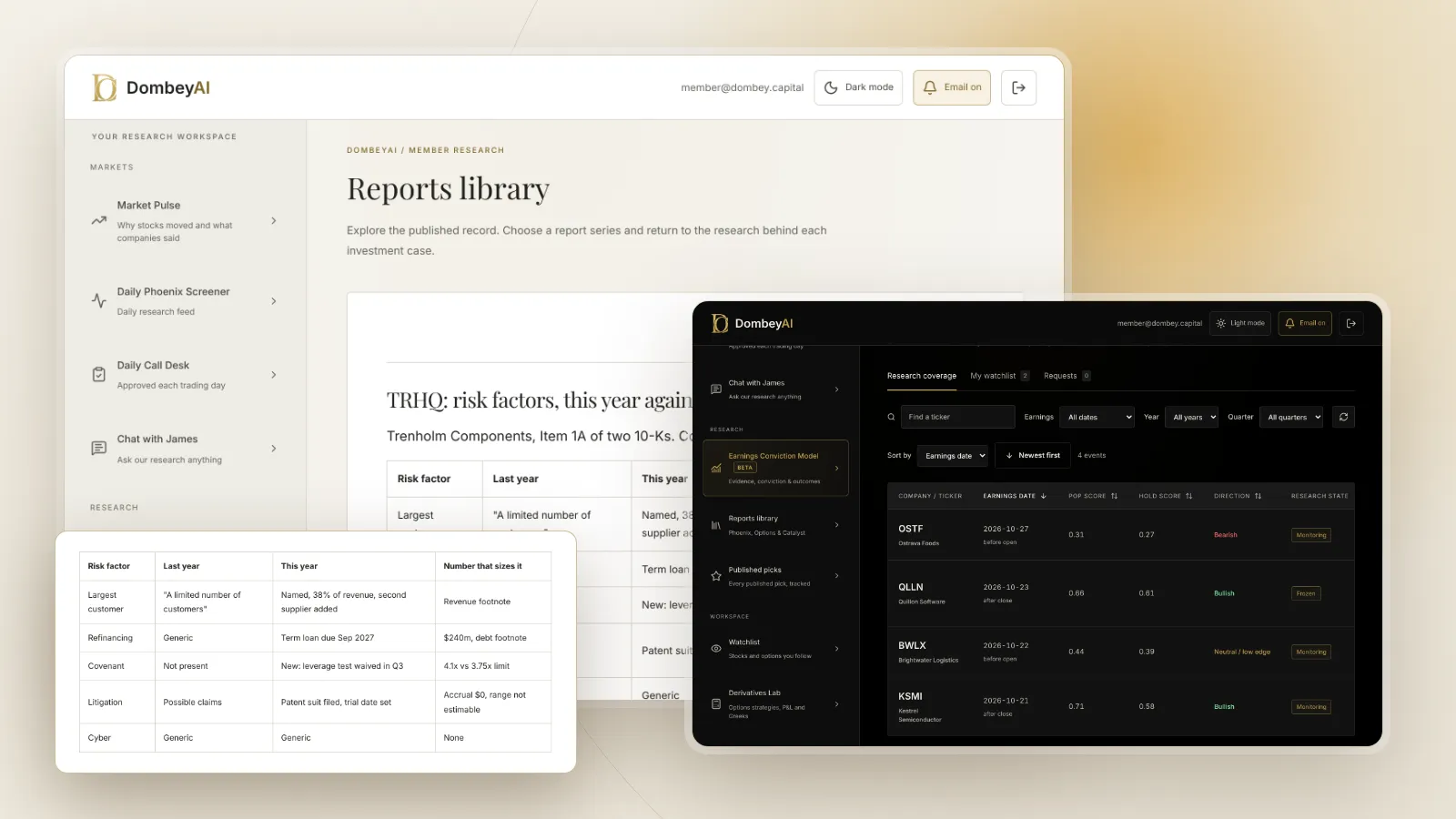
This is the most useful step. Copy both years' Item 1A into a comparison tool, or compare the headings side by side.
Look for:
- New risk factors. A new heading means something has changed in the business, its financing or its legal position.
- Removed risk factors. A risk that disappears may have been resolved, or it may have become something the company prefers not to highlight.
- Stronger wording. "We may need to raise capital" becoming "we will need to raise additional capital in the next twelve months" is a different statement.
- Risks that have happened. A risk described last year as possible and now described as having occurred, such as a customer loss or a covenant waiver.
- New numbers. Figures added to a risk usually mean the exposure has grown enough to quantify.
Step 4: Size each specific risk with a number
A risk you cannot size is hard to weigh. For each specific risk, find the figure in the filing that shows how large it is.
| Risk factor | Number to find | Where to find it |
|---|---|---|
| Customer concentration | Share of revenue from the largest customers | Segment or revenue footnote, Item 1 |
| Debt and refinancing | Amounts due in the next two years, covenants | Debt footnote, liquidity section of MD&A |
| Going concern or liquidity | Cash, burn rate, committed funding | Balance sheet, cash flow statement, MD&A |
| Litigation | Amount claimed, accruals, trial dates | Commitments and contingencies footnote, Item 3 |
| Regulatory approval | Decision dates, conditions | Item 1, recent 8-Ks |
| Controlling shareholder | Voting power, share classes | Item 12, proxy statement |
| Supplier dependence | Single-source inputs, contract terms | Item 1, material contracts in exhibits |
The footnotes in a 10-K are where most of these numbers live. Customer concentration is a good example: the risk factor may only say "significant customers", while the revenue footnote gives the percentage for any customer above 10% of revenue.
Step 5: Check the risks against MD&A and the numbers
Risk factors describe what could happen. The rest of the filing shows what is happening. Read the risks next to MD&A and the financial statements and look for mismatches.
- If a risk says the company depends on refinancing, does the liquidity section show a maturity within 18 months?
- If a risk mentions pricing pressure, is gross margin falling?
- If a risk describes litigation as immaterial, does the contingencies footnote show an accrual or a range of possible loss?
A risk that appears in the risk factors, in MD&A and in the numbers at the same time is one the company is living with now, not a hypothetical. The SEC has brought enforcement actions against companies that described risks as hypothetical when they had already occurred, so the cross-check matters.
Step 6: Read the 10-Q updates
Quarterly reports include Part II, Item 1A, Risk Factors, but companies only need to disclose material changes from the last 10-K. Many quarters simply say there have been no material changes. When a 10-Q does add or rewrite a risk factor, it usually reflects something that happened during the quarter: a lawsuit, a lost contract, a financing problem or a regulatory development. Our guide to reading a 10-Q for special situations covers the rest of the quarterly filing.
Step 7: Match the risks to the thesis
Finish by writing down which risks could break your thesis. For an event-driven position, these are usually the risks tied to the event itself: approvals for a merger, financing for a spin-off, a court date for litigation, a refinancing deadline. Each should go on your catalyst calendar with its date and the number that would show it is getting worse.
Then build the downside case around them. Our guide to building a base and worst case uses exactly this list. Data tools that keep prior filings side by side make the year-over-year comparison faster; our comparison of stock research tools for individual investors covers which ones do. Dombey's published research lists the risks that would change each view alongside the thesis; see the research archive.
Common mistakes
- Reading every risk with equal weight. A 40-page section is mostly generic. Spend your time on the specific risks and the changes.
- Skipping the comparison. The difference between this year and last is often the most informative thing in the section.
- Taking "may" at face value. A risk described as possible may already be happening. Check the numbers and recent 8-Ks.
- Ignoring removed risks. A risk that disappears without explanation deserves a question.
- Stopping at the 10-K. Material changes appear in 10-Qs, and some appear first in an 8-K or a proxy statement.
- Treating risk factors as a forecast. They list what could happen, not how likely it is. Probability is your judgment, not the company's.
The bottom line
The risk factors in Item 1A are long, defensive and mostly generic, but the few specific risks and the year-over-year changes are among the most useful disclosures in a 10-K. Read the summary or headings first, separate specific risks from boilerplate, compare with last year, and size each important risk with a number from the footnotes or MD&A. Check the quarterly updates, and tie the risks that matter to dates on your calendar and to your downside case.