

What you need
- The latest 10-K and the prior year's 10-K, from SEC EDGAR or the company's investor relations site. Our guide on how to search SEC EDGAR filings shows how to pull both.
- The most recent 10-Q, whose Item 2 updates the MD&A for the quarter.
- The latest earnings release and call transcript, to compare management's spoken story with its written one.
- A spreadsheet or notes file for the drivers you find.
- About one to two hours for a first read of a mid-sized company.
What the MD&A must contain
Item 303 of Regulation S-K sets the content. After the SEC's 2020 amendments, the main parts are these.
| Section | What it covers | What to check |
|---|---|---|
| Overview | Management's framing of the year and the business | What it chooses to emphasize, and what it leaves out |
| Results of operations | Changes in revenue, costs and income, with their causes | Whether each material change is explained by driver |
| Segment discussion | Results by reportable segment | Which segment drives the change |
| Liquidity and capital resources | Cash, cash flow, debt, funding needs | Twelve-month and longer funding plan, covenants |
| Critical accounting estimates | Judgments with the largest effect on results | Sensitivity of results to each estimate |
| Known trends and uncertainties | Developments reasonably likely to affect results | New items compared with last year |
| Non-GAAP measures, if used | Reconciliations and explanation | Whether adjustments grow every year |
Step 1: Read the overview for management's framing
The overview says what management thinks matters. Write down the three or four points it leads with. Later, check whether the numbers support them. A company that leads with record revenue but buries a falling margin in the fourth section is telling you what it would like you to focus on.
Compare the overview with last year's. If last year's key priority has disappeared without comment, ask why.
Step 2: Compare this year's wording with last year's
Put the two MD&As side by side. Many investors use a document comparison tool for this; even a careful read catches most changes. Look for:
- New sentences about customers, pricing, costs or competition
- Risks that moved from the risk factors into the MD&A, which suggests they are now affecting results
- Explanations that were dropped
- Changes in the words management uses for the same metric
Step 3: Break revenue changes into drivers
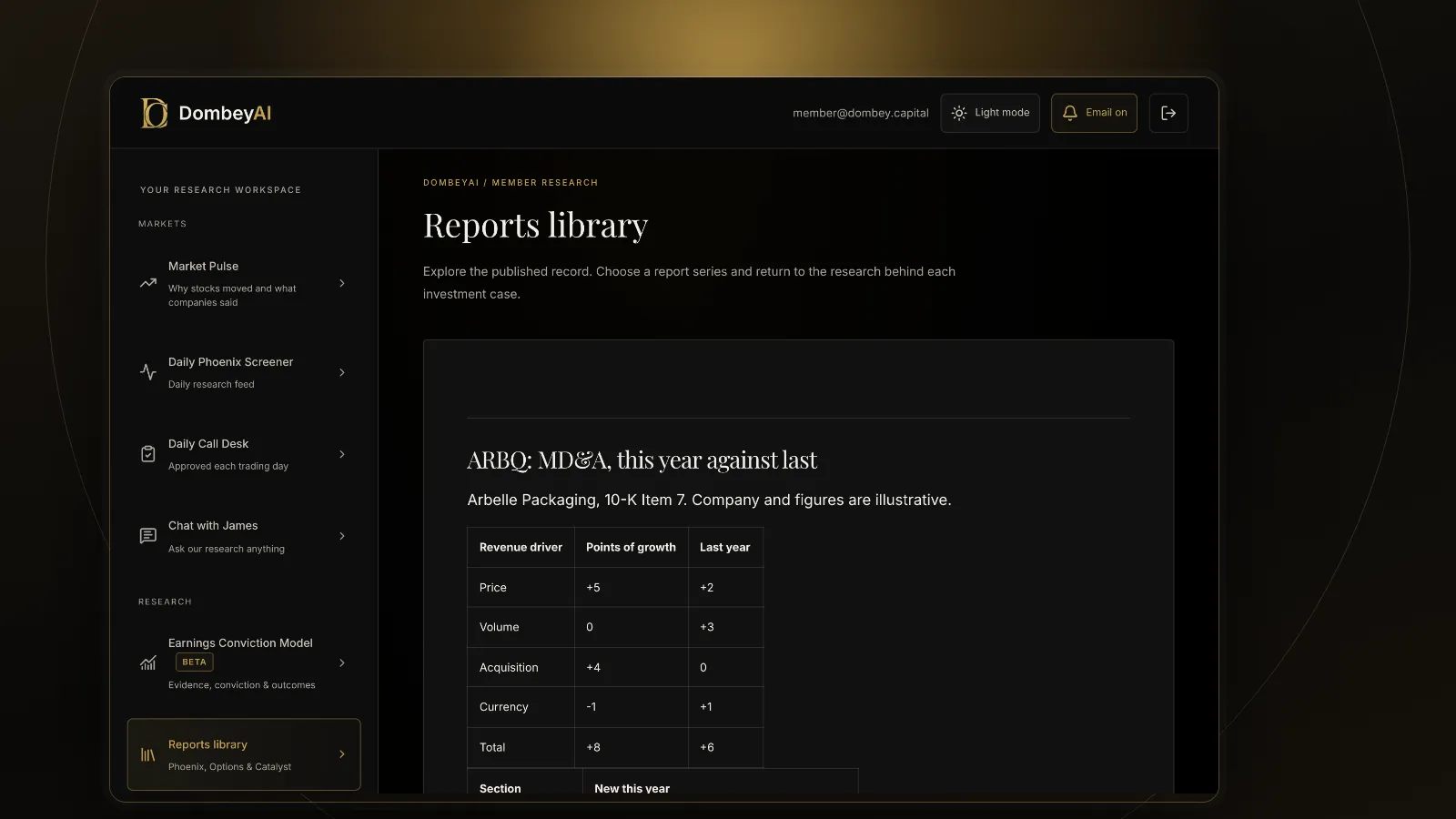
The SEC expects management to explain material changes by cause, such as price, volume, mix, currency and acquisitions. Build a small table of what the MD&A says.
If the MD&A only says revenue increased "primarily due to higher demand", the explanation is too vague to test. That is worth noting. Segment results usually help; our guide on how to read segment disclosures shows how to rebuild them.
Step 4: Work through costs and margins
Do the same for cost of sales, operating expenses and other items. Look for:
- Gross margin changes explained by input costs, pricing, mix or utilization
- One-time items management describes as non-recurring, and whether they recurred last year too
- Changes in headcount, restructuring charges and their expected savings
Tie the explanations back to the income statement. Our guide on how to read an income statement covers the line items. If the company presents adjusted figures, check them against the reconciliation; how to read a non-GAAP reconciliation shows what to look for.
Step 5: Read liquidity and capital resources closely
For special situations, this is often the most important section. It should tell you:
- Cash and available credit at year-end
- Cash flow from operations, investing and financing, with the reasons for change
- Material cash requirements, including debt maturities, leases and purchase commitments
- Covenant terms and headroom, if material
- How the company expects to fund itself over the next twelve months and beyond
| What you read | Why it matters | Where to confirm it |
|---|---|---|
| Debt maturities in the next two years | Refinancing risk | Debt footnote, credit agreement |
| Covenant headroom | Risk of default or waiver costs | Credit agreement exhibit |
| Plans to raise capital | Dilution or new debt | Shelf registration, recent 8-Ks |
| Working capital swings | Quality of operating cash flow | Cash flow statement |
Check the cash flow discussion against the statement itself with how to read a cash flow statement. A wall of near-term maturities with vague funding language deserves attention; what is a debt maturity wall covers the risk. Language about substantial doubt links to the going concern warning.
Step 6: Study the critical accounting estimates
Since the 2020 amendments, companies must explain the critical accounting estimates that involve significant uncertainty and could materially change results, including how the estimate has changed and how sensitive it is. Common ones are revenue recognition on long contracts, goodwill impairment testing, inventory reserves, pension assumptions and tax valuation allowances.
For each one, note the assumption and the sensitivity disclosed. Then read the matching footnote; how to read the footnotes in a 10-K explains where each sits.
Step 7: List known trends and uncertainties
Management must disclose known trends, events and uncertainties reasonably likely to have a material effect. Make a list. These are often the seeds of the next catalyst: a contract ending, a regulatory change, a price reset or a cost increase. Add each to your catalyst calendar with a date if one is given.
Step 8: Check the story against the call and the 10-Q
Compare the written MD&A with what management said on the earnings call. Spoken comments tend to be more optimistic. Then read the latest 10-Q MD&A, which updates the annual one. Our explainer on what a 10-K is covers how the annual and quarterly filings fit together.
A one-page summary to keep
| Item | This year | Last year | Change in tone |
|---|---|---|---|
| Lead message in overview | |||
| Revenue drivers (price, volume, mix, M&A, FX) | |||
| Margin drivers | |||
| Liquidity and funding plan | |||
| Critical estimates and sensitivity | |||
| New known trends |
Fill it in once a year and update it each quarter. The good research tools make it faster to pull filings side by side; our list of the best stock research tools for individual investors compares them.
Common mistakes
- Reading the MD&A alone. It is narrative. Tie every claim to the statements and footnotes.
- Skipping the comparison with last year. The change in language is often more useful than the language itself.
- Accepting vague drivers. "Higher demand" is not an explanation; price, volume and mix are.
- Ignoring liquidity in a healthy year. Funding problems are easier to see a year early.
- Taking non-GAAP figures at face value. Check what is excluded and whether the exclusions recur.
The bottom line
The MD&A is where management explains, in writing and under legal liability, why the numbers changed and what may change them next. Read it in order: overview, results by driver, liquidity, critical estimates and known trends, with last year's version open beside it. Tie every explanation to the statements and note anything new. That habit turns a long filing into a short list of what to watch.