

What you need
- The current 10-K and the prior year's 10-K, both from SEC EDGAR.
- The latest 10-Q, which updates several notes during the year. Our guide on how to read a 10-Q for special situations covers it.
- A spreadsheet or notes file with one row per note.
- A clear question. Reading every note with equal care takes hours. Knowing what the thesis depends on tells you where to slow down.
Step 1: Start with the auditor's report
The independent auditor's report sits just before the financial statements. Check three things:
- The opinion. An unqualified opinion is standard. Any qualification is a red flag.
- Going concern. A paragraph on substantial doubt about the company's ability to continue as a going concern changes how every other note should be read. See what a going concern warning means.
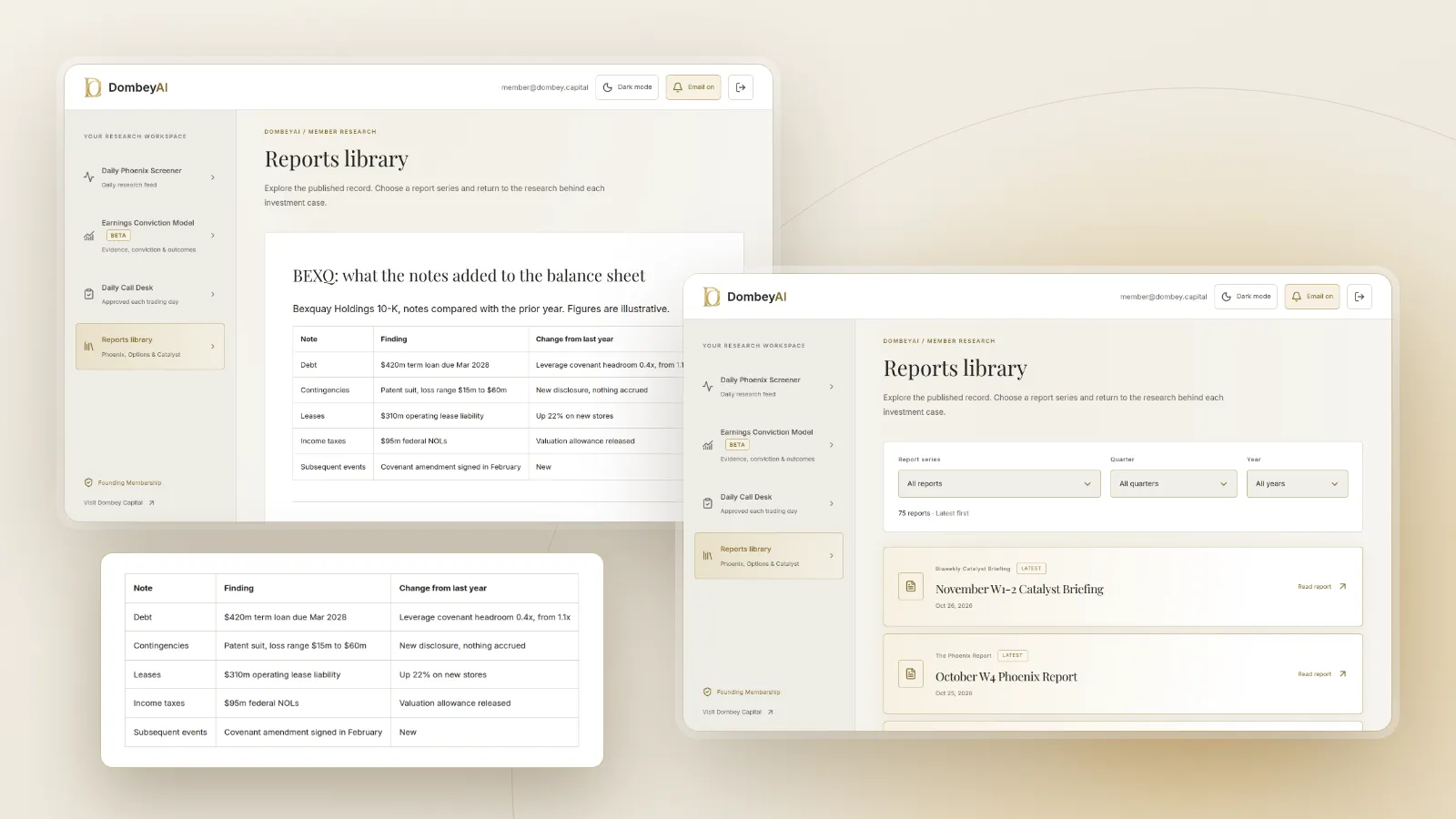
- Critical audit matters. For larger filers, the auditor lists the areas that needed especially difficult judgment, such as goodwill, revenue or tax positions, and names the related note. These are the notes to read most carefully.
Step 2: Read the significant accounting policies note
Usually Note 1 or Note 2. It sets out how the company recognizes revenue, values inventory, depreciates assets, tests goodwill and consolidates subsidiaries.
Look for changes. A new policy, a change in useful lives or a change in the inventory method can move reported earnings without any change in the business. Also look for recently issued accounting standards the company has not yet adopted, and its estimate of their effect.
Step 3: Read the debt note
The balance sheet shows debt in one or two lines. The debt note shows each instrument: amount, interest rate, maturity, security and covenants.
| What to find | Why it matters |
|---|---|
| Maturity schedule for the next five years | Shows refinancing needs. See debt maturity walls |
| Fixed or floating rates | Sensitivity to interest rates |
| Financial covenants and headroom | How close the company is to a default |
| Secured or unsecured, and guarantors | Who gets paid first in a restructuring |
| Undrawn credit facility | Liquidity available |
| Convertible notes and conversion prices | Potential dilution |
The credit agreement itself is usually filed as an exhibit. The note tells you whether it is worth reading in full.
Step 4: Read commitments and contingencies
This note covers lawsuits, government investigations, environmental liabilities, guarantees and purchase commitments.
Under US accounting rules, a loss contingency is recorded when it is probable and can be reasonably estimated. When it is reasonably possible, it is disclosed without being recorded. So a large lawsuit can appear here with no liability on the balance sheet at all.
Read for the range of possible loss, the stage of each case and any language saying a loss cannot be estimated. Our guide on how to value a litigation outcome turns these disclosures into numbers.
Step 5: Read the subsequent events note
This short note covers significant events between the balance sheet date and the date the statements were issued: a refinancing, an acquisition, a dividend change, a lawsuit, a covenant waiver. Because a 10-K is filed weeks after year end, this note can contain the most recent news in the filing.
Step 6: Read revenue and segments
The revenue note breaks sales down by product, geography or customer type, and shows contract balances and remaining performance obligations, which indicate revenue already contracted but not yet recognized.
The segment note shows revenue and profit for each reporting segment. Since recent changes to the segment reporting standard, companies disclose more of each segment's significant expenses. For conglomerates and companies with a hidden good business inside a weak one, this note is the starting point for a sum-of-the-parts valuation.
Step 7: Read leases, taxes and pensions
- Leases. Operating lease liabilities are on the balance sheet, and the note gives the maturity schedule and discount rate. Long lease tails can matter as much as debt for retailers and restaurants.
- Income taxes. The rate reconciliation explains why the effective rate differs from the statutory rate. The note also shows net operating losses, valuation allowances and uncertain tax positions.
- Pensions. The funded status, discount rate and expected contributions. See how underfunded pensions affect equity value.
Step 8: Read stock compensation, related parties and fair value
- Stock compensation. Expense, unvested awards and options outstanding with their exercise prices. Add these to the share count. Our explainer on whether stock-based compensation is a real expense covers why it matters.
- Related-party transactions. Dealings with executives, directors or controlling holders.
- Fair value. Assets measured with unobservable inputs, called Level 3, depend most on management's estimates.
Step 9: Compare with last year and record the changes
Put each note's key figures in your file next to last year's: debt by maturity, contingency ranges, segment profits, unrecognized tax benefits. Note any new note, any note that disappeared and any paragraph that grew sharply. A note that doubles in length usually means something changed. Add the dates you found, such as maturities and court hearings, to your catalyst calendar.
The platforms in our list of the best stock research tools for individual investors pull financial statements into tables, but most do not capture the notes, so this step stays manual.
A checklist for each note
| Note | What to check | Where it leads |
|---|---|---|
| Accounting policies | Changes from last year | Earnings quality |
| Debt | Maturities, covenants, security | Refinancing risk |
| Contingencies | Range of loss, case stage | Litigation valuation |
| Subsequent events | Anything after year end | Immediate catalysts |
| Revenue and segments | Mix, backlog, segment profit | Sum-of-the-parts value |
| Leases, taxes, pensions | Schedules, NOLs, funded status | Hidden liabilities and assets |
| Stock compensation | Unvested awards, options | Diluted share count |
Fill in one row per note for each year, and the comparison in Step 9 becomes a matter of reading across the columns.
Common mistakes
- Reading in page order. The first notes are often the least informative. Read by risk.
- Skipping the auditor's report. Critical audit matters point to the notes that need the most attention.
- Trusting the balance sheet alone. Contingencies, guarantees and purchase commitments may not appear there at all. See off-balance-sheet liabilities.
- Reading one year in isolation. Most of the information is in what changed.
- Ignoring the exhibits. Credit agreements and indentures carry the full covenant terms the note only summarizes.
The bottom line
The footnotes explain how a company measured every figure in its statements, and they hold debt terms, contingencies and recent events that the statements compress or leave out. Read the auditor's report and accounting policies first, then debt, contingencies and subsequent events, then the operating notes. Compare every note with last year's. The time is best spent on the notes closest to your thesis, read in full.