

What you need
- A web browser and free access to SEC EDGAR. No account is needed.
- A list of companies you follow, with their CIK numbers if you have them. Our guide to searching SEC EDGAR filings covers finding a CIK.
- A spreadsheet or notes file for the purchase log (columns in Step 7).
- About 15 minutes a week for a short watchlist.
Step 1: Know who files and when
Three forms cover insider holdings. Each has its own deadline.
| Form | What it reports | Deadline |
|---|---|---|
| Form 3 | Holdings when a person first becomes an insider | Within 10 days of becoming an insider |
| Form 4 | Changes in holdings, including purchases and sales | Before the end of the second business day after the trade |
| Form 5 | Transactions exempt from or not reported on Form 4 during the year | Within 45 days after the fiscal year ends |
Form 4 is the one that matters for tracking buying because it arrives within days. A Form 5 can show a small purchase months after it happened, so treat it as a cleanup check, not a signal source. The deadlines above come from the SEC's investor bulletin and the Form 4 instructions, listed in the sources.
Step 2: Find the Form 4 filings
Open the company's page on EDGAR and filter the filing list by form type 4. The newest filings appear first. Each company page also links to an insider transactions view that lists reported trades by person.
To see buying across many companies at once, use EDGAR's Latest Filings page filtered to Form 4, or the SEC's quarterly Insider Transactions Data Sets, which flatten the structured data from Forms 3, 4 and 5 into downloadable files. The data sets are refreshed quarterly, so they suit back-checking and research rather than daily alerts.
Step 3: Read the header
The top of the form tells you who traded and in what role.
- Box 1: the reporting person's name and address.
- Box 2: the issuer name and ticker.
- Box 3: the date of the earliest transaction reported on this form.
- Box 5: the relationship: director, officer (with title), 10% owner or other.
- The 10b5-1 checkbox: checked when a transaction was made under a contract, instruction or written plan intended to meet the conditions of Rule 10b5-1(c).
Compare Box 3 with the filing date on EDGAR. A gap longer than two business days means the form was late, which is worth a note but rarely matters on its own.
Step 4: Read Table I and filter for code P
Table I covers non-derivative securities, usually common stock. Each row is one transaction. The columns that matter:
| Column | What it shows | What to check |
|---|---|---|
| 2. Transaction date | The day of the trade | Whether it falls near a known event |
| 3. Transaction code | The type of trade | Keep code P; set the rest aside |
| 4. Amount, (A) or (D), price | Shares, acquired or disposed, price per share | Shares times price gives the dollars spent |
| 5. Amount owned after | Holdings following the trade | The base for sizing the purchase |
| 6. Direct (D) or Indirect (I) | Who holds the shares | Indirect holdings need column 7 |
| 7. Nature of indirect ownership | Trust, spouse, fund or entity | Whether the insider controls the money |
The transaction code is the filter. Code P is an open market or private purchase. Code S is the matching sale. These codes are not buying decisions:
- A: a grant or award from the company.
- M: exercise or conversion of a derivative security, such as an option.
- F: shares withheld to pay an exercise price or tax.
- G: a bona fide gift.
- J: other, described in a footnote.
Table II covers derivative securities such as options and warrants. For tracking purchases you mostly need it to explain the M and F rows in Table I.
Step 5: Read the footnotes
Footnotes change the meaning of many rows. Look for three things.
Price ranges. A purchase filled at several prices is often reported at a weighted average price, with a footnote giving the range. Use the average for your log.
Indirect holders. A purchase by a trust, a family member or a fund the insider manages shows as indirect. Read who the holder is and whether the insider disclaims beneficial ownership.
Plan details. If the 10b5-1 box is checked, the explanation of responses gives the date the plan was adopted. A purchase made under a plan adopted months earlier reflects the insider's view at adoption, not on the trade date.
Step 6: Size the purchase
A dollar figure alone tells you little. Put each purchase in two contexts.
- Against holdings. Divide shares bought by holdings before the trade (column 5 minus the shares bought). A purchase that adds 30% to an officer's stake is a different decision from one that adds 1%.
- Against the role. A chief executive or chief financial officer sees the business daily. A director sees it quarterly. A 10% holder may be a fund buying for its own mandate.
Then check the company's recent filings for context. A purchase right after a large decline, a guidance cut or a period of trading below net cash per share reads differently from one after a long rise. Read the most recent 10-Q as well; our guide on reading a 10-Q for special situations sets out what to look for.
Step 7: Log every purchase
A log turns single filings into a record you can review. Use one row per purchase.
| Field | Example entry |
|---|---|
| Company and ticker | Company A |
| Insider and role | Chief financial officer |
| Transaction date / filing date | Day 1 / Day 3 |
| Code and 10b5-1 box | P / unchecked |
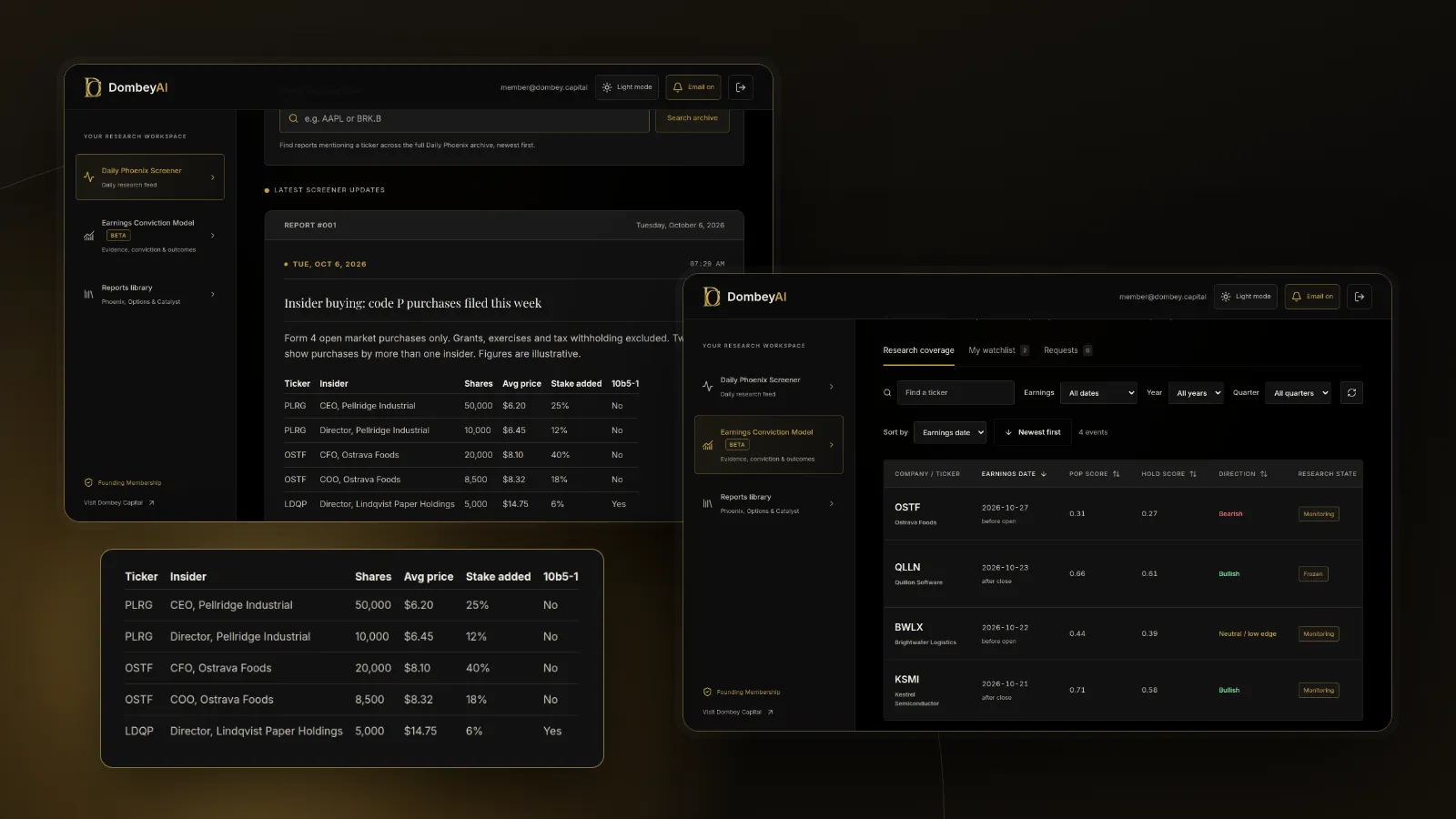
| Shares, average price, dollars | 20,000 / $8.10 / $162,000 |
| Holdings after; % added | 70,000; 40% |
| Direct or indirect | Direct |
| Context | Bought after a guidance cut; 10-Q shows net cash |
Record the EDGAR link or accession number on each row, so you can reread the filing later.
Step 8: Look for clusters and set a review
One purchase is a data point. Several insiders buying with their own money in the same few weeks is a pattern worth a closer read. Sort your log by company and date and flag any company with purchases from two or more insiders within about a month.
Check new filings on a schedule. Form 4 arrives within two business days, so a weekly check catches every purchase within about a week of the trade. If you follow event-driven names, add earnings dates and other known events to a catalyst calendar so you can see whether purchases fall before or after them. Insiders usually trade only in open windows set by company policy, which often start shortly after earnings and close weeks before the quarter ends.
A worked example
Where this goes wrong
Counting non-purchases. Grants, exercises and withholding inflate the "acquired" column. Filter on code P, not on (A).
Ignoring plans. A purchase under a 10b5-1 plan was decided earlier. Treat it as weaker evidence than a discretionary one.
Missing the size. A small purchase by a wealthy insider can be a gesture. Size it against holdings, and against pay where the proxy shows it.
Reading buying as a forecast. Insiders can be early or wrong, and their reasons may have nothing to do with the share price. Purchases do not predict returns; they prompt questions.
Overlooking the 10% holders. A large holder's purchase may reflect a fund's mandate, an activist plan or a path to control. Check for a Schedule 13D, which states the holder's purpose.
Common mistakes
- Relying only on a third-party feed. Aggregators can misclassify codes or miss footnotes. Open the filing for any purchase you plan to act on.
- Skipping Table II. Without it, M and F rows in Table I are hard to explain.
- Logging dollars without holdings. The percentage added matters more than the headline amount.
- Checking only when a stock moves. A fixed weekly review catches purchases that never make the news.
- Not writing down the thesis. Record what the purchase suggests and what would prove it wrong, with a date, as in our guide on writing a dated investment thesis.
Dombey's published research checks recent insider filings before each catalyst; see the research archive.
The bottom line
Form 4 gives every investor free, timely access to what insiders do with their own shares. Pull the filings from EDGAR, keep only code P purchases, read the footnotes for prices, trusts and plans, and size each purchase against the insider's holdings. Log every purchase with its source and look for clusters. Treat buying as a reason to do more work on a company, not as a forecast.