

When a deal needs an S-4
The trigger is Rule 145. It says that when a plan is put to a shareholder vote or consent, an offer or sale of securities is involved if the plan covers one of three things:
- A reclassification that substitutes one security for another, other than a stock split, reverse split or change in par value.
- A statutory merger or consolidation in which holders' securities become or are exchanged for securities of another company.
- A transfer of assets to another company in exchange for its securities, if the plan dissolves the seller, distributes the securities to holders, or meets the rule's other conditions.
The SEC's general instructions say Form S-4 may be used for securities issued in a Rule 145(a) transaction, in a merger where state law does not require a vote of all the target's holders, in an exchange offer for securities of the issuer or another company, and in resales of securities received under the registration. The form cannot be used by a registered investment company or a business development company. Foreign private issuers use the parallel Form F-4.
An all-cash acquisition issues no new securities, so it needs no S-4. The target files a proxy statement if holders vote, or the buyer files tender offer documents. That is why the S-4 is the document to watch in stock-for-stock and mixed cash-and-stock deals, and in exchange offers. A reverse merger that goes to a public company vote can also run through an S-4.
What an S-4 contains
The form has two parts. Part I is the prospectus that goes to shareholders. Part II holds the indemnification disclosure, the exhibits and the undertakings. The items in Part I that matter most to an investor:
| Item | What it requires | What to check |
|---|---|---|
| Item 3 | Summary, risk factors, per-share market values on the day before announcement, vote required, regulatory approvals, appraisal rights, tax summary | The equivalent per-share value and the list of approvals still needed |
| Item 4 | Terms of the agreement, both companies' reasons, differences in shareholder rights, accounting treatment, tax consequences, and any outside report or opinion | Fairness opinion assumptions, the projections behind them, the rights holders give up |
| Item 5 | Pro forma financial information under Article 11 of Regulation S-X | Combined leverage, deal adjustments, per-share earnings and book value |
| Item 6 | Past and present material contracts and negotiations between the two companies | Prior approaches, standstills, related-party ties |
| Items 10 to 17 | Information about the registrant and the company being acquired, either incorporated by reference or set out in full | Whether the target's numbers are current |
| Item 18 or 19 | Proxy information if votes are solicited, or exchange offer information if not | Record date, meeting date, vote threshold, dissenters' rights |
Two practical features follow from the instructions. First, a company that meets the Form S-3 requirements can incorporate its periodic reports by reference instead of repeating them, so a large buyer's S-4 can be shorter on the buyer and longer on the deal. Second, when information is incorporated by reference, the prospectus must be sent to holders at least 20 business days before the meeting, or before the vote or closing if there is no meeting.
The proxy statement/prospectus
When the target's holders vote, the S-4 and the proxy statement are combined into one document, often called a proxy statement/prospectus. If both companies' holders vote, it becomes a joint proxy statement/prospectus. The Exchange Act proxy rules govern the vote, and the Securities Act governs the registration of the new shares. Item 18 of the form pulls in the Schedule 14A items: the date and place of the meeting, revocability of proxies, appraisal rights and the interests of insiders in the deal.
This matters because the sections investors look for in a proxy statement sit inside the S-4, and the most useful one is usually "Background of the Merger." It walks through who approached whom, which other bidders were contacted, how the price moved and when the board agreed. Read it alongside "Opinion of Financial Advisor," which Item 4(b) brings in through Item 1015(b) of Regulation M-A when an outside report or opinion is referred to in the prospectus.
A worked example
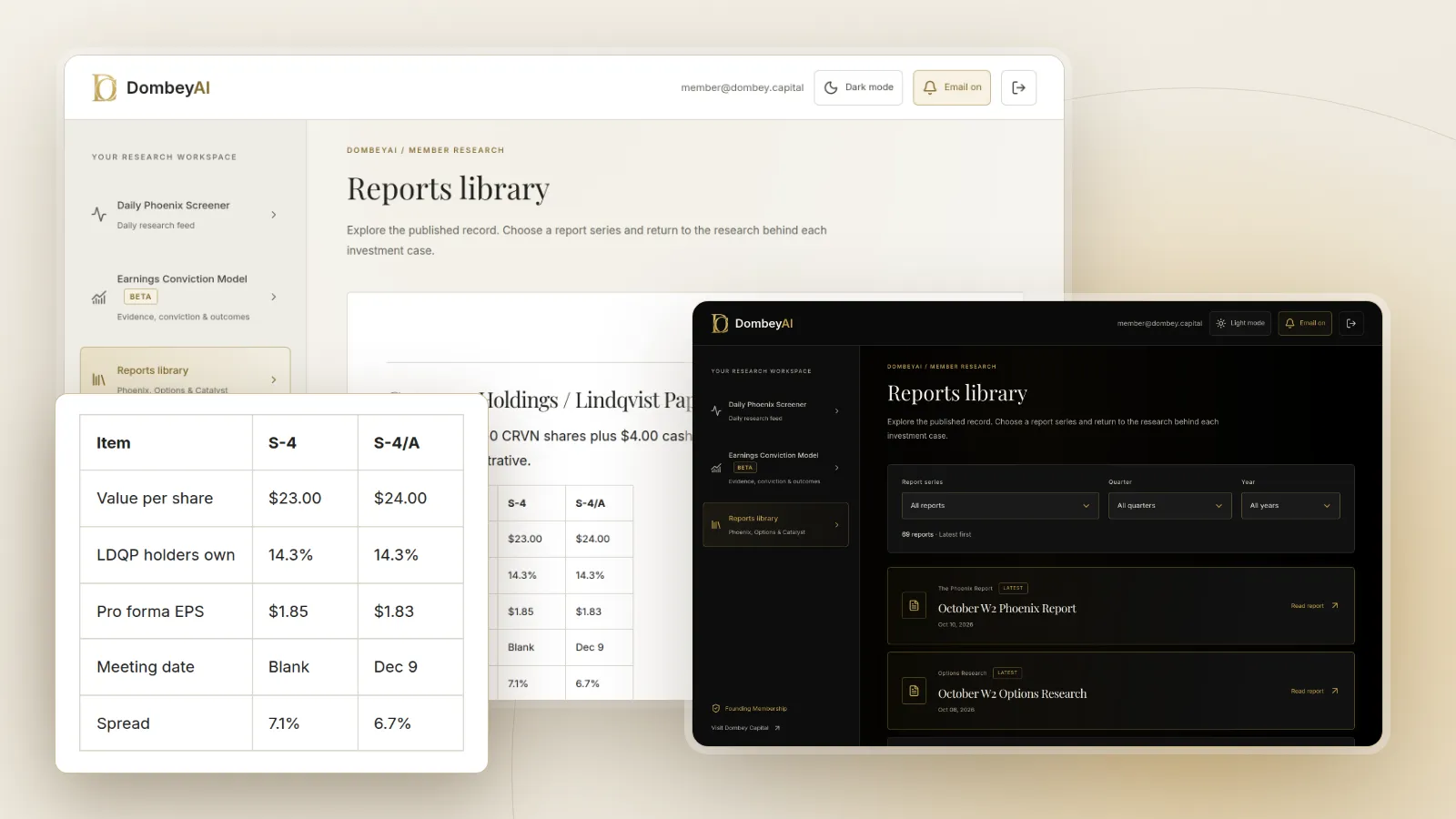
The pro forma statements in Item 5 show what that ownership buys. Suppose A earns $600 million ($2.00 a share) and B earns $90 million ($0.90 a share). The pro forma adjustments add $18 million of after-tax interest on $400 million of new debt and $30 million of after-tax amortization on acquired intangibles. Combined pro forma earnings are $642 million on 350 million shares, or about $1.83 a share, down from A's $2.00. A former B holder's 0.50 A share represents about $0.92 of pro forma earnings, close to B's standalone $0.90.
The same filing therefore answers two questions: what the spread pays if the deal closes, which the merger arbitrage spread guide covers in detail, and what the shares are worth if you keep them after closing.
How to read an S-4 as a target holder
A first S-4 often runs to several hundred pages. This order reaches the decisions quickly:
- The summary and the Q&A. Exchange ratio, cash per share, collar or adjustment terms, expected closing, conditions.
- Background of the merger. Other bidders, price changes during talks, any go-shop, and how long the board negotiated.
- Fairness opinions and projections. The advisor's valuation ranges and the management projections they relied on. Projections for both companies often appear here and nowhere else.
- Interests of directors and officers. Change-in-control payments, retained roles and equity acceleration.
- Comparison of shareholder rights. What changes if the target and buyer are incorporated in different states or have different charters.
- Pro forma financials. Combined debt, adjustments and per-share figures.
- Regulatory approvals and conditions. Antitrust filings and any other approvals that set the HSR waiting period and the closing timeline.
- The merger agreement attached as an annex. Termination fees, outside date, financing conditions and the definition of a material adverse effect.
The S-4 timeline
| Stage | Event | What to check |
|---|---|---|
| Announcement | Merger agreement signed, 8-K filed | Terms, expected filing date, outside date |
| Initial filing | S-4 filed with a delaying amendment | Background, projections, pro forma figures |
| SEC review | Staff comments, S-4/A amendments | Changes to projections, background and risk factors |
| Effectiveness | SEC declares the S-4 effective | Record date and meeting date |
| Mailing | Proxy statement/prospectus sent to holders | At least 20 business days before the meeting if information is incorporated by reference |
| Vote | Target holders, and sometimes buyer holders, vote | Vote result 8-K, appraisal demands |
| Closing | Remaining conditions met | Final exchange, cash payment and trading of the new shares |
By statute, Section 8(a) makes a registration statement effective 20 days after filing unless the SEC sets an earlier date. Rule 473 lets a filer include a delaying amendment so the statement stays pending during review, and almost all S-4s use one. Effectiveness then comes when the SEC declares it, usually at the filer's request. Exchange offers have a shortcut: Rule 162 lets the offeror start soliciting tenders before effectiveness, as long as no securities are purchased until the registration is effective and the tender offer has expired.
Each of these dates belongs on a catalyst calendar, because a slow SEC review pushes the vote back and lowers the annualized return on the spread even when the deal still closes.
How the S-4 differs from related filings
- If the deal is all cash, there is no S-4. Read the target's merger proxy or the buyer's tender offer documents.
- If a company is being spun off by pro rata distribution, it usually registers on a Form 10 instead, because holders pay nothing for the shares.
- If the shares are sold for cash to the public, the issuer uses Form S-1 or Form S-3.
- If you want the deal economics rather than the registration, start with merger arbitrage explained and come back to the S-4 for the terms.
To set up alerts for new filings and amendments, the EDGAR search guide explains how to filter by form type.
Where this goes wrong
- Projections are management's, not the advisor's. Fairness opinions rely on forecasts the companies supplied. A range that looks generous may rest on optimistic numbers that neither side will be held to.
- Pro forma figures are not forecasts. Article 11 adjustments reflect the deal's accounting, not expected cost savings, and the purchase price allocation is often preliminary until after closing.
- The market value of the stock component moves. A fixed exchange ratio means the per-share value in the S-4 is a snapshot. Without a collar, a fall in the buyer's shares lowers what target holders receive.
- Effectiveness is not approval. The SEC declaring an S-4 effective does not mean it has judged the merits of the deal or the accuracy of the disclosure.
- The background is written by the parties. It describes the process the board ran in its own words. Gaps, such as a bidder that went quiet, are often more telling than what is said.
- Late amendments change dates. A new round of SEC comments can push the mailing and the vote, and the outside date in the merger agreement may then come into play.
Dombey's published research reads the S-4 and each amendment for the deals it covers; see the research archive.
The bottom line
A Form S-4 registers the securities a buyer issues in a merger, a similar business combination or an exchange offer, and in a stock deal with a target vote it is also the proxy statement. Read the summary, the background of the merger, the fairness opinions, the insider interests and the pro forma financials before the long descriptions of each business. Track the amendments, because projections, dates and disclosures change during SEC review. Then use the filing to answer both questions a target holder faces: what the spread pays if the deal closes, and what the combined company's shares are worth afterward.