

Who files Form 4 and when
Section 16 of the Exchange Act covers three groups: directors, officers and beneficial owners of more than 10% of a class of registered equity securities. The SEC's investor bulletin calls them insiders. Three forms track their holdings.
| Form | What it reports | Deadline |
|---|---|---|
| Form 3 | Holdings when a person first becomes an insider | Within 10 days of becoming an insider |
| Form 4 | Most changes in holdings, including purchases, sales and gifts | Before the end of the second business day after the trade |
| Form 5 | Transactions that were exempt from or not reported on Form 4 during the year | Generally within 45 days after the fiscal year ends |
Form 4 is the one that matters for timely reading. A Form 5 is a year-end cleanup, so by the time it arrives the information is months old. All three forms are free on SEC EDGAR.
The parts of a Form 4
A Form 4 has a header, two tables and an explanation section. Each carries a different piece of the story.
The header. Box 1 names the reporting person. Box 2 gives the issuer and ticker. Box 3 gives the date of the earliest transaction on the form. Box 5 states the relationship: director, officer with title, 10% owner or other. The role tells you how close the person sits to the business.
Table I. Non-derivative securities, usually common stock. One row per transaction, with the date, the code, the number of shares, whether they were acquired (A) or disposed of (D), the price, the holdings after the trade, and whether ownership is direct or indirect.
Table II. Derivative securities such as options, warrants, restricted stock units and convertibles. You mainly need it to explain rows in Table I, such as an exercise that creates new shares.
Explanation of responses. The footnotes. This is where you find weighted average price ranges, the identity of a trust or fund holding the shares, and the adoption date of any Rule 10b5-1 plan.
What the transaction codes mean
The Form 4 instructions list about 20 codes. A handful account for most filings. The table groups them by how much they say about an insider's view.
| Code | What it records | What it says about the insider's view |
|---|---|---|
| P | Open market or private purchase | The most direct signal: own money, chosen price |
| S | Open market or private sale | Some signal, but many reasons to sell |
| A | Grant or award from the company | Little: compensation, not a decision |
| M | Exercise or conversion of a derivative under Rule 16b-3 | Little on its own; read with any same-day S |
| F | Shares delivered or withheld to pay exercise price or tax | Almost none: usually automatic at vesting |
| G | Bona fide gift | Little on the outlook; can matter for estate or tax planning |
| J | Other, described in a footnote | Depends on the footnote; always read it |
Two more codes are worth knowing. Code K marks an equity swap or a similar instrument, which can hedge away the economic exposure of shares the insider still holds. Code U marks a disposition through a tender of shares in a change of control transaction, which you will see when a tender offer for control of the company closes.
Reading insider buying
A code P purchase is an insider choosing to spend their own money at a market price. That is why most investors weight it more heavily than anything else on the form. Four questions sharpen the reading.
- If the purchase adds a large share to existing holdings, it is a bigger decision than a token addition.
- If the buyer is the chief executive or chief financial officer, they see the business daily; a director sees it at board meetings.
- If several insiders buy within a few weeks, the pattern carries more information than any single filing.
- If the 10b5-1 box is checked, the decision was made when the plan was adopted, not on the trade date.
Check who holds the shares. An indirect purchase by a family trust usually still reflects the insider's choice. A purchase by a fund where the insider is a partner may reflect the fund's mandate. For a 10% holder buying more, look for a Schedule 13D, which states the holder's purpose.
Reading insider selling
Sales are harder to read than purchases. The SEC's investor bulletin says plainly that insiders sell for many reasons, including liquidity and diversification. Executives are often paid mostly in stock, so selling is how they pay taxes, buy a house or reduce concentration in one company. Most sales say nothing about the outlook.
Start by removing what is not a market decision.
- Code F rows. Shares withheld to pay tax at vesting. Holdings fall, but nobody chose to sell into the market.
- Exercise and sale pairs. A code M exercise followed by a code S sale on the same day is a cashless exercise. The insider converted options to cash, often near expiry.
- Plan sales. A checked 10b5-1 box with an adoption date months earlier means the sale was scheduled in advance.
What remains is the small set of discretionary sales. These deserve a closer read when the sale is large against remaining holdings, when several senior insiders sell in the same window, when an insider sells soon after adopting or changing a plan, or when sales cluster ahead of a known event. Even then, a sale is a question to research, not an answer.
How the 2023 rule changes affect reading
Amendments to Rule 10b5-1 changed both how plans work and what Form 4 shows. Section 16 filers had to comply with the Form 4 changes for reports filed on or after April 1, 2023.
The checkbox. Filers must mark whether a reported trade was made under a plan intended to meet the Rule 10b5-1(c) affirmative defense, and give the plan's adoption date in the explanation of responses. Before this, you often could not tell a planned sale from a discretionary one.
Cooling-off periods. For directors and officers, trading under a new or modified plan cannot start until the later of 90 days after adoption or modification, or two business days after the company discloses results for the fiscal quarter in which the plan was adopted, with a maximum of 120 days. Everyone else except the issuer waits 30 days. Directors and officers must also certify at adoption that they are not aware of material nonpublic information.
Gifts. Bona fide gifts of securities must now be disclosed on Form 4, with code G, rather than later on Form 5.
Company disclosure. Issuers now disclose in their quarterly and annual reports when directors and officers adopt or terminate trading plans. The 10-Q can tell you a plan exists before the first trade under it appears on a Form 4.
A worked example
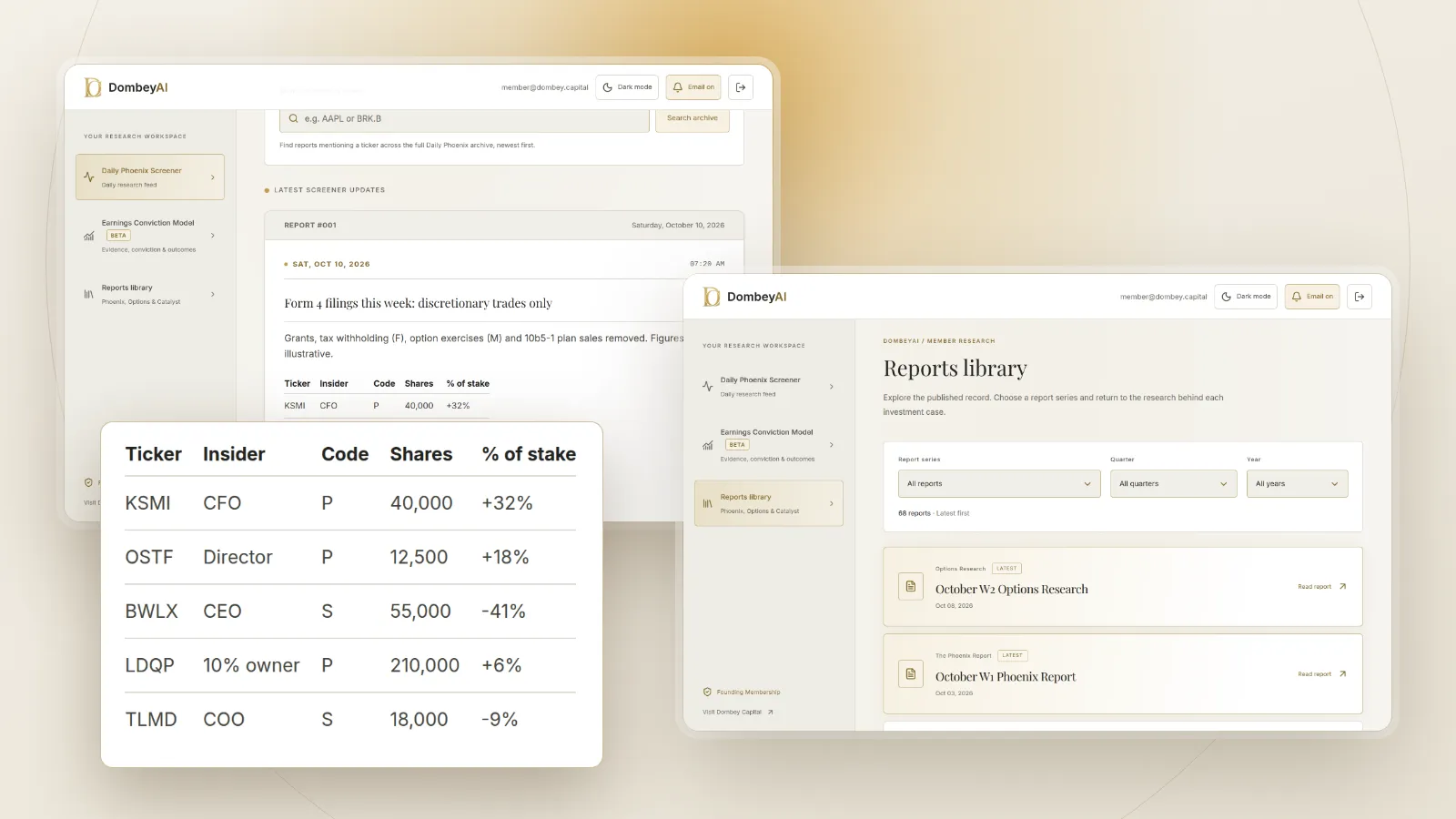
Reading it in order: the F row is tax, set it aside. The director's M and S pair is an option conversion near expiry. The chief operating officer's sale was scheduled before the last two quarters, so it carries little information about today. Two filings deserve attention. The chief financial officer made a large discretionary sale relative to her stake, and a director made a discretionary purchase. They point in opposite directions, which is common. The next step is to read the 10-Q for anything the finance team would see first, such as covenant headroom, cash flow or a change in auditor language, and to note any dated event that falls within the coming months.
Where this goes wrong
Treating every acquisition as buying. The (A) column includes grants, exercises and gifts received. Filter on code P.
Treating every sale as bearish. Tax withholding, cashless exercises and planned sales dominate the sell side. Strip them out first.
Ignoring hedges. A code K swap or a similar arrangement can leave an insider holding shares with little economic exposure. Holdings after the trade can overstate their stake in the outcome.
Reading single filings. One trade is a data point. Patterns across insiders and over months say more, and even those do not predict prices.
Relying on summaries. Third-party feeds can misread codes, merge rows or drop footnotes. Open the filing on EDGAR before relying on any one trade. Our review of tools for tracking insider buying covers which feeds show codes and footnotes.
Missing the calendar. Insiders usually trade only in open windows set by company policy, so trades bunch after earnings. A burst of filings in that window is normal. Put trades next to the company's catalysts before reading anything into timing.
Dombey's published research reviews recent Form 4 filings before each catalyst; see the research archive.
The bottom line
Form 4 shows what insiders did with their shares within two business days of the trade. Start with the transaction code and the holdings left afterwards, then read the footnotes for plans, trusts and price ranges. Weight discretionary purchases more than sales, and strip tax withholding, exercises and plan trades out of the sell side before judging it. Use what you find as a reason to read the company's filings more closely, not as a forecast.