

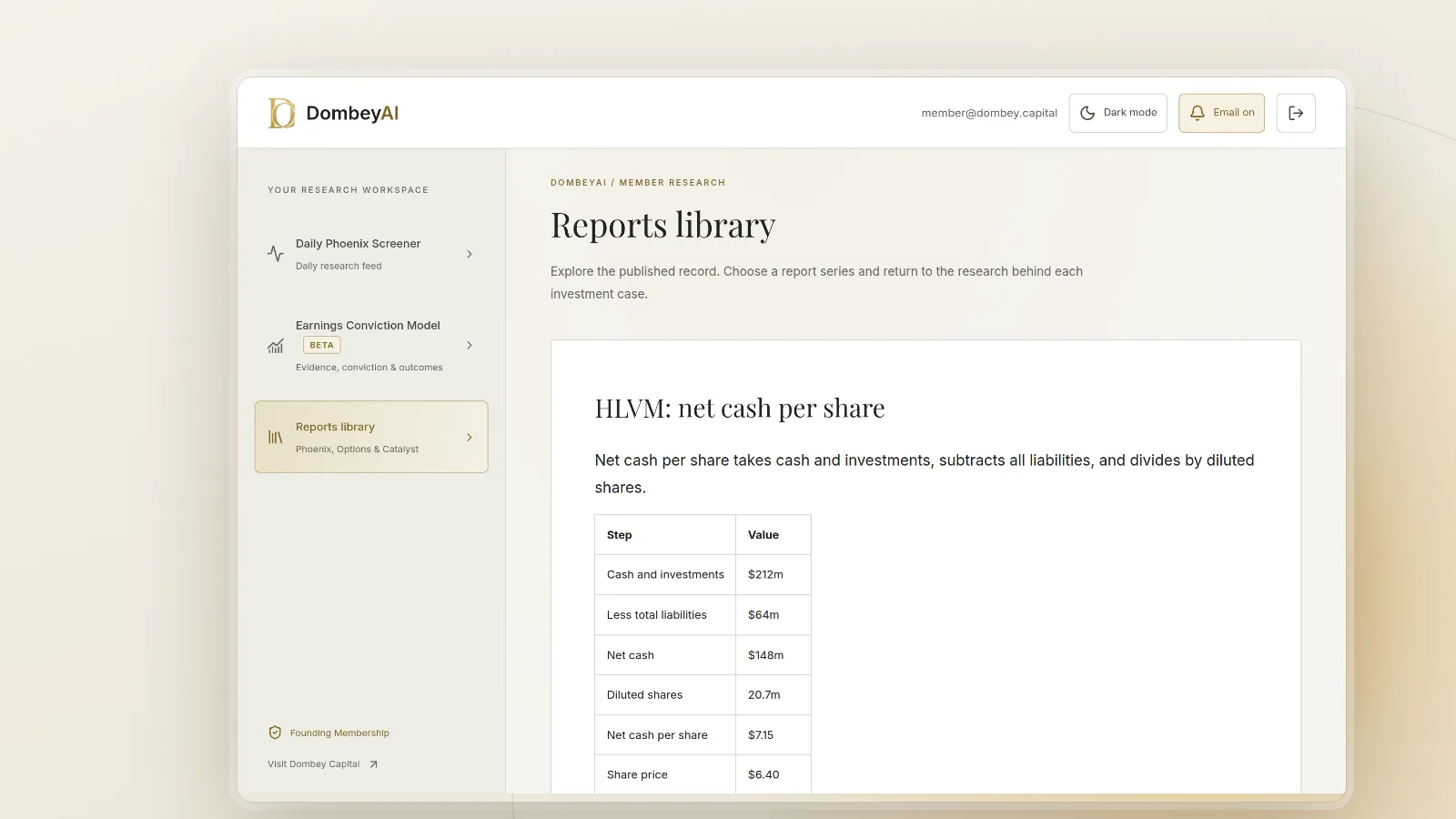
The net cash per share formula
The basic formula has three parts:
Net cash per share = (Cash and cash equivalents + Short-term investments - Total debt) / Diluted shares outstanding
- Cash and cash equivalents come from the top of the balance sheet. Equivalents are highly liquid instruments with short maturities, such as Treasury bills and money market funds.
- Short-term investments are marketable securities the company can sell quickly, such as Treasury notes or commercial paper. Some companies also hold long-term marketable securities that are just as liquid; include them if the notes show they are high-quality and readily sold.
- Total debt includes short-term borrowings, the current portion of long-term debt and long-term debt.
- Diluted shares include common shares plus the effect of options, warrants, restricted stock units and convertible securities.
Take the numbers from the latest 10-Q or 10-K, not a data provider. Providers sometimes use different definitions, and they may lag a quarter. How to read a 10-Q for special situations explains where each item sits.
What to include and what to exclude
The headline formula is a starting point. These adjustments separate a careful figure from a misleading one.
Restricted cash
Restricted cash is held for a specific purpose, such as collateral for a letter of credit or a legal escrow. The company cannot use it freely. Exclude it, or include it only when you know when and how it will be released.
Lease liabilities
Since the current lease accounting rules took effect, operating leases appear on the balance sheet as liabilities. They are not borrowings, but they are fixed obligations. For a company with many offices or stores, leases can be large. Calculate net cash both ways and note the difference.
Preferred stock
Preferred stock ranks ahead of common shareholders. If the company liquidated, preferred holders would be paid first, often at a stated liquidation preference. Subtract the liquidation preference, not the carrying value, when it is higher.
Convertible debt
Convertible notes are debt unless they convert. If the conversion price is well above the share price, treat them as debt. If the share price is above the conversion price, treat them as shares and add them to the diluted count. Check the terms for put dates, when holders can demand repayment.
Other liabilities
Look for items that will consume cash: accrued severance, legal settlements, deferred purchase payments, tax liabilities on repatriated cash and earn-outs owed from past acquisitions. Working capital matters too. Accounts payable will be paid, and receivables may not all be collected.
Cash burn until the catalyst
This is the most important adjustment. A company losing money will have less cash in the future than it does today. Estimate the quarterly cash burn from the cash flow statement, multiply by the number of quarters until a plausible catalyst, and subtract it. A figure that ignores burn describes the past, not what holders might receive.
Quick reference: adjustments to net cash
| Item | Typical treatment | Why |
|---|---|---|
| Cash and equivalents | Include | Freely available |
| Short-term investments | Include | Readily sold |
| Restricted cash | Exclude unless release is clear | Not freely available |
| Short-term and long-term debt | Subtract | Must be repaid |
| Operating lease liabilities | Subtract, or show both ways | Fixed obligations |
| Preferred stock | Subtract liquidation preference | Ranks ahead of common |
| Convertible debt, out of the money | Subtract as debt | Likely repaid in cash |
| Convertible debt, in the money | Add shares to diluted count | Likely converts |
| Expected cash burn to catalyst | Subtract | Cash will be spent first |
Price-to-net-cash
Price-to-net-cash divides the share price by net cash per share. A ratio of 1.0 means the price equals net cash. Below 1.0, the market values the operating business, along with any other assets, at less than zero. Above 1.0, the market assigns some positive value to the business.
The related measure is enterprise value. Enterprise value equals market capitalization plus debt minus cash. When a stock trades below net cash, enterprise value is negative. Screens for negative enterprise value find the same group of companies; see how to find stocks trading below net cash.
Net cash is a narrower measure than book value. Price-to-book counts all assets, including inventory, property and goodwill. Net cash counts only the most liquid assets, which makes it a stricter test.
Worked example: Company A
The numbers below are illustrative. Company A is hypothetical.
Company A's latest balance sheet shows:
- Cash and cash equivalents: $120 million, of which $10 million is restricted
- Short-term investments: $60 million
- Total debt: $30 million
- Operating lease liabilities: $15 million
- Diluted shares outstanding: 40 million
- Share price: $3.00
Headline net cash. ($120M + $60M - $30M) / 40M = $3.75 per share. Price-to-net-cash is $3.00 / $3.75 = 0.80.
Adjusted for restricted cash and leases. ($110M + $60M - $30M - $15M) / 40M = $3.13 per share. Price-to-net-cash is 0.96.
Adjusted for cash burn. Company A burned $8 million per quarter in operating cash flow over the last year. Suppose the plausible catalyst is a strategic review expected to conclude in four quarters. Burn to the catalyst is $32 million.
($110M + $60M - $30M - $15M - $32M) / 40M = $2.33 per share. Price-to-net-cash is 1.29.
The headline figure suggested a 20% discount to cash. After three reasonable adjustments, the stock trades above its expected net cash at the catalyst date. The conclusion reversed. That is common, and it is why the adjustments matter more than the formula.
Why stocks trade below cash
A stock below net cash looks like free money. It rarely is. The market usually has a reason.
Cash burn. The most common reason. Investors expect losses to consume the cash before holders see it. A biotech company after a failed trial, or a technology company with shrinking revenue, may hold large cash balances and still be expected to spend most of them.
Capital allocation. Management may use the cash for an acquisition holders would not choose, or pay itself well while the business declines. A cash pile controlled by a team with no plan to return it is worth less than its face value to outside holders.
Value traps. Some companies trade below cash for years. Without a special situation such as a liquidation, a sale, a tender offer or an activist campaign, there may be nothing to close the gap.
Forced selling and neglect. After a sharp fall, index removals, fund mandates and tax-loss selling can push a stock below cash for reasons unrelated to value. Small companies with no analyst coverage can stay mispriced for a while. These are the cases where the discount may be genuine.
Dombey's published research applies this screen with the burn adjustment before each catalyst; see the research archive.
Where this goes wrong
Net cash per share has clear limits.
- The balance sheet is a snapshot. It is dated the last day of the quarter. Cash can fall sharply in the weeks after.
- Cash may sit abroad or in subsidiaries. Moving it to the parent can trigger taxes or require approvals.
- Off-balance-sheet obligations. Purchase commitments, guarantees and pending litigation can consume cash without appearing as debt.
- Investments may not be as liquid as they look. Auction-rate securities, private stakes or long-dated bonds can be hard to sell at the carrying value.
- Dilution. A company that issues new shares to fund losses lowers net cash per share even if total cash holds steady.
- No catalyst. A discount to cash without a path to realize it can last indefinitely.
The figure tells you what is on the balance sheet. It does not tell you what holders will receive.
The bottom line
Net cash per share is cash plus short-term investments, minus total debt, divided by diluted shares. The raw figure is easy to calculate and easy to misuse. Adjust for restricted cash, leases, preferred stock, convertibles and especially cash burn until a catalyst, then compare the result with the price. A stock below adjusted net cash is a reason to read the filings closely, not a conclusion on its own.