

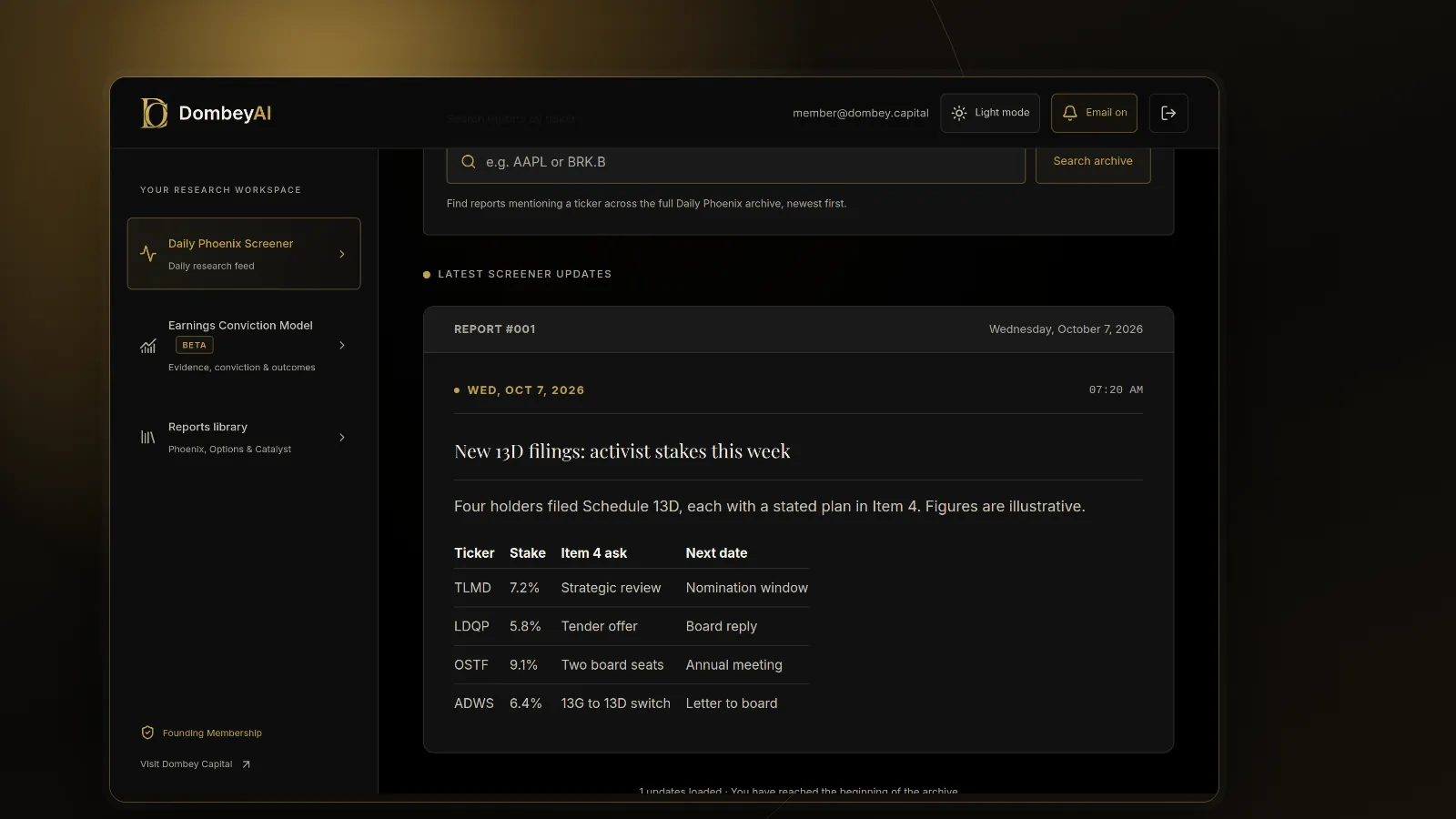
What a Schedule 13D is
Section 13(d) of the Securities Exchange Act and the SEC's Regulation 13D-G require disclosure when someone becomes the beneficial owner of more than 5% of a class of equity registered under Section 12. Beneficial ownership means having or sharing the power to vote the shares or the power to sell them. It also includes shares the holder has the right to acquire within 60 days, such as through options, warrants or conversion rights.
Holdings are aggregated across a group. Two or more investors who act together to acquire, hold, vote or dispose of shares can form a group, and the group's combined stake is what counts against the 5% line. The SEC said in its 2023 amendments that a group does not depend only on an express agreement; concerted action can be enough, depending on the facts.
The filing is made on EDGAR, and since December 18, 2024 the information in the schedule has had to be submitted in a structured, machine-readable format. That makes the cover page data (holder, shares, percentage) easier for screening tools to pick up.
The filing deadlines
The SEC shortened the deadlines in rules adopted in 2023. The current rules, as published in the eCFR, are below.
| Filing | Who files | Deadline |
|---|---|---|
| Initial Schedule 13D | Holder above 5% with a possible control purpose | 5 business days after the acquisition |
| Schedule 13D amendment | Same holder, after a material change | 2 business days after the change |
| Initial 13G, passive investor | Holder below 20% with no control purpose | 5 business days after the acquisition |
| Initial 13G, qualified institution or exempt holder | Banks, brokers, registered advisers, funds and similar | 45 days after the end of the calendar quarter |
| Switch from 13G to 13D | Any 13G filer that gains a control purpose | 5 business days |
Two details matter in practice. A business day runs to 11:59 p.m. Eastern under the rule, and EDGAR accepts Schedules 13D and 13G as filed that day if they arrive by 10:00 p.m. Eastern. So a filing that lands late in the evening is not a mistake; it is within the rules, and the market sees it the next morning.
What is in the filing
Schedule 13D has seven items. Some are routine. Three carry most of the information.
- Item 1, Security and Issuer. The class of shares and the company.
- Item 2, Identity and Background. Who the holder is, where it is organized, and any relevant criminal or securities proceedings in the past five years.
- Item 3, Source and Amount of Funds. How much was spent and whether any of it was borrowed. Borrowed money to buy a stake raises the cost of waiting.
- Item 4, Purpose of Transaction. The holder's plans or proposals. This is the item to read first.
- Item 5, Interest in Securities of the Issuer. The number and percentage of shares owned, voting and disposition power, and every trade in the past 60 days or since the last filing, with dates and prices.
- Item 6, Contracts and Arrangements. Agreements with others about the shares, including options, swaps and other derivatives that reference the company's stock, cash-settled ones included.
- Item 7, Exhibits. Joint filing agreements, financing agreements and any letters or proposals relating to Item 4.
Item 4 lists the plans the holder must describe if it has any: buying more shares or selling, a merger, reorganization or liquidation, a sale of a material amount of assets, changes to the board or management, changes to capitalization or dividend policy, other material changes to the business, charter or bylaw changes, delisting, deregistration, or anything similar.
How to read Item 4
Holders write Item 4 with care, and the wording tells you a lot. A boilerplate version says the shares were bought for investment and the holder may talk to management about many topics. That keeps options open without committing to anything.
A specific version names a goal: a strategic review, a sale of a division, a larger buyback, or a slate of directors. Specific language usually comes with an exhibit, such as a letter to the board. That letter is the activist's case in its own words, and it often contains the numbers the activist thinks the market is missing.
Read Item 4 alongside Items 3 and 5. A holder that bought quickly with borrowed money and states a narrow goal has a different time horizon from one that built a stake slowly with its own funds and lists every option in general terms.
Schedule 13D versus Schedule 13G
Schedule 13G is the short form. It suits three kinds of holders:
- Qualified institutions, such as banks, brokers, insurers, registered funds and registered investment advisers, that bought in the ordinary course of business and not to influence control.
- Passive investors that own less than 20% and have no control purpose.
- Exempt investors, such as holders who crossed 5% without an acquisition that triggers Section 13(d).
The switch rules are where the catalyst signal sits. A 13G filer that develops a purpose of changing or influencing control must file a 13D within five business days. From the time its purpose changes until 10 days after the 13D is filed, it may not vote the shares or buy more. A passive investor that reaches 20% must also move to a 13D, under the same 10-day restriction.
So a 13D from a holder that has filed 13Gs on the same company for years tells you more than a fresh 13D from a new holder. The investor already knows the company, and something made it decide to act.
Worked example: reading a new 13D
What the filing establishes:
- The stake and its cost. Roughly $43 million at a blended cost near $16.50, so the holder is in profit at $18 but not by much.
- The ask. A cash return, which Company A can do on its own without a buyer.
- The next dates. The nomination window in Company A's bylaws, set out in its last proxy statement, and the annual meeting date.
What it does not establish: whether the board will agree, whether other holders will back Fund X, or whether Fund X will stay. A holder can sell and file an amendment two business days later. For how a tender offer would work if the board agrees, see what a tender offer is and the Dutch auction tender offer guide.
How a 13D becomes a dated catalyst
A 13D by itself has no date attached to the outcome. The dated events come after it:
- If the holder wants board seats, the date is the advance notice deadline in the bylaws and then the meeting. The guide to reading a proxy statement shows where these dates appear, and shareholder votes and proxy season catalysts covers the vote itself.
- If the holder wants a sale, the dates come from a strategic review, a merger agreement and then regulatory and shareholder approvals.
- If the holder signs a cooperation agreement, the company usually adds directors and the holder agrees to a standstill. The agreement is filed as an exhibit to a 13D amendment, and the campaign ends there.
This is why a 13D is usually a soft catalyst at first and can become a hard one later. The difference is covered in hard versus soft catalysts. Dombey's published research reads these filings as part of tracking event-driven situations to their dated steps; see the research archive.
Where this goes wrong
- Reading the headline percentage and nothing else. The stake matters less than Item 4. A 9% holder with generic language may do nothing; a 5.2% holder with a letter and a nomination plan may force a vote.
- Assuming the holder will stay. Activists sell. Amendments are due within two business days of a 1% change, but a holder can reduce its stake in steps and the market learns afterward.
- Ignoring derivatives. Item 6 can show that part of the economic exposure comes from swaps or options. That changes how the holder gains and how long it is likely to stay.
- Counting days wrong. The deadlines are in business days and federal holidays do not count. Filings late in the evening are still on time.
- Treating the letter as analysis. An activist's letter argues one side. Check its numbers against the company's own 10-K and 10-Q before relying on them.
- Confusing 13D with 13F. A Form 13F is a quarterly holdings report from large institutional managers. It lists positions, says nothing about intent and arrives well after the trades it reports.
The bottom line
A Schedule 13D is filed within five business days of crossing 5% by any holder that may seek to influence the company, and it must be amended within two business days of a material change. Read Item 4 first, then Items 3, 5 and 6 to see how the holder paid, how fast it bought and whether derivatives are involved. A switch from 13G to 13D signals a change in intent. The filing starts a story; the dated events that follow, a nomination deadline, a vote or a deal, decide how it ends.