

Why spin-offs file a Form 10
A spin-off distributes shares of a subsidiary to the parent's shareholders. The shares are new to the public market, so the new company must register them under the Exchange Act before they trade.
It usually does not need a Securities Act registration such as an S-1. SEC Staff Legal Bulletin No. 4 sets out when a spin-off can proceed without one. Its conditions, briefly:
- Parent shareholders provide no consideration for the spun-off shares.
- The distribution is pro rata, so each holder keeps the same proportional interest.
- The parent gives shareholders and the market adequate information about the spin-off and the subsidiary.
- The spin-off has a valid business purpose.
- If the parent acquired the subsidiary's shares as restricted securities, it has held them for at least two years.
On the information point, the bulletin says that when the subsidiary is not already a reporting company, the parent must provide an information statement that substantially complies with Regulation 14A or Regulation 14C by the date of the spin-off, and the subsidiary must register the shares under the Exchange Act. The Form 10, with the information statement attached, does both jobs.
Form 10 is also used outside spin-offs. A company that crosses the Section 12(g) thresholds for holders and assets without listing must register, and some companies choose to register a class of securities to start reporting. For investors in special situations, spin-offs are the use that matters most.
10-12B vs 10-12G
On EDGAR, a Form 10 appears under one of two form types, depending on the section of the Exchange Act it registers under. The two differ mainly in when they become effective.
| Form 10-12B | Form 10-12G | |
|---|---|---|
| Registers under | Section 12(b) | Section 12(g) |
| Typical use | Shares that will list on a national exchange, which covers most spin-offs | Shares that will not list, or a company that crossed the 12(g) size thresholds |
| Becomes effective | 30 days after the SEC receives the exchange's certification, or sooner if the SEC allows (Section 12(d)) | 60 days after filing, or sooner if the SEC directs (Section 12(g)(1)) |
| Amendments on EDGAR | 10-12B/A | 10-12G/A |
| After effectiveness | Files 10-K, 10-Q and 8-K reports | Files 10-K, 10-Q and 8-K reports |
In a spin-off, the first Form 10 is often filed months before the distribution and then amended several times as the SEC staff comments and the terms are settled. The effective date usually comes shortly before the parent's board sets the record date and mails the information statement.
What a Form 10 contains
The form itself is short. It lists 15 items, each pointing to a disclosure requirement in Regulation S-K or Regulation S-X. In a spin-off, most items are answered by cross-reference to sections of the information statement, which carries the real content.
The items, from the SEC's form:
- Item 1. Business and Item 1A. Risk factors. Smaller reporting companies do not have to provide risk factors.
- Item 2. Financial information. Management's discussion and analysis and market risk disclosures.
- Item 3. Properties.
- Item 4. Security ownership of certain beneficial owners and management.
- Item 5. Directors and executive officers.
- Item 6. Executive compensation.
- Item 7. Certain relationships and related transactions, and director independence.
- Item 8. Legal proceedings.
- Item 9. Market price of and dividends on the registrant's common equity.
- Item 10. Recent sales of unregistered securities.
- Item 11. Description of the securities to be registered.
- Item 12. Indemnification of directors and officers.
- Item 13. Financial statements and supplementary data.
- Item 14. Changes in and disagreements with accountants.
- Item 15. Financial statements and exhibits.
The information statement adds the spin-off specific sections that the form's items do not name directly: the reasons for the separation, the distribution ratio, the record and distribution dates, the tax treatment, the pro forma financial statements and the agreements between the parent and the new company.
What to read first in a spin-off Form 10
A first Form 10 can run to several hundred pages. Not every section carries the same weight. This is the order that tends to answer the important questions fastest.
| Step | What to check | Where to find it |
|---|---|---|
| 1 | Distribution ratio, record date, distribution date, expected exchange | "The Distribution" or "Questions and Answers" section |
| 2 | Debt the new company takes on and any cash it pays the parent before the spin | Pro forma financial statements, capitalization table, "Description of Material Indebtedness" |
| 3 | Standalone costs not in the historical figures | Pro forma notes and MD&A |
| 4 | Ongoing ties to the parent | Separation agreement, tax matters agreement, transition services agreement, supply or license agreements |
| 5 | Who runs the company and how they are paid | Management, executive compensation, new equity plan |
| 6 | Tax treatment and the risk it fails | "Material U.S. Federal Income Tax Consequences" and risk factors |
| 7 | Takeover defenses and governance | Description of capital stock, charter and bylaw summary |
Two points deserve emphasis.
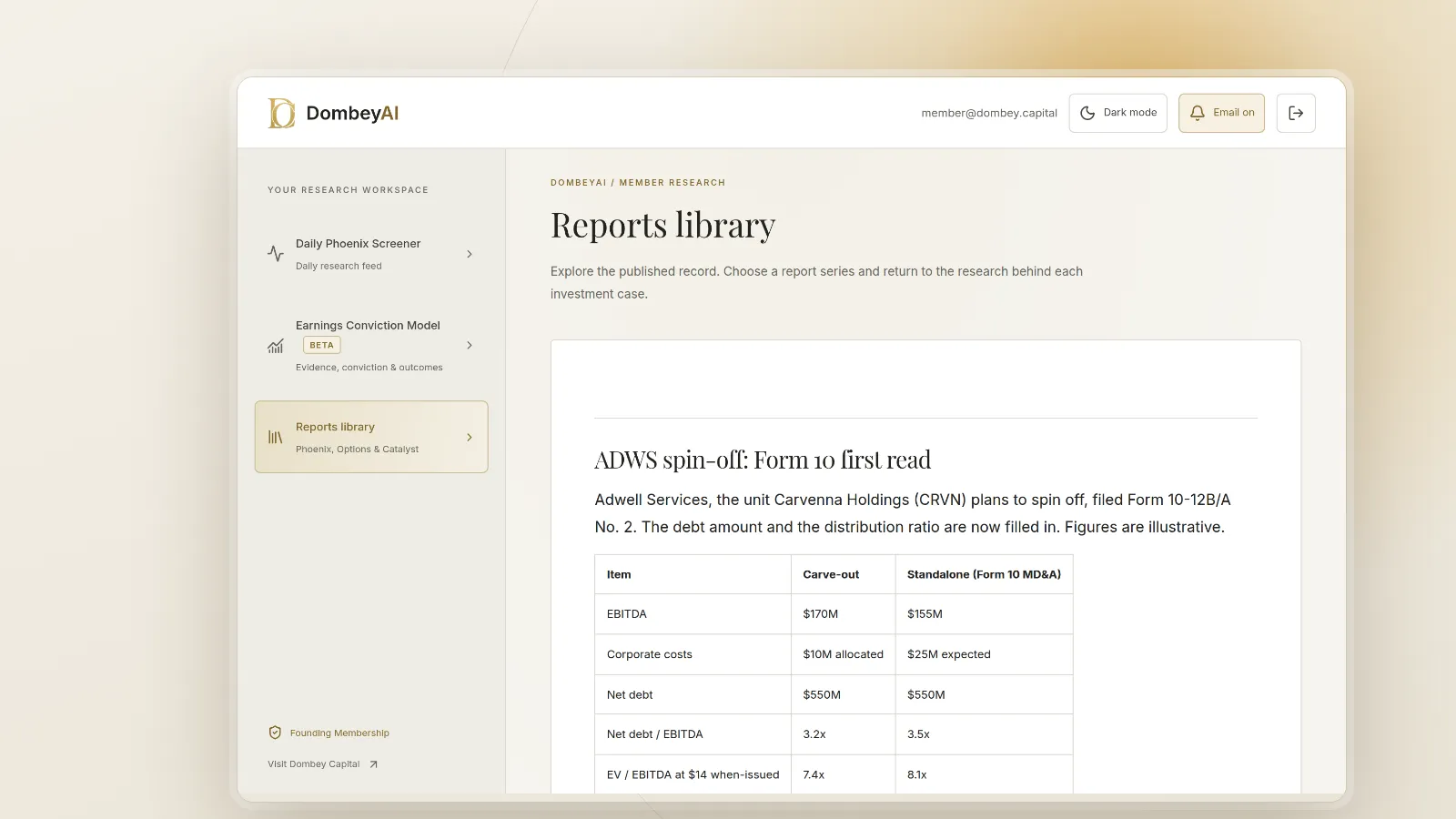
The historical financials are carve-outs. They show the business as it was run inside the parent, with corporate costs allocated by formula. The pro forma statements adjust for the new capital structure and some separation effects, and the MD&A usually discusses the expected cost of running as a standalone company. That is closer to the business you would own.
The debt is often set by the parent. It is common for the new company to borrow before the spin and send much of the proceeds to the parent as a cash distribution. That shifts value to the parent and leaves the spinco more leveraged. The capitalization table shows the result.
A worked example
The point of the example is the gap between two readings of the same filing. On the headline carve-out EBITDA, B looks cheaper and less leveraged. On the standalone figure in the MD&A, it is somewhat more expensive and carries more debt per dollar of earnings. Both numbers are in the Form 10. For the arithmetic behind the enterprise value step, see how to calculate enterprise value.
The spin-off timeline around the Form 10
The sequence below is typical, though the timing varies widely from one deal to the next.
| Stage | Event | What to check |
|---|---|---|
| Announcement | Parent announces the planned separation | Stated rationale, expected timing, whether a sale is also being considered |
| Initial filing | First Form 10 (10-12B or 10-12G) is filed | Business description, carve-out financials, blanks in key terms |
| Amendments | Form 10/A filings respond to SEC comments | Debt amount, distribution ratio, management and pay as they fill in |
| Effectiveness | Registration becomes effective | Final information statement, record date, distribution date |
| When-issued trading | New shares trade before distribution; parent may trade ex-distribution | Implied value of each piece |
| Distribution | Shares are delivered to holders of record | Index changes and the holder base |
| First reports | First 10-Q or 10-K as a standalone company | Actual standalone costs against the Form 10 estimate |
Dates from the Form 10 and the parent's 8-Ks belong on a catalyst calendar. Writing the expected terms down before the final amendment, as in a dated investment thesis, makes it clear later what changed.
How the Form 10 fits with other filings
The Form 10 is not the only document worth reading.
- If you hold the parent, read its proxy statement if shareholders vote on the separation, and its 8-Ks for board approval and the record date. The proxy statement guide covers what to look for.
- If you want the parent's view of the unit, read the segment note in the parent's latest 10-K. It shows how the unit was reported before the carve-out restated it.
- If the separation involves an exchange offer, where holders swap parent shares for new shares, expect a Securities Act registration and tender offer documents rather than only a Form 10.
- If you want filing alerts, set up EDGAR searches for the new company's name and form types 10-12B and 10-12G. The guide to searching EDGAR explains how.
Where this goes wrong
The Form 10 is a detailed disclosure document, but it has limits.
- Carve-out numbers are estimates. Allocated costs are the parent's method, not a market price. Standalone costs can come in higher than the Form 10 suggests, and the first few quarters often show it.
- Terms change late. The debt amount, the cash payment to the parent and the distribution ratio can move between amendments, sometimes close to effectiveness. An early read can be out of date.
- The agreements favor whoever wrote them. The parent drafts the separation, tax and transition agreements while it controls the subsidiary. Indemnities and tax obligations can run against the new company for years.
- Tax-free status is not certain. Many spin-offs are structured to be tax-free under Section 355 of the Internal Revenue Code and may rely on an IRS ruling or a tax opinion. If the conditions fail, the tax cost can fall on the parent, the shareholders or both, and the tax matters agreement may push that cost onto the new company.
- Management incentives are not set yet. Early drafts often describe pay plans in general terms. The final grants, and whether they reward per-share value, may only appear in the last amendment or after the spin.
- Disclosure is not valuation. The Form 10 tells you what the company owns, owes and pays. It does not tell you what the shares are worth or how holders will trade them after the distribution.
Dombey's published research reads the Form 10 and each amendment before a spin-off date; see the research archive.
The bottom line
A Form 10 registers a class of securities under Section 12(b) or 12(g) of the Exchange Act, and in a spin-off it carries the information statement that describes the new company and the terms of the separation. Read the distribution terms, the pro forma debt, the standalone costs and the agreements with the parent before the carve-out history. Track the amendments, because the key numbers often appear late. Then value the company on its standalone figures, not the ones it reported inside the parent.