

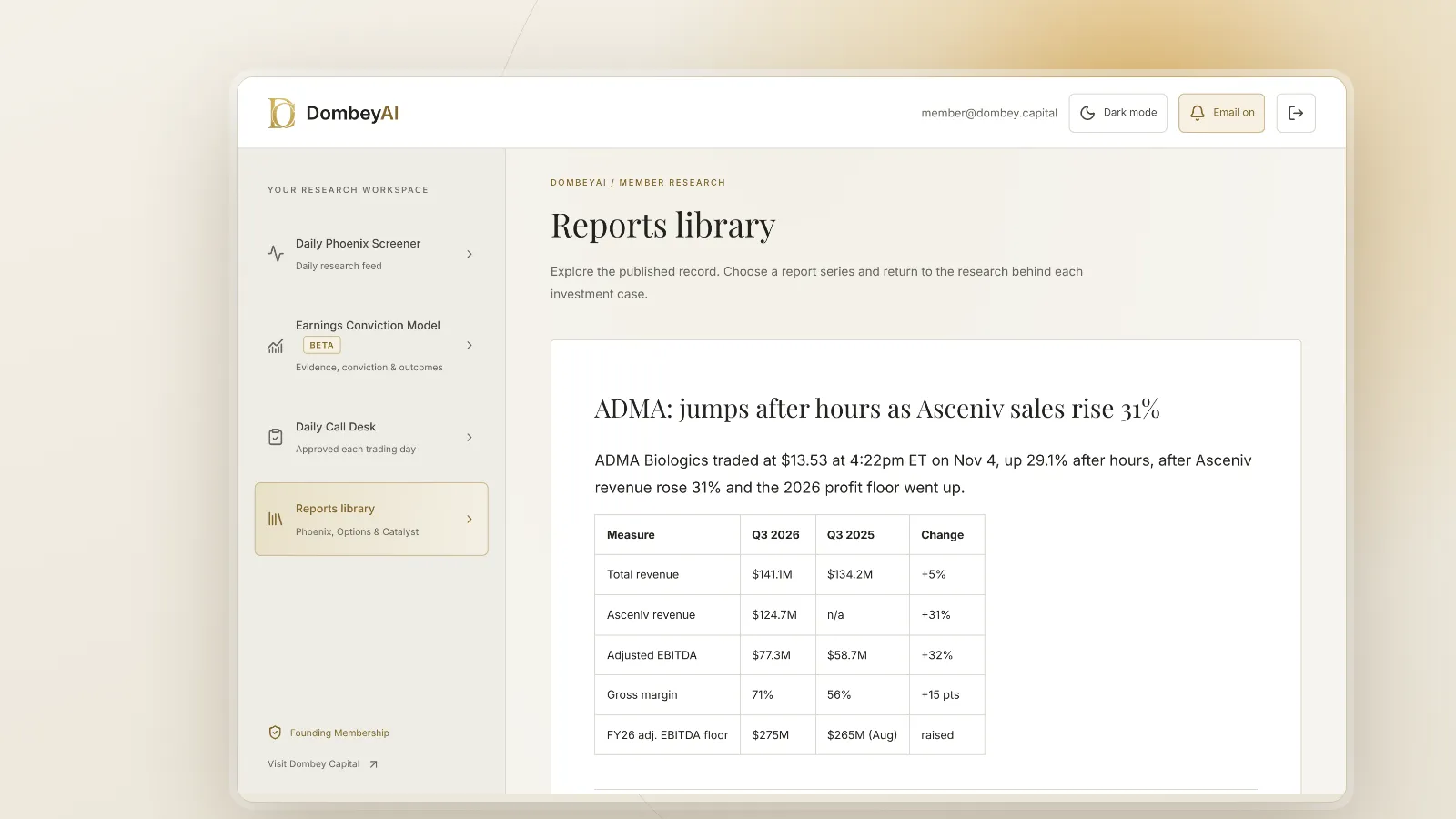
Nov 4, 2026: Asceniv carries the quarter
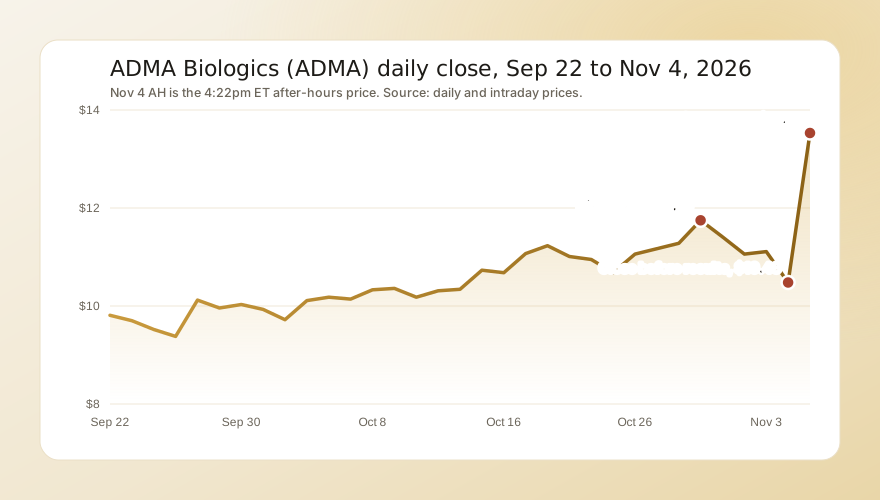
ADMA closed Nov 3 at $11.11. It opened Nov 4 at $11.49, its high of the session, and spent the morning between about $10.80 and $11.40. In the afternoon it slid, reaching a low of $10.26 at 2:59pm, and closed at $10.48, down 5.7%, on 12.4 million shares, about 4.3 times its 20-day average. The company had no news during the session, and the drop ran against the sector: the SPDR S&P Biotech ETF rose 2.7%, and the plasma peers Grifols, CSL and Takeda rose 0.6%, 1.2% and 1.5%. At the close, RSI(14) stood at 47, the shares sat 4.1% above their 50-day average and 3.5% below their 200-day average, and the stock was 48.8% below its 52-week high of $20.46.
The release came out at about 4:05pm and the call was set for 4:30pm. The stock traded near $11 for the first few minutes, then climbed from $11.30 at 4:08pm to a high of $14.80 at 4:13pm and was $13.53 at 4:22pm. The rest of the session's movers are in today's biggest stock moves.
What moved the stock:
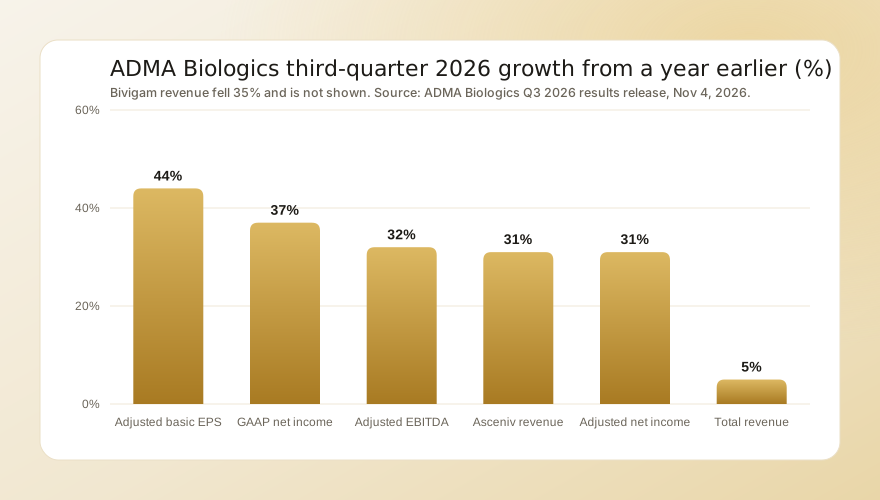
- Asceniv sped up. Revenue rose 31% to $124.7 million, against 24% growth in the second quarter. Chief executive Adam Grossman credited "expanding physician adoption, new patient starts" and said the favorable trends continued into the fourth quarter.
- Profit grew faster than sales. Gross margin rose to 71% from 56% a year earlier, helped by the higher Asceniv mix and the company's yield-enhanced manufacturing process. Adjusted EBITDA rose 32% to $77.3 million, up 25% from the second quarter, and GAAP net income rose 37% to $49.9 million.
- The profit floor went up. ADMA now expects 2026 adjusted net income of at least $180 million and adjusted EBITDA of at least $275 million. In August the ranges were $170 million to $200 million and $265 million to $300 million. Our guide to guidance changes explains why a higher floor can matter more than the quarter itself.
- Pipeline and buyback. The company said it received constructive FDA feedback on the pre-IND package for SG-001, a program it sizes at $300 million to $500 million of annual revenue if approved, and it repurchased 2.7 million shares in the quarter.
Why the stock had fallen
ADMA closed 2025 at $18.24 and set its 52-week high of $20.46 on Dec 12, 2025. On March 24, 2026, Culper Research disclosed a short position and published a report alleging that ADMA's growth was driven by "a de facto channel stuffing scheme and an undisclosed related party distributor," and estimating that reported Asceniv revenue was inflated by 40% to 76%. The stock fell 17% that day, kept falling for two more sessions and touched its 52-week low of $7.21 on March 26, the day Cantor Fitzgerald downgraded it to neutral. Our guide on how to evaluate a short-seller report covers how to test claims like these against the filings.
The second blow came on May 6. First-quarter revenue of $114.5 million was flat and far below the roughly $140 million expected, Bivigam sales fell 54%, and the company cut its 2026 revenue guide to $530 million to $560 million from more than $635 million and withdrew its long-term targets. The stock fell 24% after hours. It spent the summer between about $8 and $10, and before this report it was down 42.5% for the year.
The numbers
| Measure | Q3 2026 | Q3 2025 | Change |
|---|---|---|---|
| Total revenue | $141.1 million | $134.2 million | +5% |
| Asceniv revenue | $124.7 million | n/a | +31% |
| Bivigam revenue | $15.4 million | $23.8 million | -35% |
| Gross margin | 71% | 56% | +15 points |
| Adjusted EBITDA | $77.3 million | $58.7 million | +32% |
| GAAP net income | $49.9 million | $36.4 million | +37% |
| Adjusted basic EPS | $0.23 | $0.16 | +44% |
For the first nine months, revenue was $380.0 million and adjusted EBITDA $198.8 million. That means the full-year floors imply at least about $150 million of fourth-quarter revenue and $76 million of adjusted EBITDA, both above or near the third quarter's pace. Our page on adjusted EBITDA explains what the company adds back to reach that figure.
Cash rose to $124.6 million from $87.6 million at the end of 2025, and operating cash flow for nine months was $105.2 million. Total debt rose to about $195.9 million from about $72.1 million, and inventories grew to $266.1 million from $206.5 million. Share repurchases cost $180.3 million through September, and ADMA said it is on track for its target of $200 million or more this year, a sizable amount for a company valued at about $2.35 billion at the close. Our explainer on buybacks as catalysts covers when repurchases change the share count enough to matter.
The bull case
Asceniv is now 88% of revenue, and its growth sped up rather than slowed. ADMA said a 127-patient real-world study, to be presented at the ACAAI meeting in mid-November, showed significant drops in infection-related hospitalizations and antibiotic use after patients started the drug, which supports its pitch to doctors and payers. The margin gains show that each extra Asceniv dollar is worth more than a Bivigam dollar, so a shrinking Bivigam line hurts revenue far more than it hurts profit. Before the report the stock traded at a forward P/E of about 11, and the average analyst target was $18.67.
The risks
The channel-stuffing question has not gone away. A 21% sequential jump in Asceniv revenue is what a strong quarter looks like, but it is also what a skeptic would point to. SG&A rose to $26.6 million from $21.7 million, partly on litigation-related legal fees. Bivigam is still shrinking under price pressure, and the company chose to hold revenue at the bottom of its old range rather than reaffirm the midpoint. Debt has nearly tripled this year while inventories grew 29%. Short interest was 9.1% of the float before the report, and our explainer on short interest and squeezes covers how much of an after-hours jump can come from short sellers covering.
What comes next
The call transcript was not yet posted when we published, so management's answers on distributor inventory and fourth-quarter Asceniv orders are the next thing to read. After that come the ACAAI presentation in mid-November and the fourth-quarter report, expected around February 25, 2027, about a year after the last one. Watch whether the shares hold above the $10.48 close in the regular session, whether fourth-quarter revenue clears $150 million, and whether Bivigam sales stop falling.