

Why most buyback announcements change little
A board authorization sets a maximum amount and sometimes an expiry date. It does not oblige the company to buy anything. Many programs run for years, get topped up before they are used, or quietly lapse.
That is why the earlier piece on hard vs soft catalysts files a buyback authorization under soft. It fails two of the three tests: there is no date by which shares must be bought, and the outcome depends on execution. It only partly passes the third, because purchases do add buying pressure and reduce the share count when they happen.
Three other things blunt most programs:
- Size. An authorization worth 2% of market value spread over three years barely moves the share count.
- Offsetting issuance. Stock compensation and conversions can add back the shares bought.
- Price. A company that buys at any price is spending shareholders' cash, not necessarily creating value for them.
The four tests that make a buyback matter
Run every repurchase program through four questions before treating it as part of a thesis.
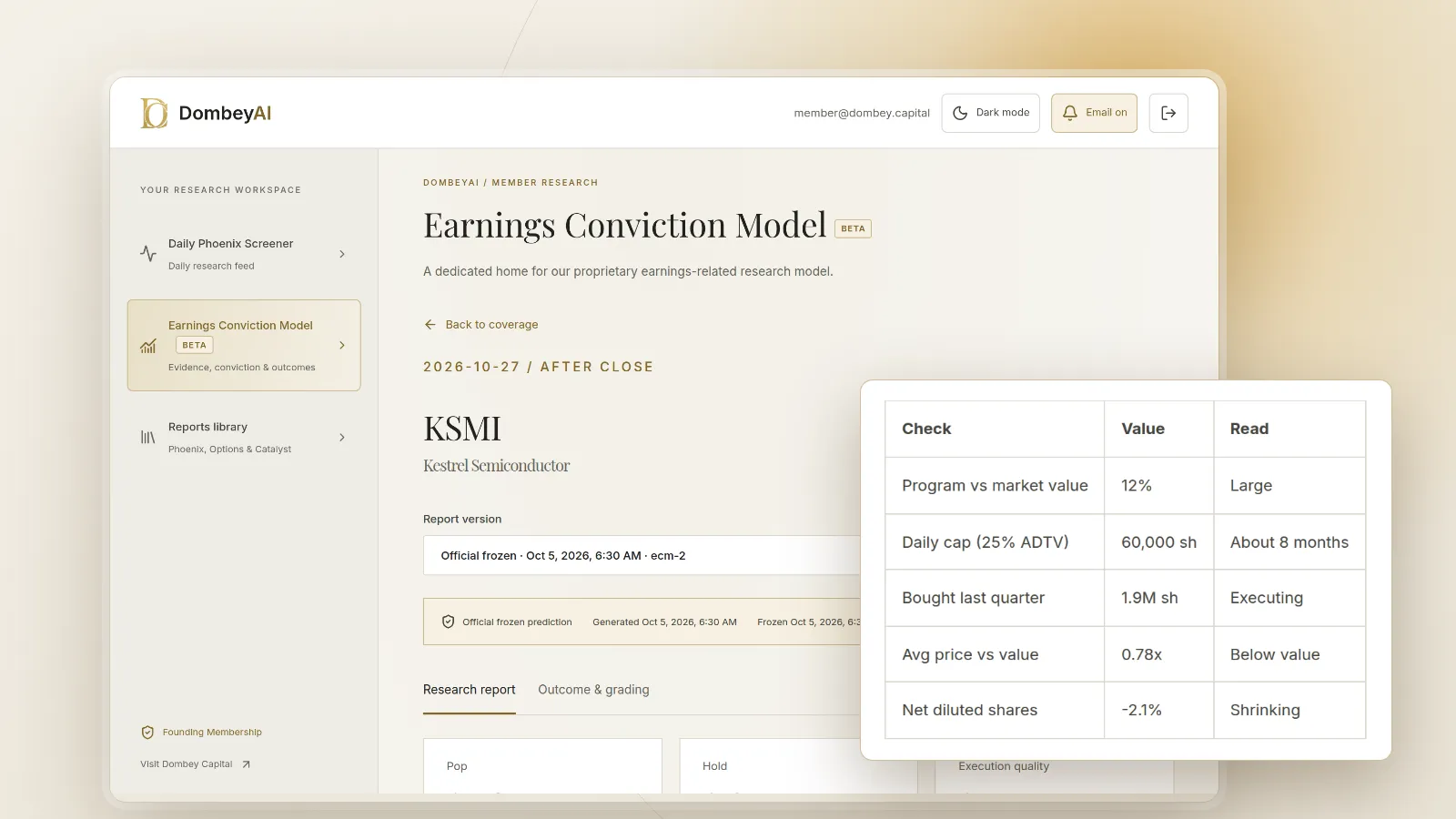
- Is it large? Compare the authorization to market value and to the float, not to the company's past programs. A program equal to 10% or more of the market value is in a different category from one equal to 1%.
- Is it funded? Check cash, free cash flow and debt capacity. A program paid from surplus cash or recurring free cash flow is credible. One that needs new borrowing in a weak business is a risk, not a catalyst.
- Is it priced well? Buying below a conservative value raises value per share for the holders who stay. Buying above value moves wealth to the holders who sell.
- Is it being executed? The repurchase table in the next filing answers this. An announcement with no purchases a quarter later tells you more than the press release did.
Quick reference: buyback forms compared
| Form | Amount set? | Timetable set? | Main filing | Catalyst type |
|---|---|---|---|---|
| Open-market authorization | Maximum only | No, or a loose expiry | 8-K or press release, then 10-Q and 10-K tables | Soft |
| Open-market program under a 10b5-1 plan | Within plan terms | Plan schedule, often not public | Same as above | Soft to mixed |
| Accelerated share repurchase | Yes, a fixed dollar amount | Yes, a contract term | 8-K with the agreement terms | Mixed to hard |
| Fixed-price tender offer | Yes | Yes, at least 20 business days | Schedule TO | Hard |
| Dutch auction tender offer | Yes, within a price range | Yes, at least 20 business days | Schedule TO | Hard |
| Privately negotiated block purchase | Yes | Usually immediate | 8-K, footnote to the repurchase table | Hard but one-off |
The pattern matches other catalysts: the more the paper fixes the amount and the date, the harder the event. A tender offer is governed by Rule 13e-4 and must stay open at least 20 business days, which is why it sits at the hard end. The step-by-step version is in how to evaluate a tender offer.
How fast can a company actually buy?
Open-market repurchases are paced by trading volume. Rule 10b-18 gives issuers a safe harbor from manipulation claims based on the manner, timing, price and volume of their purchases, if they meet four conditions each day:
- One broker or dealer. Solicited purchases go through a single broker or dealer on any day.
- Timing. No opening purchase, and no purchases in the last 10 minutes of the session for securities with ADTV of at least $1 million and public float of at least $150 million, or the last 30 minutes for all others.
- Price. No higher than the highest independent bid or the last independent transaction price, whichever is higher.
- Volume. No more than 25% of ADTV, the average daily trading volume over the four calendar weeks before the week of purchase. Once a week, a company may make one block purchase in place of that day's 25% limit.
Compliance is voluntary, and missing any one condition removes all of that day's purchases from the safe harbor. Most companies follow it, so the 25% limit is a practical ceiling on pace.
This is why a large program in a thinly traded stock can matter more than it looks. The company may be the steady buyer for months, absorbing sellers that would otherwise push the price down. It is also why such a program cannot be finished quickly through the open market. A company that wants to retire a large block fast will usually use a tender offer or an accelerated repurchase instead.
How to check whether the company is buying
Item 703 of Regulation S-K requires a table of issuer repurchases in each quarterly and annual report. It shows, for each month of the period:
- the total number of shares purchased
- the average price paid per share
- the shares bought under publicly announced plans or programs
- the maximum number of shares, or approximate dollar value, that may still be bought under those programs
Footnotes give each program's announcement date, approved amount and expiry, and flag programs that expired or that the company has decided to stop using. Purchases outside an announced program, such as shares withheld to cover employee tax on vesting, are counted in the total and explained in a footnote.
| Step | What to check | Where to find it |
|---|---|---|
| 1 | Authorization amount, expiry and funding source | 8-K or press release; see how to read an 8-K for catalysts |
| 2 | Shares bought each month and average price | Part II, Item 2 of the 10-Q; Item 5 of the 10-K |
| 3 | Amount remaining under the program | Column (d) of the same table |
| 4 | Cash spent on repurchases | Financing section of the cash flow statement |
| 5 | Net change in diluted shares | Income statement share count, several years |
| 6 | Shares issued for compensation and conversions | Equity statement and stock compensation note |
The average price column is the one to compare with your estimate of value. A company that bought heavily at a high price and stopped when the stock fell has a different record from one that bought more as the price dropped. Our guide to reading a 10-Q for special situations covers where else to look in the quarterly report.
When a buyback becomes a hard catalyst
A buyback hardens when the paper fixes the amount and the date. Watch for these conversions:
- If the company signs an accelerated share repurchase, a bank delivers most of the shares up front and the contract sets a final settlement window, so the amount is committed.
- If the company files a Schedule TO, the offer has a price or range, a size and an expiry, and you can model proration.
- If the company agrees to buy a block from a large holder, the purchase is defined and usually immediate, and the seller's overhang is gone.
- If the authorization is paired with a debt financing or an asset sale whose proceeds are earmarked for repurchases, the funding is real, though the timetable may still be loose.
- If an activist's 13D asks for capital return and the board agrees in a settlement, the commitment becomes public and harder to drop.
Each of these leaves a filing. A buyback that lives only in a conference call remark has not hardened.
Where this goes wrong
Buying back a declining business. A buyback in a business whose earnings are shrinking can retire shares at a price that later looks expensive. A low multiple and a large program do not rule out a value trap.
Counting dollars, not shares. Repurchase spending that only offsets stock compensation returns nothing to holders. The diluted share count over three to five years is the honest measure.
Borrowing to buy. Debt-funded programs raise leverage. If results weaken, the company may need to stop buying and conserve cash at the point when the shares are cheapest.
Assuming the program will be used. Boards authorize more than they spend. Plan on what the table shows, not on what the press release allows.
Ignoring blackout periods and pacing. Without a 10b5-1 plan, many companies avoid buying around earnings while they hold material information. Volume limits slow purchases further in thinly traded stocks.
Treating a buyback as a floor. A buyback can slow a fall, but it does not set a price. A company can stop buying at any time.
Common mistakes
- Reading the announcement as a valuation call. Management may think the stock is cheap, or may want to offset dilution, support earnings per share or use idle cash. Read what the filings show, not the motive the release implies.
- Comparing the program with the wrong base. Use market value and float, not the size of the last program or the company's revenue.
- Skipping the footnotes. The footnotes say when a program expires and whether the company has stopped using it.
- Not checking pace against volume. A large authorization in a stock that trades little cannot be completed quickly in the open market.
Dombey's published research checks funding, pace and price for any buyback that forms part of a thesis; see the research archive.
The bottom line
A buyback authorization is a soft catalyst: a maximum, with no date and no obligation. It starts to matter when it is large against market value and trading volume, funded from cash the business does not need, and executed below a conservative value. The Item 703 table in each 10-Q and 10-K shows whether the company is actually buying and at what price, and the diluted share count shows whether it is working. Tender offers, accelerated repurchases and negotiated block purchases are the forms that come closest to a hard event, because the filing fixes the amount and the timetable.