

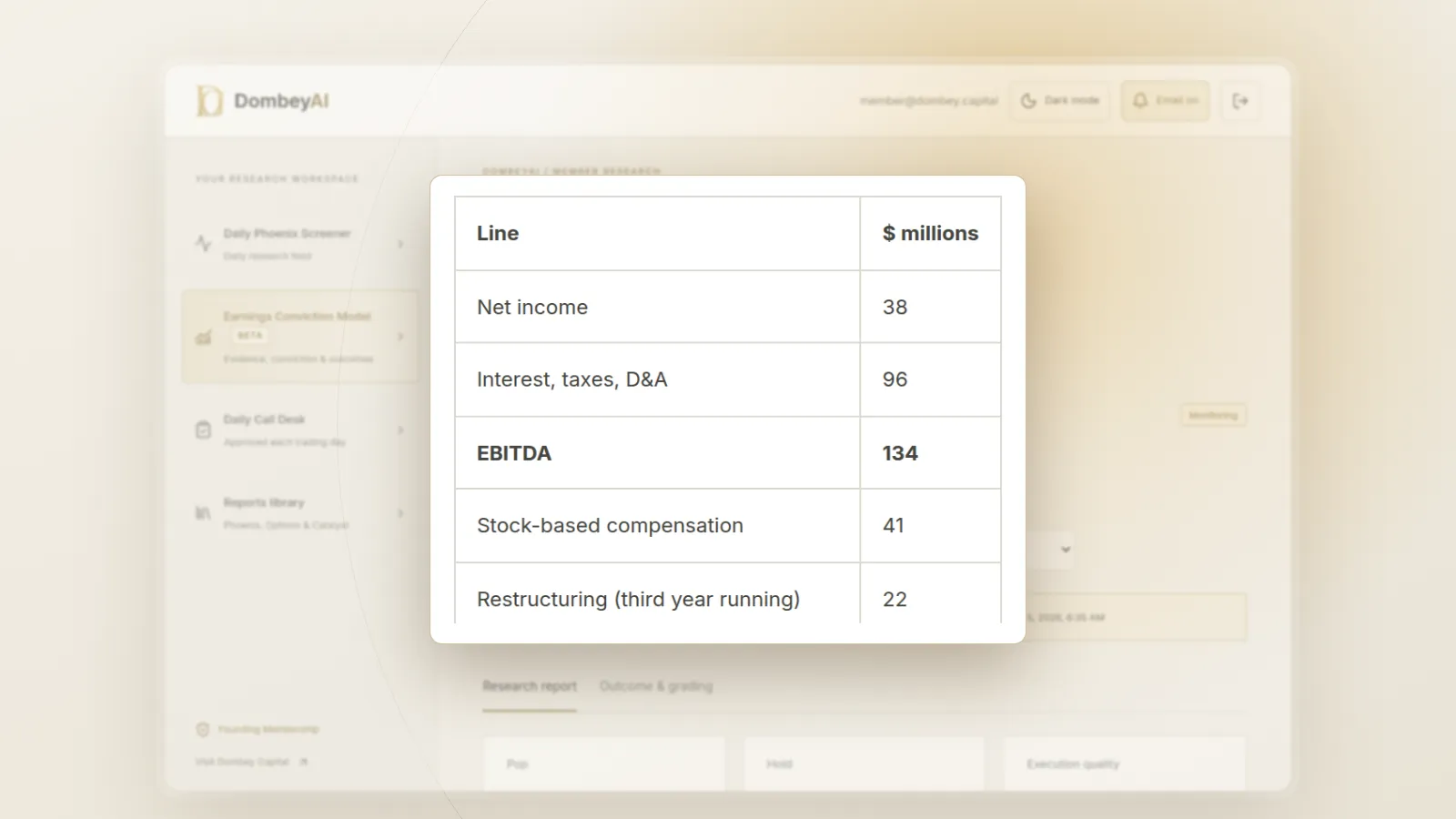
How adjusted EBITDA is built
The calculation starts from GAAP net income and moves up in two stages.
The first stage produces plain EBITDA. It adds back interest, income taxes, depreciation and amortization. SEC staff guidance treats this as a defined term: the "earnings" in EBITDA means net income as shown in the GAAP income statement.
The second stage is where companies differ. Management adds back any further items it considers outside the normal run of the business. Common ones include:
- Stock-based compensation
- Restructuring and severance
- Acquisition, integration and transaction costs
- Litigation settlements and legal fees
- Asset impairments and gains or losses on asset sales
- Changes in the fair value of contingent consideration or warrants
- Pro forma results of acquired businesses and expected cost savings
Some of these are fair. An impairment is a non-cash write-down of past spending, and a gain on selling a building says little about the operating business. Others remove costs that the business pays every year. The label "adjusted" does not tell you which kind you are looking at. Only the reconciliation does.
The add-backs to question
| Add-back | Company's usual reason | What to check | Conservative treatment |
|---|---|---|---|
| Stock-based compensation | Non-cash | Diluted share count growth, buyback spending | Treat as an operating cost |
| Restructuring | Not part of ongoing operations | How many of the last five years had a charge | Leave in if it recurs |
| "One-time" costs | Unusual or infrequent | Whether a similar item appeared in the prior two years | Leave in if it recurs |
| Acquisition and integration costs | Tied to specific deals | Whether the company is a serial acquirer | Leave in for serial acquirers |
| Pro forma cost savings | Expected from a completed deal | Whether savings have shown up in reported costs | Exclude until realized |
| Impairments and asset sale gains | Non-cash or non-operating | Whether they reflect overpaying for past deals | Usually accept, but note the cause |
Stock-based compensation
This is the largest add-back at many technology and growth companies. The argument for adding it back is that no cash leaves the business. The argument against is stronger: employees are paid partly in shares because they would otherwise need to be paid in cash. Shareholders bear the cost through dilution, and many companies then spend real cash on buybacks to hold the share count flat. If you add back the compensation and ignore the buybacks, you count the benefit and skip the cost.
Restructuring that recurs
A restructuring charge is meant to be a single event: closing a plant, cutting a layer of management. When a company records one every year, it is a cost of running that business. Pull five years of reconciliations and count the years with a charge. If the answer is four or five, treat the average as an ongoing expense.
"One-time" costs
Litigation, system upgrades, consulting fees for a transformation program and inventory write-downs are often labeled one-time. Read the descriptions across several years. A company in a litigious industry will always have legal costs, and a company that is always transforming will always pay consultants. SEC rules for filed documents, covered below, restrict calling an item nonrecurring when a similar charge occurred in the prior two years or is reasonably likely within the next two.
Pro forma cost savings from acquisitions
This is the add-back furthest from historical results. After an acquisition, some companies add the target's earnings for the period before the deal closed and then add the cost savings management expects to achieve. The second part is a forecast. It is common in credit agreements, where covenant EBITDA often permits expected savings, sometimes capped as a share of EBITDA. The effect is to make leverage look lower at exactly the point the company has taken on debt. Our piece on the debt maturity wall covers why that matters when the loans come due.
What the SEC requires
Regulation G
Regulation G was adopted in 2003 under the Sarbanes-Oxley Act. It applies whenever a public company publicly discloses a non-GAAP financial measure, whether in a press release, on an earnings call, in a presentation or on its website. It has two core requirements:
- Present the most directly comparable GAAP financial measure alongside it.
- Provide a quantitative reconciliation showing the differences between the non-GAAP measure and that GAAP measure.
It also prohibits a non-GAAP measure that, taken with its accompanying information, contains an untrue statement of a material fact or omits one needed to make it not misleading. For adjusted EBITDA presented as a performance measure, the comparable GAAP measure is normally net income.
Item 10(e) of Regulation S-K
Item 10(e) applies when the measure appears in a document filed with the SEC, such as a 10-K, 10-Q or registration statement. It adds stricter conditions. The company must:
- Present the GAAP measure with equal or greater prominence.
- Include the reconciliation.
- Explain why management believes the measure is useful to investors and, to the extent material, how management uses it.
It also prohibits certain practices in filed documents. A company may not adjust a performance measure to remove items it calls nonrecurring, infrequent or unusual when a similar charge or gain is reasonably likely within two years or occurred within the prior two years. It may not present non-GAAP measures on the face of the GAAP financial statements or in the accompanying notes, and it may not use titles that are confusingly similar to GAAP titles.
Earnings releases furnished under Item 2.02 of Form 8-K sit in between: they must meet Regulation G and some of the Item 10(e) presentation requirements, including the prominence and reconciliation rules. Our guide on reading an 8-K for catalysts shows where the earnings release exhibit sits.
Staff guidance
The SEC's Division of Corporation Finance publishes compliance and disclosure interpretations on non-GAAP measures. Among other points, they say that excluding normal, recurring cash operating expenses necessary to run the business can make a measure misleading, and that a measure calculated differently from EBITDA should not be called EBITDA. Staff apply these points through comment letters, which are public on EDGAR after the review closes.
A worked example: rebuilding the number
| Line | Company A's figure | Conservative rebuild |
|---|---|---|
| Net income | $30m | $30m |
| Interest, taxes, depreciation, amortization | $70m | $70m |
| EBITDA | $100m | $100m |
| Stock-based compensation | +$20m | 0 |
| Restructuring (charges in 4 of last 5 years) | +$10m | 0 |
| Acquisition and integration costs | +$5m | +$5m |
| Pro forma cost savings not yet achieved | +$15m | 0 |
| Adjusted EBITDA | $150m | $105m |
| Net debt to adjusted EBITDA | 3.0x | 4.3x |
The rebuild keeps one add-back: Company A made a single acquisition in five years, so its deal costs look genuinely occasional. It rejects the rest. Stock compensation is a pay cost, restructuring recurs, and the savings have not happened yet. The result is 30% lower, and leverage moves from a level many lenders treat as ordinary to one that limits refinancing options. Any EV/EBITDA multiple built on the reported figure would be understated by the same proportion.
How to read a reconciliation
- If the same add-back appears in three or more of the last five years, treat it as a recurring cost.
- If adjusted EBITDA grows much faster than cash from operations over several years, the add-backs are hiding cash costs. Compare the two using how to read a cash flow statement.
- If the definition changes from one year to the next, recompute the prior year on the new basis, or the current year on the old one, before comparing growth.
- If management pay is tied to adjusted EBITDA, read the definition in the proxy statement and note any differences from the earnings release.
- If an add-back is described only as "other", ask on the call or search the 10-K notes for the detail.
The full-year reconciliation usually sits in the 10-K, either in management's discussion and analysis or in the earnings exhibit. Data platforms often use their own EBITDA definitions, so a screen's figure may not match the company's; our guide to stock research tools compares how the main ones report fundamentals.
Where this goes wrong
- Rejecting every add-back. Some adjustments are fair. Impairments, gains on asset sales and genuinely rare deal costs say little about future operating profit. A rebuild that rejects everything is as distorted as one that accepts everything.
- Comparing adjusted figures across companies. Two companies with the same adjusted EBITDA may have used entirely different definitions. Rebuild both on one basis first.
- Ignoring the cash flow statement. Adjusted EBITDA is still an accrual measure before capital spending. A clean rebuild can still overstate cash generation; free cash flow yield is the cross-check.
- Missing changes in definition. Companies sometimes add a new category of adjustment in a weak year. The growth rate then reflects the new definition, not the business.
- Treating SEC compliance as approval. A reconciled measure meets the disclosure rules. It does not mean the adjustments are reasonable. That judgment is yours.
Dombey's published research rebuilds adjusted figures from the filings before using them in any valuation; see the research archive.
The bottom line
Adjusted EBITDA is EBITDA with extra costs removed by management, so its value depends entirely on which costs were removed. Stock-based compensation, recurring restructuring, "one-time" costs that repeat and pro forma savings from deals are the add-backs to question first. Regulation G and Item 10(e) give you a reconciliation to net income, not a reasonable number. Read that table across several years, keep the adjustments that are genuinely rare, and use the rebuilt figure in every multiple and leverage ratio that follows.