

What you need
- The full report, including appendices and the disclaimer that discloses the author's position.
- The company's last two 10-K filings, the latest 10-Q and recent 8-K filings, from EDGAR.
- The proxy statement, for related-party transactions and board composition.
- Any public records the report cites: court filings, state corporate registries, property records, regulatory databases.
- The company's response, if it has published one, and the transcript of any call it held.
- Short interest and options data for the stock.
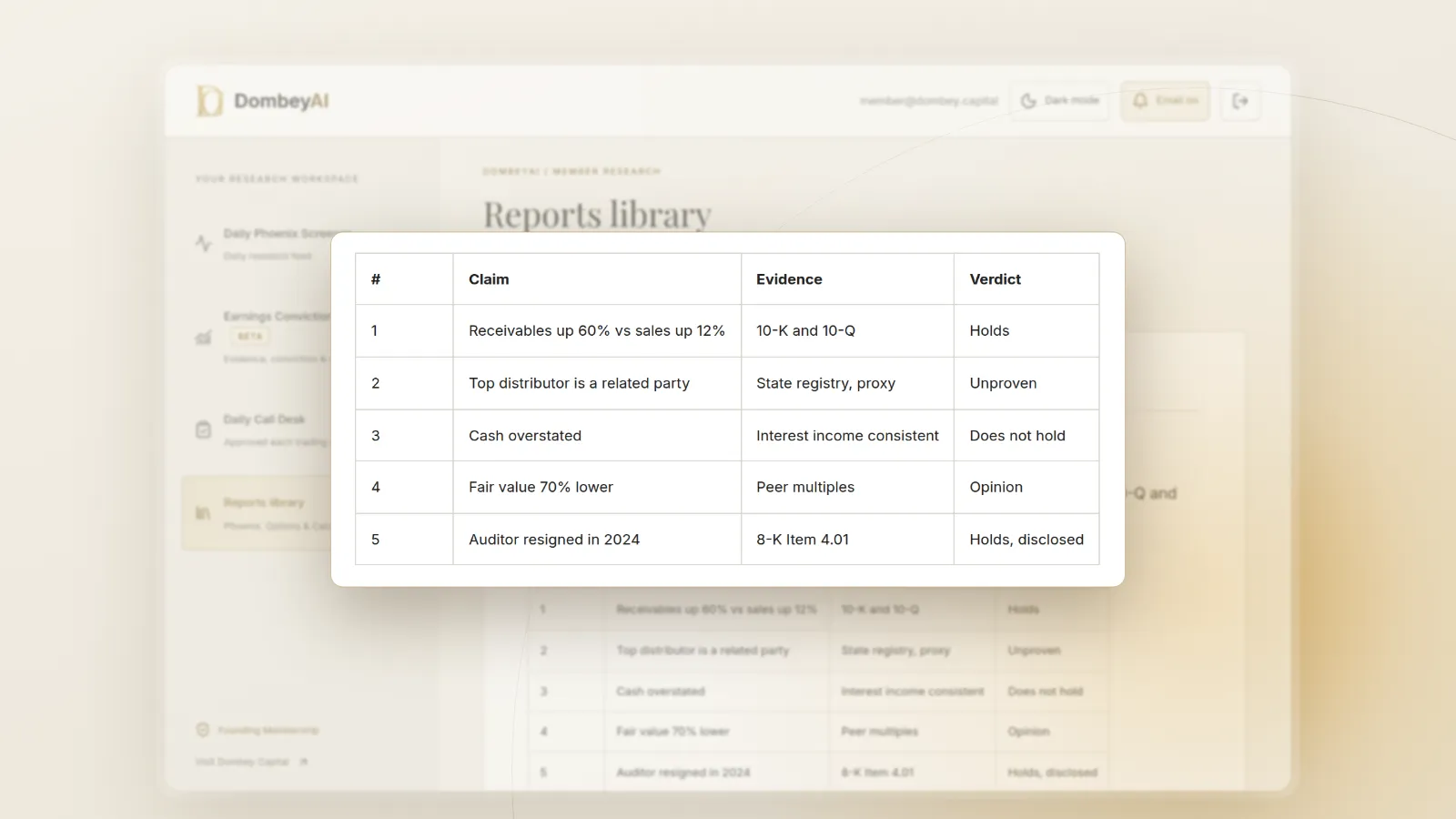
- A blank spreadsheet with four columns: claim, evidence cited, what the filings show, your verdict.
Step 1: Identify the author and the position
Read the disclaimer first. Most reports state that the author holds a short position and may trade in the stock after publication. Note whether the author has published before and how earlier reports turned out, but do not let reputation stand in for evidence on this one.
Note the timing as well. A report published just before an earnings date, a shareholder vote or a debt deadline is built to land on that catalyst. The author also has an incentive to make the strongest case, which is the reason to read it with care, not to dismiss it.
Step 2: List every claim separately
Reports mix strong and weak points to build momentum. Pull them apart. Write each allegation as one line in your spreadsheet, in the author's own terms, with the page it appears on.
Then sort each claim into one of three groups:
| Type of claim | Example | How to test it |
|---|---|---|
| Verifiable from documents | Revenue reported to a regulator differs from revenue in the 10-K | Pull both documents and compare |
| Plausible but unproven | A supplier is secretly a related party | Look for registry, address or officer overlaps |
| Opinion about value | The stock is worth 70% less on peer multiples | Rebuild the valuation yourself |
Verifiable claims carry the most weight, in either direction. Opinions about value are the weakest, because a valuation argument is a matter of assumptions, not facts.
Step 3: Check the numbers against the filings
Before reading the company's reply, test the verifiable claims yourself. Our guide on how to read a 10-Q for special situations lists where the key figures sit.
Common areas to check:
- Cash and cash flow. Does reported cash match interest income? Does operating cash flow track net income over several years, or does the gap keep widening?
- Receivables and inventory. Are days sales outstanding or inventory days rising faster than revenue?
- Related parties. What does the related-party note in the 10-K and the proxy disclose, and does it match what the report found?
- Off-balance-sheet items. Guarantees, unconsolidated entities and commitments in the notes; our article on off-balance-sheet liabilities covers what to look for.
Step 4: Check the public records the report cites
Follow every citation. Open the court docket, the registry entry or the regulatory database yourself. Reports sometimes cite a document accurately but draw more from it than it says. Note where the author's inference goes beyond the source. Our article on primary vs secondary sources in equity research explains why the original document is the only thing to rely on.
Step 5: Read the company's response
Now read the reply. Score it claim by claim, using the same spreadsheet.
Strong responses address each allegation, cite documents, and offer something checkable: a reconciliation, a bank confirmation, an independent investigation by a committee of outside directors with its own counsel.
Weak responses deny everything in general terms, attack the author's motives, or announce a buyback without answering the points. A company with good answers usually gives them.
Watch what the company leaves out. If it answers seven claims in detail and skips the eighth, the eighth is where to focus.
Step 6: Look at the stock's setup
The report lands on a stock with its own positioning. Check short interest and days to cover; our explainer on short interest and squeeze risk covers how to read them, and our comparison of short interest data tools lists where to find the figures.
High short interest after a report means a convincing rebuttal can produce a sharp rally as shorts cover, whatever the long-term truth. Options pricing tells you how large a move the market expects from the next development.
Step 7: Track the follow-on events
The weeks after a report usually tell you more than the report. Put these on a calendar:
| Event | Where it appears | What it can mean |
|---|---|---|
| Auditor resignation or dismissal | 8-K Item 4.01 | Disagreement over accounting, or a scope issue |
| Late filing notice | NT 10-K or NT 10-Q | The company cannot complete its accounts on time |
| Special committee investigation | Press release or 8-K | The board is taking the claims seriously |
| Regulatory inquiry or subpoena | 8-K or 10-Q legal proceedings note | An outside body is looking at the same issues |
| Restatement | 8-K Item 4.02 | Prior financial statements can no longer be relied on |
Any of these strengthens the report's case. A clean audit opinion on time, with no new disclosures, weakens it. Our article on what a financial restatement is covers the most serious outcome.
Step 8: Build cases for both outcomes
Write down what the stock is worth if the verified claims are the whole story, and what it is worth if the unproven claims turn out true as well. Our guide on how to build a base and worst case shows the method. The gap between the two cases, against the current price, tells you whether the market has priced the risk, overpriced it or ignored it.
Common mistakes
- Accepting the report whole. One strong claim does not prove the weak ones. Score each separately.
- Dismissing it because of the author's motive. A short position explains why the report was written, not whether it is right.
- Reading the company's reply first. You will anchor on management's framing. Do your own check of the filings before reading either side's conclusion; confirmation bias works in both directions.
- Trading on the first day's move. The opening reaction reflects positioning and fear more than evidence.
- Ignoring the squeeze risk. Even a correct report can be followed by a sharp rally if a rebuttal lands while short interest is high.
Dombey's published research follows situations like this through their dated follow-on events; see the research archive. For newsletters that cover special situations of this kind, see the 10 best investing newsletters for special situations.
The bottom line
A short seller report is an argument from someone who profits if the stock falls, so treat it as a list of claims to test. Sort the claims, check the verifiable ones against the filings and public records, then score the company's response on the same terms. The events that follow, such as auditor changes, late filings and investigations, usually settle more than the report itself. Your conclusion should rest on the claims that survive your own checks.