

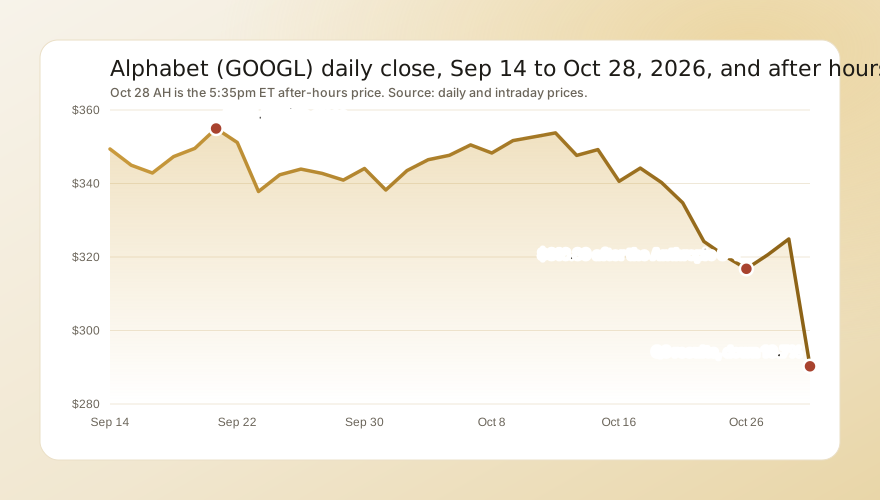
Oct 28, 2026: up 1.3% in the session, down 10.7% after the release
Alphabet traded between about $323 and $326 through the afternoon and closed at $324.89, up from $320.58, as the Nasdaq rose after the Federal Reserve held rates. The results crossed just after 4pm. The stock was at $315.50 in the first after-hours minute, near $301 by 4:03pm, and $290.27 at 5:35pm, its lowest level since April, Seeking Alpha reported.
| Measure | Q3 2026 | Q3 2025 | Expected |
|---|---|---|---|
| Revenue | $127.6B | $102.3B | $128.0B |
| Diluted EPS | $2.12 | $2.87 | $3.02 |
| Google Services revenue | $96.3B | $87.1B | $98.5B |
| Google advertising revenue | $82.0B | $74.2B | $83.6B |
| Google Services operating income | $39.2B | $33.5B | $40.8B |
| Google Cloud revenue | $30.7B | $15.2B | $29.1B |
| Google Cloud operating income | $11.1B | $3.6B | $9.8B |
| Free cash flow | -$9.1B | $24.5B | n/a |
What pushed it down:
- An earnings miss that was not only accounting. An $8.7 billion loss on equity securities lowered earnings by $0.55 a share, the release said. Without it earnings were about $2.67, still well below $3.02. Alphabet's equity holdings include its stake in Anthropic; we covered how those marks move its results in what Anthropic's loss means for Alphabet and Amazon stock.
- Search slowed. Search and other revenue rose 12% to $63.4 billion, after 17% in the second quarter and 19% in the first. On the call, management said currency was the biggest reason, and that AI Mode queries, which are growing fast, earn less per search for now. YouTube ad revenue rose 9% to $11.2 billion.
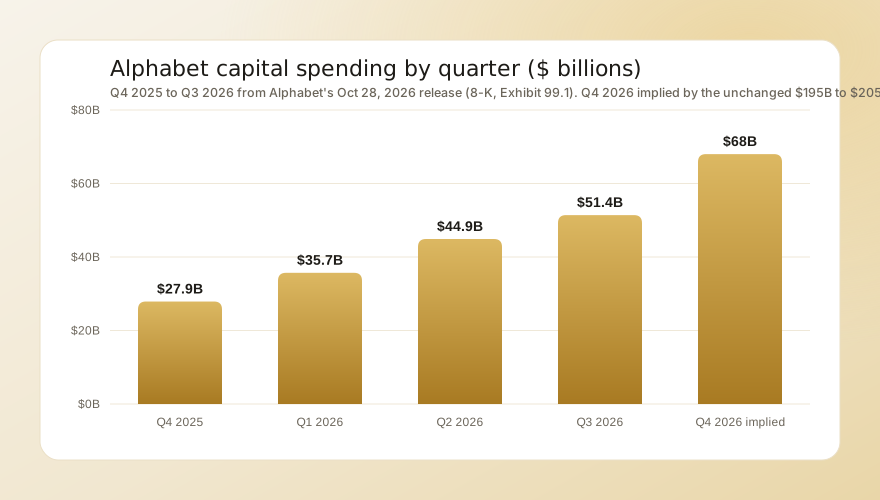
- Cash flow went further negative. Capital spending rose to $51.4 billion from $44.9 billion, more than the $42.3 billion of operating cash flow, so free cash flow was negative $9.1 billion after negative $5.9 billion in the second quarter. Trailing 12-month free cash flow is $19.7 billion, about 0.6% of the roughly $3.6 trillion market value at $290.27.
- The fourth quarter was flagged as harder. The CFO said the currency headwind will be larger than in the third quarter, that renting third-party compute capacity will pressure margins, and that the ramp of TPU sales will weigh on free cash flow, Dow Jones reported from the call.
Other large AI names moved in the same after-hours session, with Microsoft reporting at the same time:
| Stock or fund | Oct 28 close | 5:35pm ET | Change |
|---|---|---|---|
| Alphabet (GOOGL) | $324.89 | $290.27 | -10.7% |
| Alphabet Class C (GOOG) | $321.89 | $287.61 | -10.6% |
| Broadcom (AVGO) | $351.81 | $341.44 | -2.9% |
| Invesco QQQ (QQQ) | $725.61 | $718.00 | -1.0% |
| Amazon (AMZN) | $254.60 | $252.40 | -0.9% |
| Meta (META) | $612.49 | $618.94 | +1.1% |
| Microsoft (MSFT) | $531.01 | $551.06 | +3.8% |
Broadcom designs the TPU chips with Google, so it fell with Alphabet. Microsoft rose after its own results, where Barron's reported capital spending came in lower than expected, which shows what investors rewarded on the same evening.
Why the spending mattered more than the cloud beat
Barron's put it plainly: missing on earnings is not an option for a company asking investors to fund this much AI investment. Alphabet kept its 2026 capital spending guide of $195 billion to $205 billion. It spent $132.0 billion through September, so the midpoint leaves about $68 billion for the fourth quarter, a third more than the record third quarter. The CFO said spending will increase significantly in 2027, and Barron's reported $924 billion of future purchase commitments at the end of September.
The money now comes from outside as well as from the business:
| Through Sep 30, 2026 | Amount |
|---|---|
| New debt issued | $85.2B |
| Common stock sold | $42.9B |
| Mandatory convertible preferred sold | $19.1B |
| Share repurchases | $0 |
| Long-term debt | $125.1B, from $46.5B at Dec 31, 2025 |
| Cash and marketable securities | $265.1B |
| Shares outstanding | 12.29B, from 12.09B at Dec 31, 2025 |
That is a change in what owning the stock means. Alphabet bought back $39.8 billion of stock in the first nine months of 2025; in 2026 it has bought back none and sold $12.4 billion of common stock in the third quarter alone. Barron's reported it is the first time since 2015 the company has gone three quarters without a repurchase. For how a rising share count hits each holder, see how dilution works, and for why negative free cash flow matters at this size, free cash flow yield.
The case for the stock
- Cloud is now a second profit engine. Google Cloud's operating income of $11.1 billion was 22% of combined Services and Cloud operating income, from 10% a year earlier, at a 36% margin. Sales of TPU systems to outside customers add a revenue line the other cloud companies do not have, which Yorkville Ives analyst Dan Ives highlighted after the report.
- Search demand is growing. Alphabet said query growth is the highest in five years and AI Mode queries are about three times longer than traditional searches. If those queries earn closer to normal rates over time, the Search slowdown reverses.
- The valuation already fell. Before the report the forward P/E was about 21; at $290.27 it is near 19, and the stock is 29% below its 52-week high of $408.61. The consensus target before the report was $426.93. See forward vs trailing P/E for why we use the forward figure here, since the trailing figure is lifted by $126.8 billion of investment gains this year.
- The balance sheet is deep. $265.1 billion of cash and securities covers the $125.1 billion of long-term debt about twice.
The risks
- Spending keeps rising before cash returns. The fourth quarter implies the largest spending quarter yet, and 2027 rises from there. Until free cash flow turns positive, more stock and debt sales are likely.
- Search is the cash engine and it slowed. BNP Paribas analyst Nick Jones said the 2% Search miss is likely to add to fears that AI assistants take share from Google, Seeking Alpha reported.
- Anthropic concentration. Anthropic's prospectus, filed Monday, showed it has committed about $114.5 billion to Google Cloud through 2033, and Google owns more than 5% of it. Barron's noted that much of Cloud's and the TPU business's future depends on that one customer, which also shows up as swings in Alphabet's investment gains and losses.
- The fourth quarter is guided lower in parts. A larger currency hit and margin pressure from rented capacity were both named on the call, and our guide to guidance changes covers how markets treat a quarter flagged in advance.
For how to read the segment tables in a release like this, see our guide to the earnings release, and more of today's biggest stock moves.
What comes next
- Thursday's regular session. After-hours prices trade on thin volume; the Oct 29 open will show whether the drop holds near 11%.
- Analyst updates. Estimate and target changes are likely over the next days, starting from a $426.93 consensus target.
- The 10-Q. The quarterly filing will give the remaining performance obligation for Google Cloud and more detail on purchase commitments.
- Fourth-quarter results. Expected in early February 2027, with the first 2027 capital spending number and the fourth-quarter free cash flow.
Dombey's published work on event-driven moves is in the research archive.