

Oct 29, 2026: a 24.6% response rate, and a 34% drop
The updated results, from an Oct 14 data cutoff, cover 30 more patients than the November 2025 update. Seventeen of 69 patients responded: 15 confirmed responses and 2 unconfirmed partial responses awaiting confirmation. Iovance said durability and safety were consistent with earlier reports and that a reduced-dose lymphodepletion regimen has improved safety. Independent radiology review is still under way. The stock traded between $10.51 and $11.58 in the first 15 minutes, on 16.6 million shares, about a full day's average volume, and kept falling: by 10:55am it was $9.85, down 33.5%, on 28.8 million shares.
What pushed it down:
- No step up in the broad population. A 24.6% response rate in 69 patients is the same result as 25.6% in 39 patients a year ago. The headline "positive data" on Oct 28 had led the market to expect more, which is why the after-hours gain reversed into a loss.
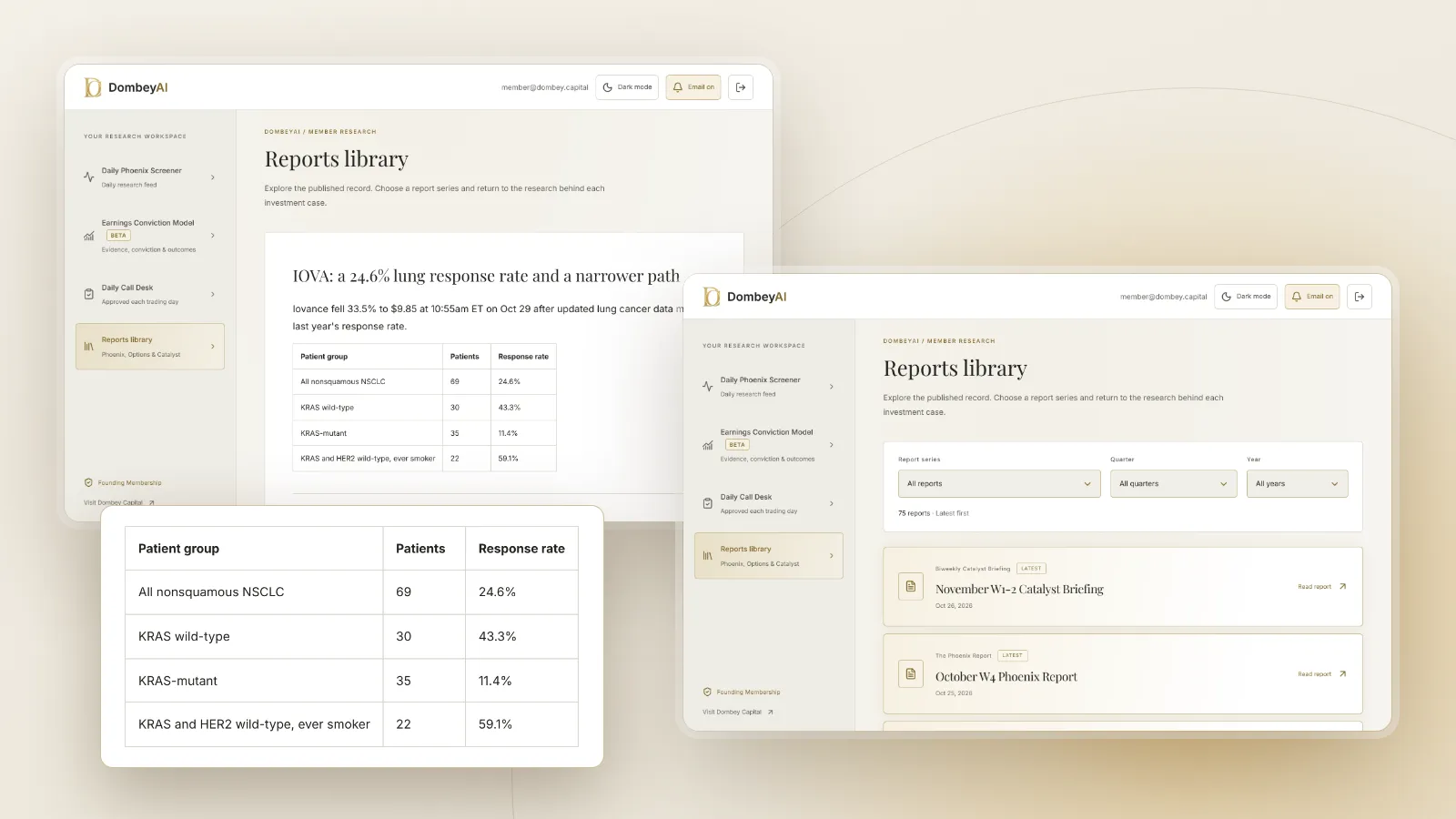
- The strong number is retrospective. Iovance looked back at which patients responded and found a pattern by tumor genetics and smoking history:
| Patient group | Patients | Response rate |
|---|---|---|
| All nonsquamous NSCLC | 69 | 24.6% (17 of 69) |
| KRAS wild-type | 30 | 43.3% (13 of 30) |
| KRAS-mutant | 35 | 11.4% (4 of 35) |
| KRAS and HER2 wild-type | 25 | 52.0% (13 of 25) |
| KRAS and HER2 wild-type, ever smoker | 22 | 59.1% (13 of 22) |
A group defined after the results are in tends to look better than it does in a new trial, so the 59.1% has to be shown again. The company also cited 6 of 7 responses in a small frontline group with pembrolizumab.
- A new trial, a longer road. POSITILITY, a biomarker-selected cohort inside IOV-LUN-202 with registrational intent, starts enrolling in November 2026, and any filing on it is subject to FDA feedback. A frontline trial, OPTILISM, starts in 2027. Iovance says the selected population is about 45% of nonsquamous NSCLC cases diagnosed each year in the U.S.
- An open question at the FDA. The broad sBLA is still planned for 2027 with about 80 patients, but Iovance said discussions with the FDA are ongoing and further updates on that program will come in 2027.
What the deck and the call added
The 21-page deck and the 8:30am call filled in what the release left out, and most of it cuts against the stock:
- Durability is shorter than before. In November 2025 the median duration of response was not reached at 25.4 months. The new deck gives no median. Asked by Wells Fargo, interim CEO Fred Vogt said that reading from the swimmer plot "we'd be at about a year," while stressing the data are immature, and later that the median "could end up" at 18 months or more. By our count of the deck's swimmer plot, about 8 of the 15 confirmed responders had progressed or come off study at the cutoff. Docetaxel, the standard drug here, has a 12.8% response rate and a 5.6-month median duration, so lifileucel's edge is roughly double on both, not more.
- Confirmed rates are lower than the headline. Counting only confirmed responses, the rate is 21.7% (15 of 69) overall, 40.0% in KRAS wild-type tumors and 8.6% (3 of 35) in KRAS-mutant tumors. No never-smoker (0 of 9) or HER2-mutant patient (0 of 5) responded.
- The FDA path is open. Vogt said Iovance has "some alignment" with the FDA on manufacturing and the original trial design, with "more to say" in 2027. A final data cut comes early next year, the filing in 2027, and he expects approval "late 2027 into 2028." He also said the last patients are all-comers but likely richer in KRAS wild-type tumors, so the final rate "could be a little bit higher."
- The smoker result is the real bull case. In patients who have ever smoked and whose tumors are KRAS and HER2 wild-type, 12 of 22 had a confirmed response (54.5%). In first-line patients with the same profile, 6 of 7 responded (85.7%). Those are strong numbers, but the group was picked after the data came in, the samples are small, and it is not what Iovance can file on in 2027. It gets tested properly in the new cohort below.
- The new cohort is large. POSITILITY, Cohort 5 of IOV-LUN-202, will enroll 80 patients whose tumors lack EGFR, ALK, ROS1, KRAS and HER2 alterations and who have ever smoked, with response rate by independent review as the primary endpoint. Vogt said KRAS wild-type status could also matter in colorectal cancer.
For how biotech stocks react when a readout falls short of the hope priced in, see how clinical trial readouts move stocks.
Oct 28, 2026: a quiet session, then an 11% jump on the lung data notice
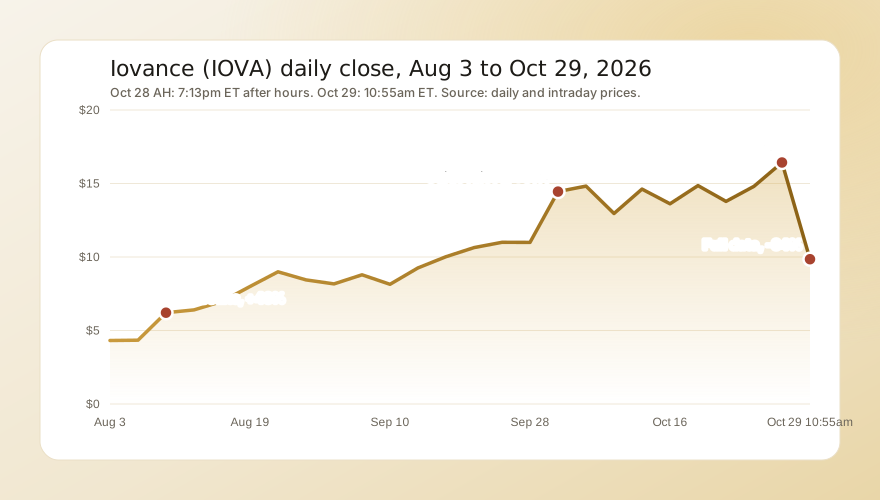
Iovance traded between $14.18 and $14.91 during the regular session and closed at $14.81, up 1.6%, on 8.8 million shares, about half its 16.3 million average. After the close it held near $14.90 until the 7:00pm ET release, then climbed in steps: $15.39 at 7:00pm, $15.87 at 7:09pm and $16.43 at 7:13pm. After-hours volume is thin, and the gain did not survive the full data the next morning.
What pushed it up:
- A registrational readout called positive. IOV-LUN-202 is the trial Iovance plans to file on. In its Aug 6 release the company said enrollment in the pivotal cohorts was nearly complete and an update was due in the fourth quarter. It delivered the headline four weeks into the quarter.
- A bigger market than melanoma. Iovance says the U.S. opportunity in metastatic nonsquamous NSCLC is about seven times that of advanced melanoma. Amtagvi alone brought in about $91 million of U.S. revenue in the second quarter.
- A bar it has cleared before. The November 2025 interim cut showed a 25.6% objective response rate in 39 patients, with 2 complete responses, 7 partial responses and 1 unconfirmed partial response, a 71.8% disease control rate, and a median duration of response not reached at 25.4 months. The after-hours buying bet that the full data would look better. They did not.
- Short sellers. About 58.9 million shares, or 15% of the float, were sold short, about 3.6 days of average volume. Shorts buying back after a surprise headline can add to a move like this one.
How the stock got here
This is the third big step up for Iovance since August. On Aug 6 it reported record second-quarter revenue of $99.3 million, up 66% from a year earlier, a 56% gross margin and Fast Track designation for soft tissue sarcomas, and the stock jumped 43% to $6.21. On Sep 29 it raised 2026 revenue guidance to $410 million to $420 million, from $350 million to $370 million, and rose 31% to $14.45. Since then it has traded between about $13 and $15, even as it reported strong frontline melanoma and sarcoma data at ESMO last week. Over 52 weeks the stock is up from a low of $1.76.
| Date | Event | Close before | Close after | Change |
|---|---|---|---|---|
| Aug 6, 2026 | Q2 revenue $99.3M, up 66% | $4.34 | $6.21 | +43% |
| Sep 29, 2026 | 2026 guide raised to $410M to $420M | $10.99 | $14.45 | +31% |
| Oct 23, 2026 | ESMO: 62.5% ORR in frontline melanoma | $14.14 | $14.09 | -0.4% |
| Oct 28, 2026 | Lung cancer data called positive | $14.81 | $16.43 (after hours) | +10.9% |
| Oct 29, 2026 | Lung data: 24.6% ORR in 69 patients | $14.81 | $9.85 (10:55am) | -33.5% |
The muted reaction to the ESMO melanoma data shows that, at these prices, investors had already paid for good news in melanoma. The lung readout is what was not yet in the price. For how readouts like this move stocks, see how clinical trial readouts move stocks, and for how to put a value on a pipeline, how to value a biotech pipeline.
The case for the stock
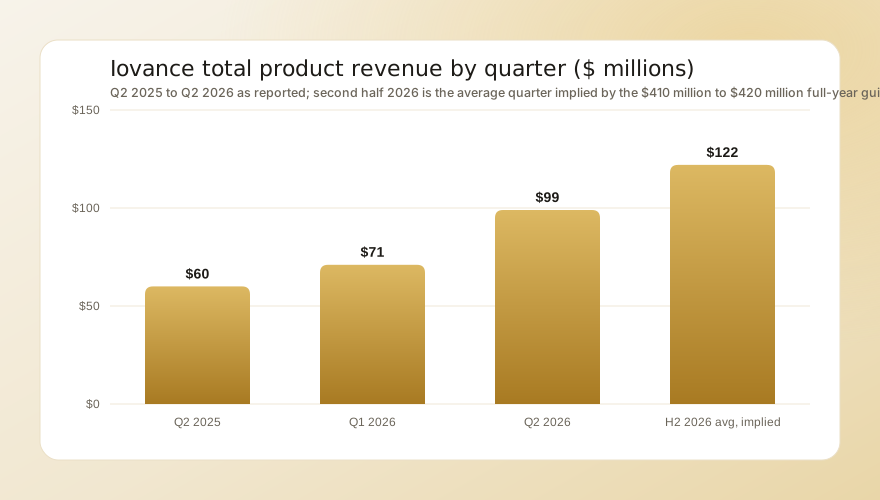
- Revenue is growing fast. Revenue rose from about $60 million in the second quarter of 2025 to about $71 million in the first quarter of 2026 and $99 million in the second. The full-year guide implies about $122 million a quarter in the second half, and management said manufacturing schedules give it strong visibility into those quarters.
- More doors to sell through. The network of authorized treatment centers has grown to about 100 and should reach at least 110 by year-end. Amtagvi is approved in the U.S., Canada and Australia, with a U.K. decision expected later in 2026 and Switzerland in the first half of 2027.
- A pipeline that keeps reading out. Frontline melanoma with pembrolizumab showed a 62.5% response rate and a 29.2% complete response rate, with median overall survival not reached at 50.9 months, and the TILVANCE-301 Phase 3 trial includes an early interim analysis that could support a frontline filing. In sarcomas, the first six evaluable patients showed a 50% response rate.
- Funded into 2028. Iovance held about $304 million in cash and investments at June 30, enough to fund operations into the second half of 2028, and debt is about 6% of equity, so a stock sale is not forced on it.
The risks
- The lung case is narrower. "Positive" was the company's word on Oct 28; the Oct 29 numbers showed a 24.6% response rate overall, and the 59.1% subgroup still has to be confirmed in a trial that has not started enrolling.
- The filing has slipped. In November 2025 the plan was to move toward a filing in 2026 and a launch in the second half of 2027. The plan is now a filing in 2027, so lung revenue is more likely a 2028 story.
- Still not cheap. At $9.85 the market value is about $4.5 billion, near 11 times the $415 million midpoint of the revenue guide, for a company that lost $290 million over the last four quarters. Baird rated the stock Neutral with an $11 target on Oct 8. See the price-to-sales ratio explained for why that multiple matters.
- Cell therapy is hard to scale. Each dose is made from the patient's own tumor, a process that takes about 31 days, and treatment requires a hospital stay. A larger lung population will test manufacturing and treatment center capacity.
For how short interest can amplify a move like this, see short interest, days to cover and squeeze risk, and more of today's biggest stock moves.
What comes next
- Analyst updates. Targets set before the lung readout are likely to come down; Barclays had an $18 target as of Oct 28.
- Third-quarter results on Nov 5, before the open. Revenue against the $115.5 million estimate and the roughly $120 million to $125 million a quarter implied by the guide, the gross margin and any word from the FDA on the broad lung filing.
- POSITILITY enrollment in November. The first sign of how fast the biomarker-selected cohort can fill.
- The FDA on the 2027 filing. Whether the broad population, at about 80 patients and a 24.6% response rate, is enough for a filing.
Dombey's published work on event-driven moves is in the research archive.