

Oct 15, 2026: a gap down, a failed bounce, then new lows
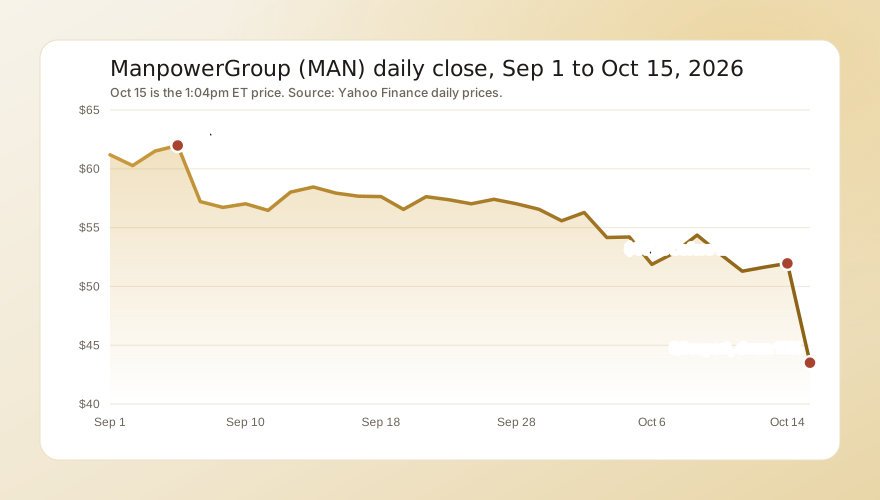
ManpowerGroup released its results at 7:30am ET and held its call at 8:30am. Investing.com reported one early premarket price of $47.99, down 7.6%. As the details spread, the selling picked up: Investing.com reported the shares down 19.75% in premarket trading, and the last premarket trade was $43.93, down 15.5% from Wednesday's $51.96 close.
The stock opened at $45.08, down 13.2%. Buyers pushed it as high as $48.03, which cut the loss to 7.6%, but the bounce did not hold. It slid to a low of $42.81, down 17.6%, and traded at $43.51 at 1:04pm ET. By then about 1.82 million shares had changed hands, against a three-month daily average of about 1.07 million.
What pushed it down:
- A soft fourth-quarter outlook. EPS guidance of $1.03 to $1.13 has a $1.08 midpoint, below the $1.10 consensus Investing.com cited. Revenue guidance of 3% to 7% constant-currency growth implies about 4% organic growth at the midpoint, slower than the third quarter's 6%.
- A lower gross margin. Gross profit fell 0.2% to $767.3 million even as revenue rose 4.4%. The gross margin dropped to 15.9% from 16.6%, and the company guided to about 15.9% again for the fourth quarter.
- A slight revenue miss. Revenue of $4.84 billion fell just short of the $4.85 billion estimate.
- Charges and a CEO change. Restructuring, transformation costs, a business sale adjustment and Argentina currency losses cut $0.30 a share, leaving reported EPS at $0.71. Prising, CEO since 2014, becomes Executive Chair, and this was his last scheduled call as CEO.
What helped the bounce off the open:
- Profit grew. Operating profit rose 23.7% to $82.3 million, and adjusted EPS rose 24% in constant currency.
- The U.S. business is growing. Manpower brand revenue in the U.S. rose 15% on a days-adjusted basis, its ninth straight quarter of growth, and management expects mid-single-digit U.S. growth in the fourth quarter.
- The new CEO backed the margin plan. Frankiewicz said she is "fully committed" to the 110 basis point margin improvement target, and the company says it is on track for $200 million of permanent annual cost savings by 2028.
The bounce faded because none of that changed the near-term numbers. The stock had already fallen from $61.98 on Sep 4 to $51.96 before the report, so expectations were not high going in.
The numbers behind the drop
The margin is the figure that explains the move. Staffing companies earn thin margins, and a few tenths of a point changes profit a lot.
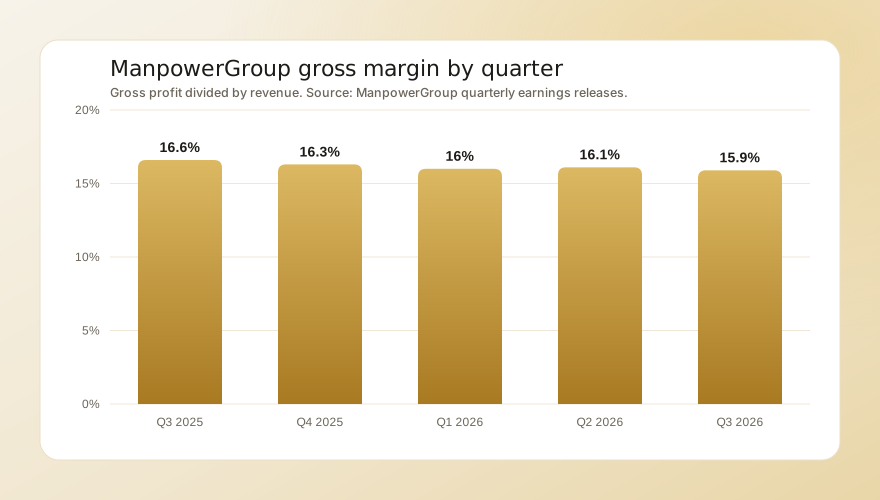
Management gave three reasons on the call. Staffing margins fell 50 basis points on mix, because lower-margin Manpower staffing is growing faster than Experis and Talent Solutions, whose gross profit each fell 2% organically. Softer permanent hiring in France and some other markets cost 10 basis points. Fewer layoffs meant less outplacement work at Right Management, which cost another 10 basis points.
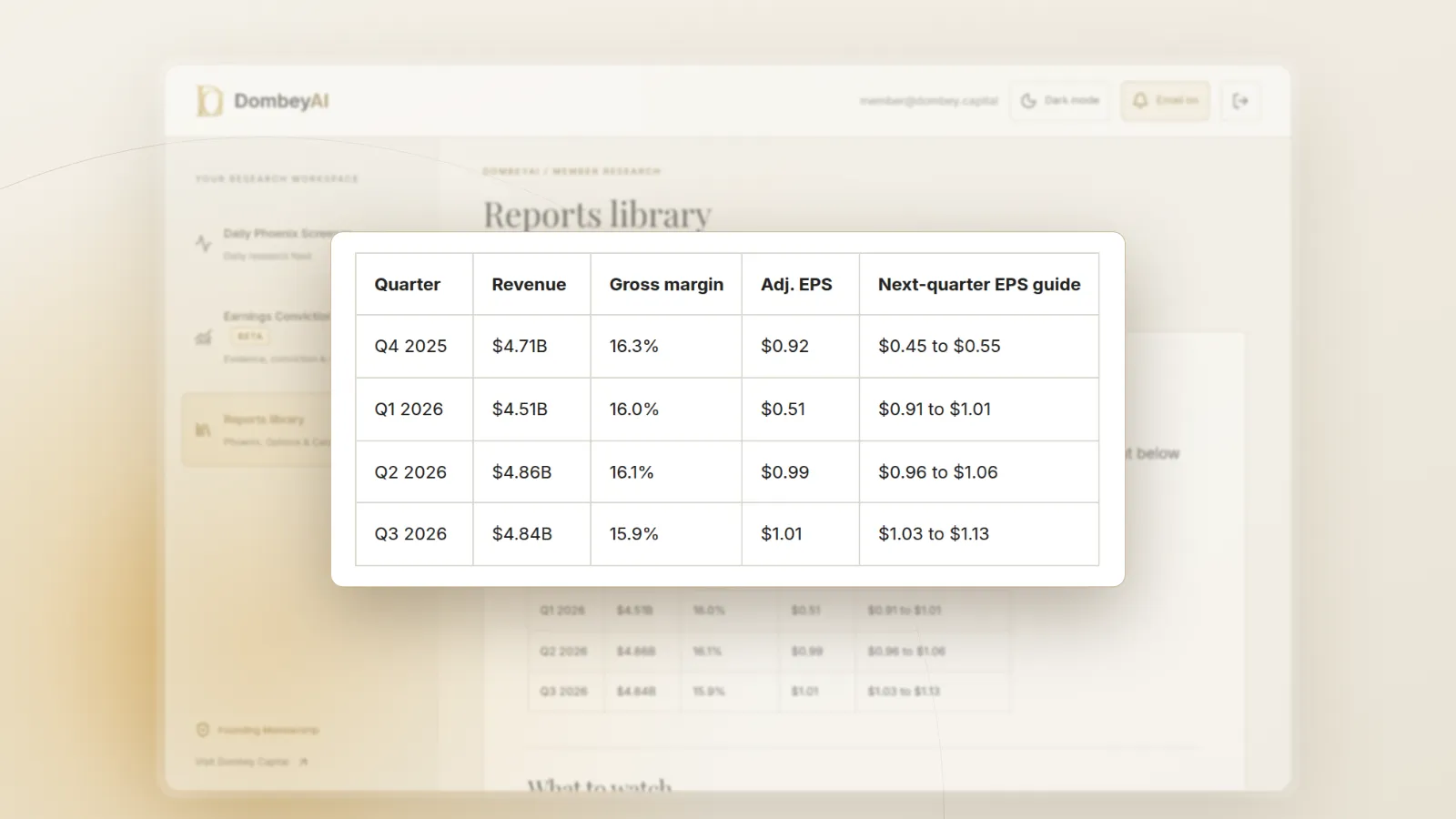
The last four quarters, from the company's releases:
| Quarter | Revenue | Gross margin | Adjusted EPS | Next-quarter EPS guidance |
|---|---|---|---|---|
| Q4 2025 | $4.71 billion | 16.3% | $0.92 | $0.45 to $0.55 |
| Q1 2026 | $4.51 billion | 16.0% | $0.51 | $0.91 to $1.01 |
| Q2 2026 | $4.86 billion | 16.1% | $0.99 | $0.96 to $1.06 |
| Q3 2026 | $4.84 billion | 15.9% | $1.01 | $1.03 to $1.13 |
Each quarter of 2026 landed at or above the midpoint of the prior guidance. The fourth-quarter range is the highest yet. For how a modest outlook miss can move a stock this much, see our guide to why guidance changes move stocks. For other notable moves, see today's biggest stock moves.
The case for the stock
The business grew. Revenue rose 5.2% in constant currency and 6% organically. The Americas grew 11.5% in constant currency with operating profit up to $47.4 million from $37.9 million. Northern Europe swung to a $7.5 million profit from a $14.9 million loss a year earlier, helped by the U.K. at 7% and strong growth in Germany.
The cost program is working. Operating profit rose 23.7% on flat gross profit, which means the savings are coming through in selling and administrative costs. Management guided for the operating margin to improve 20 basis points year over year in the fourth quarter, against a 10 basis point pace in the first three.
The price now sits near the balance sheet. At about $43, the stock trades close to its book value of about $45 a share. Our explainer on the price-to-book ratio covers what that measure does and does not tell you for a services company.
The risks
- The margin keeps sliding. Gross margin has fallen from 16.9% in the second quarter of 2025 to 15.9%. If growth keeps coming from lower-margin staffing, revenue gains will not turn into profit.
- France is still weak. French revenue fell 2% in constant currency on political uncertainty and a weak July. Management expects only slight improvement in the fourth quarter.
- Cash is tighter. Cash fell to $233.1 million at Sep 30 from $871.0 million at the end of 2025, and operations used $137.0 million of cash in the first nine months. Total debt fell to about $1.10 billion from about $1.68 billion over the same period. The company bought back almost no stock this year and does not expect buybacks in the near future.
- Charges keep recurring. One-time items cut EPS by $0.46 in the first quarter, $0.30 in the third and $0.28 in the fourth quarter of 2025. A cheap stock with recurring "one-time" costs can turn into a value trap.
- A leadership change. A new CEO often resets targets. Frankiewicz has backed the current plan so far.
What comes next
- Fourth-quarter results, expected in late January 2027. Last year's came on January 29. Watch adjusted EPS against the $1.03 to $1.13 range, the gross margin against 15.9%, and the first-quarter 2027 guidance, the first under the new CEO. Our guide to preparing for an earnings report covers what tends to move a stock on the day.
- France. Management said trends improved into September and early October. A return to growth there would help the margin most.
- The cash balance. Operations used $137.0 million of cash in the first nine months. A positive fourth quarter would ease the balance sheet concern.
- The CEO handover on January 1. Any change to the 110 basis point margin target or the $200 million savings goal would be the first sign of a new plan.