

How a deal actually ends
A merger agreement does not lapse by itself in most cases. It ends when a party with a termination right uses it. The termination section of the agreement lists those rights, and they usually fall into a few groups:
- Mutual agreement. Both boards agree to walk away, often after a regulator signals it will oppose the deal.
- Outside date. If the deal has not closed by the date set in the agreement, either side can usually terminate, unless its own breach caused the delay. Many agreements allow an extension when only regulatory approvals remain.
- Legal restraint. A final court order blocking the deal gives either party a right to end it.
- Failed vote. If target or acquirer shareholders vote the deal down at the meeting, the agreement typically allows termination.
- Superior proposal. The target board accepts a better offer, usually after giving the original buyer a chance to match, and pays the target termination fee.
- Breach or material adverse effect. One side claims the other broke a representation or covenant, or that the target's business suffered a material adverse effect. These claims are often disputed in court.
The trigger matters because it decides which fee, if any, is owed. Read the termination section and the fee section together, since a fee often applies only to some termination rights.
The filings that follow
The first public signal is usually a press release. The formal record comes on Form 8-K. Under Item 1.02, a company that terminates a material definitive agreement made outside the ordinary course of business must disclose the date of termination, the parties, the material terms, the material circumstances of the termination and any material early termination penalties. Under the form's general instructions, the report is due within four business days of the event unless another deadline applies.
Two instructions in Item 1.02 are useful to know. No disclosure is required under that item while the parties are only negotiating a termination. And none is required if the company believes in good faith that the agreement has not been terminated, unless it has received a notice of termination under the agreement. That second point is why a disputed termination can leave the record unclear for a while: one side sends a notice and the other says the agreement is still in force.
If the deal was a tender offer, SEC Rule 14e-1(c) requires the bidder to pay for or return deposited securities promptly after the offer is terminated or withdrawn. Shares tendered into a failed offer go back to holders.
The guide to reading an 8-K for catalysts covers how to read the item list and exhibits on the filing.
Who pays whom
| Termination trigger | Fee usually owed | Who receives it | What it tells you |
|---|---|---|---|
| Target takes a superior proposal | Target termination fee | Original buyer | A higher bid exists; the stock follows the new deal |
| Antitrust approval fails or outside date passes on regulatory grounds | Reverse termination fee, if the agreement provides one | Target | Cash cushion for the target; the buyer accepted regulatory risk |
| Buyer cannot complete financing | Reverse termination fee, in many financed buyouts | Target | The fee may be the target's main remedy |
| Target shareholders vote no | Sometimes expense reimbursement, sometimes a fee if a rival deal follows | Buyer | Holders judged the price too low |
| Mutual agreement | Whatever the parties negotiate | Either | Read the termination agreement filed with the 8-K |
| Disputed breach or material adverse effect | Decided by negotiation or litigation | Either | Timing and amount stay uncertain |
A reverse termination fee goes to the company, not directly to shareholders. It raises cash on the target's balance sheet, which matters for the post-break valuation, but the board decides whether to keep it, pay down debt or return it. Fee income may also be taxable to the company, so the after-tax figure is the one to use.
What happens to the target's stock
The target usually reprices in one or two sessions. Holders who bought for the spread have no reason to stay once the deal value is gone, and many sell at the open. The price then moves toward what long-term investors will pay for the standalone business, plus any fee received, less any costs the deal left behind.
The pre-announcement price, often called the undisturbed price, is the usual starting estimate. It is often a poor one. Since the deal was signed:
- The business has changed. A target under contract may have lost customers, staff or management attention, and some merger agreements restrict how it can run the business before closing.
- Peers have moved. If comparable companies have re-rated up or down, the standalone value has moved with them.
- The shareholder base has turned over. Many long-term holders sold after the announcement. The new holders were mostly there for the deal and sell when it ends.
- Costs and claims have built up. Advisory fees, retention payments and litigation reserves reduce cash.
The result can be a post-break price above the undisturbed price, if the business grew or the fee is large, or below it, if the business weakened or the sale of spread positions overshoots.
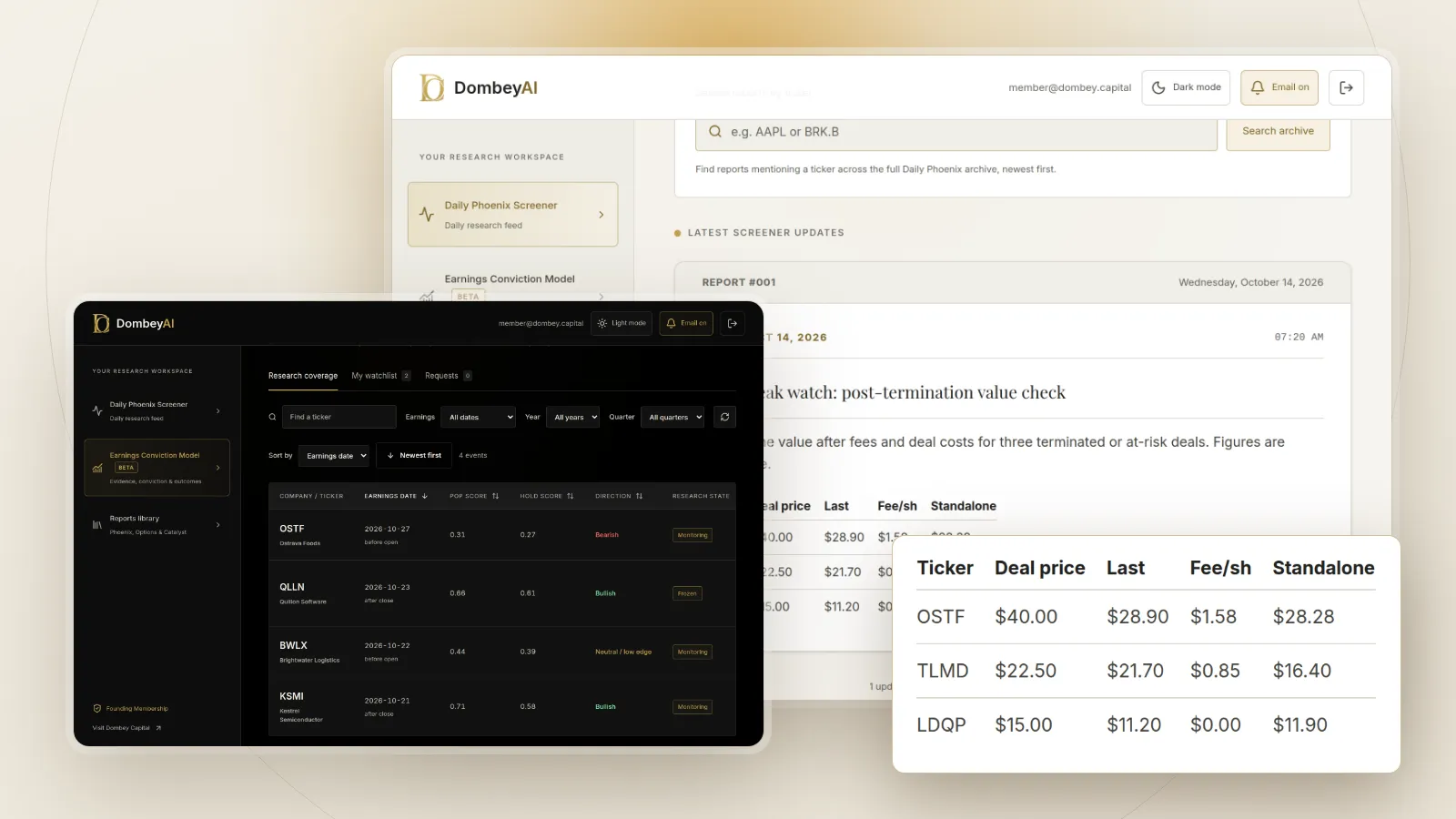
The example shows why the fee alone rarely protects holders. A fee worth a few percent of the deal value does not offset a fall of a quarter or more.
What happens to the acquirer
The acquirer's reaction depends on what investors thought of the deal. If the market viewed the price as too high or the financing as too heavy, the acquirer's stock can rise on the break. If the deal was central to its strategy, it can fall. The acquirer may also owe a reverse termination fee, carry unused financing commitments and fees, and face questions about what it will do with the capital instead.
In a stock deal, holders who were long the target and short the acquirer lose on both legs when the target falls and the acquirer rises. The unwind of those hedges can move the acquirer's price for a few sessions in a way that says little about its business.
What comes after the break
A failed deal is not always the end of the story. The common next steps for the target are:
- Run as a standalone company. Management issues new guidance, sometimes with cost cuts. The next quarterly report is the first clean look at the business after the deal.
- Return the fee or buy back stock. A board holding a large fee may announce a buyback or special dividend.
- Seek another buyer. A board that wanted to sell may start a new process. An antitrust block against one buyer does not rule out a buyer with no overlap.
- Restructure the deal. The same parties sometimes return with a new agreement, for example with divestitures that answer the regulator's objection.
- Face pressure from holders. An activist may push for a sale or other changes; 13D filings show when a holder crosses the reporting threshold with intent to influence. A contested board fight is covered in what a proxy fight is.
- Litigate. If the termination was disputed, the parties may sue over the fee or over whether the buyer had the right to walk. Outcomes and timing are hard to predict.
When the FTC believes a merger is unlawful, its guidance says it may issue an administrative complaint and authorize a federal court lawsuit to block the deal while the administrative case proceeds. A court loss for the parties often leads straight to termination; the article on the HSR waiting period explains the review that comes before any challenge.
How to assess the stock after a break
The questions after a break are different from the questions before it. Before, the work was the probability and timing of closing. After, it is a standalone valuation and a new catalyst list.
- If a reverse termination fee is owed, confirm the trigger in the agreement, the payment date and whether the buyer disputes it before adding it to cash.
- If the termination is disputed, treat any fee or damages as uncertain and value the company without them first.
- If the business was restricted under the agreement, read the next 10-Q for lost customers, delayed projects and one-time costs.
- If a rival bidder appeared during the process, check whether its interest was ever made public in the proxy's background section, since a known bidder makes a new process more likely.
- If event-driven funds held a large part of the float, expect selling pressure in the first days that may not reflect long-term value.
Build a base and worst case from current figures, not from the numbers in the deal proxy. A check of net cash per share after the fee and deal costs gives a floor for companies with large cash balances. Dombey's published research works through standalone value and the next dated catalyst for each situation it covers; see the research archive.
Where this goes wrong
- Anchoring on the undisturbed price. It is months old and ignores changes in the business and its peers.
- Counting the fee before it is paid. Buyers sometimes dispute whether a fee is owed, and payment can take time or end up in court.
- Ignoring the tax on fee income. The after-tax amount is what the company keeps.
- Assuming a new buyer will appear. A second bid after a break happens, but a valuation that depends on it is speculation.
- Reading the first day's price as a verdict. Forced selling by spread holders can push the price well below where it settles once the shareholder base turns over.
- Missing a disputed termination. If one side says the agreement is still in force, the deal may not be over, and the 8-K may not yet be filed.
The bottom line
A deal break ends the merger agreement, sends any termination fee to the party the agreement names, and forces the market to price the target as a standalone business. The 8-K under Item 1.02 and the termination section of the agreement tell you what happened and who pays. The post-break value depends on the current business, its peers, the after-tax fee and the costs left behind, and it is often below the undisturbed price. Start the analysis again from current filings rather than from the deal documents.