

What makes an earnings report a catalyst
A report moves a stock when it changes the market's estimate of future cash flows. The usual drivers:
- Results against consensus. Revenue and earnings per share compared with analysts' average estimates.
- Guidance. The company's own outlook for the next quarter or year, compared with what analysts had modeled.
- The key operating metric. Each business has one or two numbers investors watch most: same-store sales for a retailer, net interest margin for a bank, bookings or net retention for a software company, backlog for an industrial.
- Margins and cash flow. Whether growth is coming with or without profit, and whether earnings are turning into cash.
- Capital allocation news. Buybacks, dividends, asset sales or a strategic review announced alongside results.
- Tone on the call. Answers to analyst questions can move the stock after the release, especially on topics the release avoided.
The important word in each line is "against." A company can report record results and fall if investors expected more.
Hard or soft catalyst
Earnings are usually a soft catalyst. They reveal information, but nothing forces the market to close a gap between price and value on that date. Compare that with a tender offer or a liquidating distribution, which pays a defined amount on a defined schedule. Our piece on hard vs soft catalysts covers the distinction.
There are exceptions. A report can become a hard catalyst when the company has said it will announce something specific with results, such as the outcome of a strategic review, a covenant test or a special dividend. In those cases the date carries a defined event, not just new numbers.
The earnings timeline
Most companies follow a predictable sequence. Knowing it tells you when each piece of information arrives.
| Timing | Event | What to check |
|---|---|---|
| 3 to 5 weeks before | Company announces the report date and call time | Whether the date is confirmed or still an estimate from a calendar |
| 2 to 3 weeks before | Quiet period; analyst estimates settle | Consensus revenue, EPS and the key metric; any recent revisions |
| 1 week before | Options expiries around the date are priced | Implied move from the at-the-money straddle |
| Report day | Press release, usually furnished on Form 8-K under Item 2.02 | Results, guidance, the key metric, any one-off items |
| Report day | Conference call | Answers on the topics the release left out |
| Within 40 or 45 days of quarter end | Form 10-Q filed (10-K for the year) | Notes, liquidity, segment detail, risk factor changes |
The 10-Q deadline is 40 days after quarter end for large accelerated and accelerated filers and 45 days for others. Many companies file it on the same day as the release; some file later, and the notes can hold details the release left out. Our explainer on what a 10-Q is covers what it contains.
How to prepare for a report
Preparation is mostly writing things down before the event so you can judge it clearly after.
- Confirm the date. Check the company's investor relations page or its press release. Put it on a catalyst calendar with the time (before the open or after the close).
- Write down expectations. Consensus revenue and EPS, the company's prior guidance, and the consensus for the key metric. Note whether estimates have risen or fallen over the past month.
- Pick the one or two numbers that matter. For most companies, one metric decides the reaction. Name it in advance.
- Read the last call transcript. Note what management promised, the questions analysts pressed on, and anything management declined to answer.
- Check the options-implied move. The cost of the straddle tells you how large a move is priced. Our guide on estimating an earnings move from options shows the method.
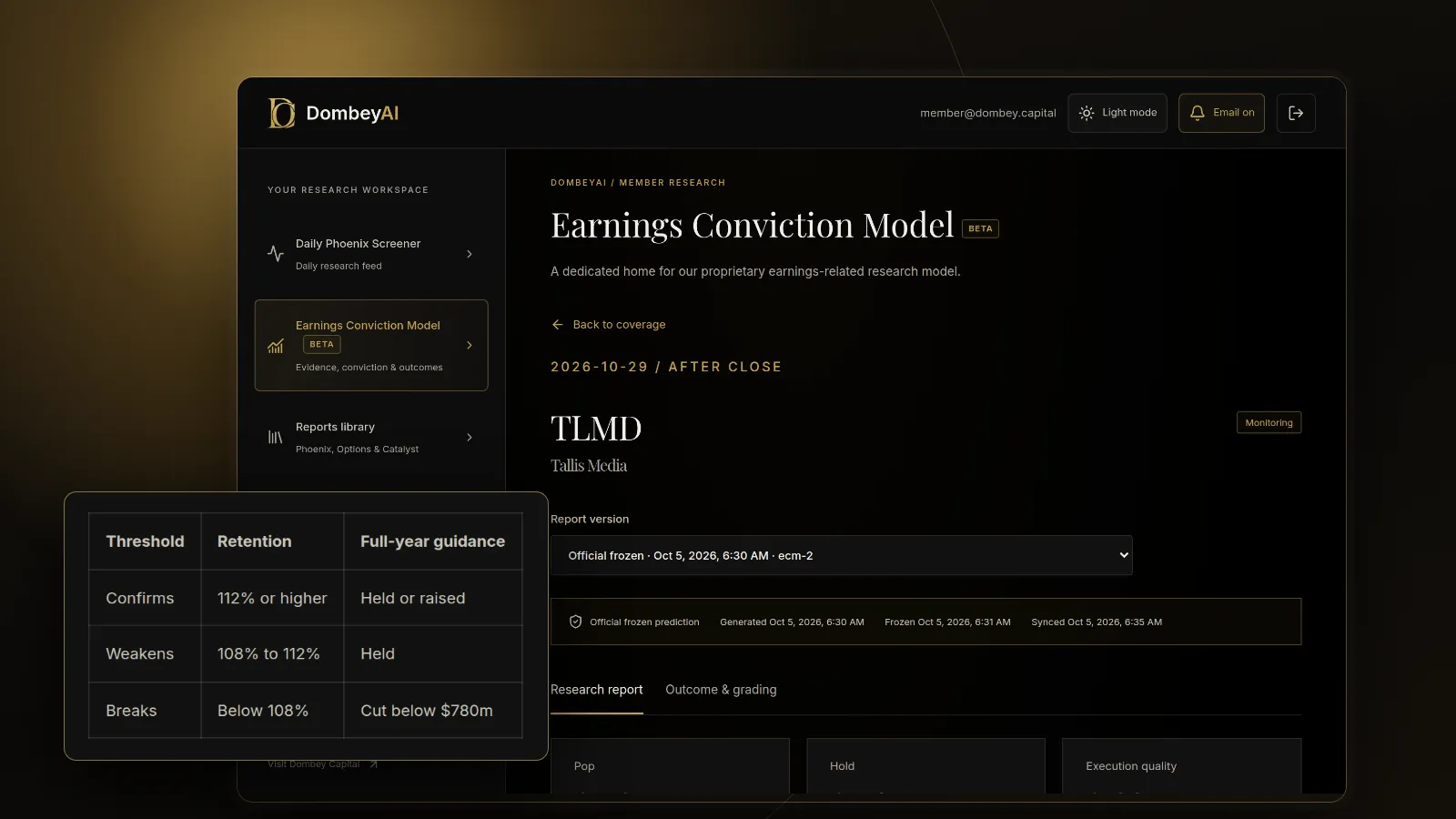
- Set your thresholds. Write what result would confirm your thesis, what would weaken it and what would break it.
- Size for the gap. A stock can open well above or below the prior close after a report. Size any position so that a move larger than the implied one is survivable.
A worked example
The figures below are illustrative. Company A is hypothetical.
Company A, a software business, reports after the close in two weeks. It trades at $50.
- Consensus revenue is $200 million and consensus EPS is $0.40.
- Last quarter, the company guided full-year revenue to $780 to $800 million.
- The key metric investors watch is net revenue retention, which was 112% last quarter.
- The at-the-money straddle in the expiry just after the report costs $4.00, so the options market prices a move of about 8% in either direction.
Before the report, the investor writes:
- Confirms the thesis: retention at or above 112% and full-year guidance held or raised.
- Weakens it: retention between 108% and 112%, guidance held.
- Breaks it: retention below 108% or full-year guidance cut below $780 million.
The company reports revenue of $204 million and EPS of $0.43, both above consensus, but retention falls to 107% and guidance is trimmed to $770 to $790 million. The headline is a beat. By the investor's own thresholds, the thesis is broken. The written plan makes that judgment quick and unemotional, whatever the stock does the next morning.
Where this goes wrong
- Reacting to the headline. An EPS beat from a lower tax rate or a one-off gain is not the same as a beat from operations. Read past the first line.
- Ignoring guidance. The outlook often matters more than the quarter just ended.
- No written expectations. Without them, any result can be rationalized after the fact.
- Wrong date or time. Calendar dates can be estimates. A report before the open moves the stock at a different time from one after the close.
- Overweighting one quarter. A single report rarely proves a long-term thesis right or wrong unless it touches the specific point the thesis rests on.
- Size too large for the gap. Stop orders do not protect against an overnight gap; the stock can open past them.
Choosing your approach
- If your thesis rests on a long-term value gap, treat earnings as a checkpoint and judge only the numbers that bear on that gap.
- If your thesis is about the report itself, write explicit thresholds and know the implied move before the date.
- If the company has promised a specific announcement with results, treat the date as a harder catalyst and read the prior statement closely.
- If you cannot name the one metric that matters, the report is not yet a catalyst for you; do more work or wait.
Dombey's published research sets out the expectations and thresholds before each earnings date; see the research archive. For tools that track report dates, see our review of earnings calendar and catalyst tools.
The bottom line
An earnings catalyst is a scheduled report that can reprice a stock, and the reaction depends on results and guidance against expectations. Prepare by confirming the date, writing down consensus and guidance, naming the one or two metrics that matter and noting the implied move. Set numeric thresholds for what confirms, weakens or breaks your thesis before the release. Then the report becomes a test you planned for rather than a surprise you react to.