

Why approvals work as catalysts
A catalyst is an event that forces the market to reprice a stock. An approval does this well because it has three useful features. A specific body decides. The decision is usually made public. And the value on each side of the decision is often very different.
Approvals show up in many special situations:
- Mergers and acquisitions. Antitrust review, national security review, and industry regulators such as banking, insurance, telecom or energy authorities.
- Products. Drug and device approvals, safety certifications, and licenses to sell in a new market.
- Operations. Permits for a plant or mine, rate decisions for a regulated utility, and licenses for gaming or financial services.
- Corporate actions. Approvals needed for a spin-off, a change of control of a regulated entity, or a restructuring.
In each case, the stock trades on two things before the decision: the probability of approval and the expected timing. When the decision comes, both are replaced by facts. That is the whole trade. The hard vs soft catalysts framework helps here: an approval is a hard catalyst on substance, but its timing can be soft.
Clocked reviews and open-ended reviews
The first question to ask of any approval is whether a written rule sets the clock.
Clocked reviews have a deadline in law or regulation. Two examples, checked against the agencies' own pages:
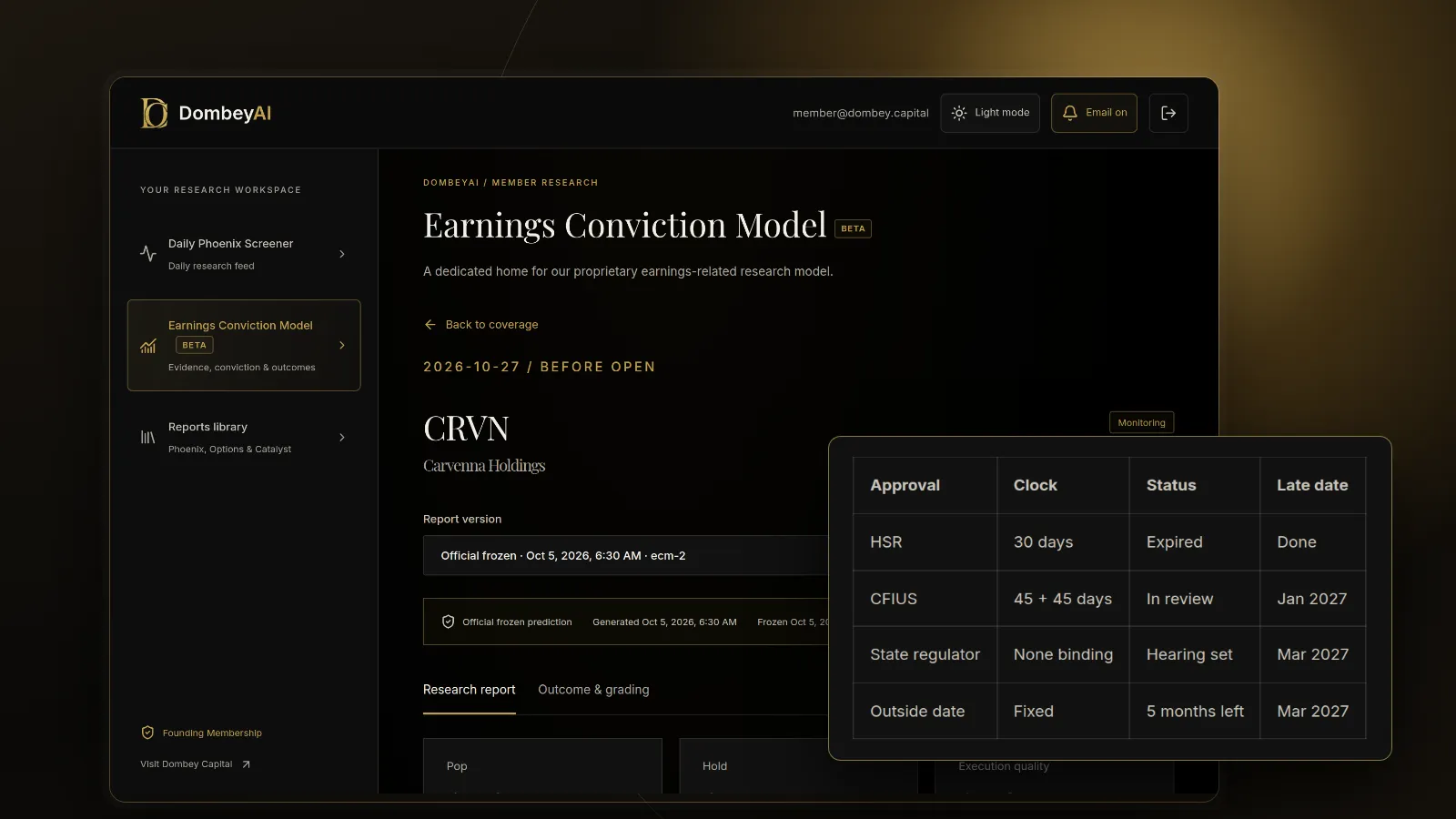
- HSR. After a complete filing, the parties must wait 30 days before closing, or 15 days for a cash tender offer or a bankruptcy. If the agency issues a Second Request, the waiting period extends until the parties substantially comply, and the agency then generally has another 30 days, or 10 for a cash tender offer or bankruptcy, to act.
- CFIUS. A notice review ends no later than the 45th calendar day after it begins. CFIUS may then open an investigation, which must be completed within 45 days, and in extraordinary circumstances that investigation can be extended once by 15 days. If a case goes to the President, a decision must be announced within 15 days.
Open-ended reviews have no binding deadline, or only an informal target. Many state, industry and foreign reviews fall here. The regulator can ask for more information, hold hearings, or simply take longer, and the company has limited ability to force a decision.
The distinction matters because a clock caps the delay risk only within that one review. Even a clocked review has escape valves. A Second Request has no fixed length because it ends only when the parties comply, and parties to an HSR or CFIUS review can withdraw and refile, which restarts the clock.
Quick reference: approval types and their timing
| Approval type | Clock | Main timing risk | What to read |
|---|---|---|---|
| HSR antitrust | 30 days, or 15 for cash tender | Second Request has no fixed end | Merger agreement, 8-K, proxy |
| CFIUS | 45-day review, 45-day investigation | Withdraw and refile | Proxy regulatory section |
| Drug or biologic (FDA) | Goal date, not a legal deadline | Extension or complete response letter | Company filings, FDA briefing documents |
| Industry regulator | Often none binding | Hearings, comment periods | Docket, company updates |
| Foreign antitrust | Varies by country | Phase 2 reviews, remedies | Proxy, regulator press releases |
Treat the table as a starting point. The specific rule for each review is in the company's filings, usually in a section titled "regulatory approvals" in the proxy statement or S-4.
The three risks: delay, conditions, denial
Most models collapse an approval into two branches: approved or not. That leaves out the two outcomes that happen most often.
Delay
Delay is the most common outcome and the one investors most often underweight. It costs money in three ways. First, time value: a fixed payoff received in 18 months is worth less than the same payoff in 9 months. Second, outside dates: a merger agreement usually lets either party walk away if the deal has not closed by a set date, so a long review can turn into a termination right. Third, cash: a small company waiting on a product approval keeps spending, and a longer wait can force a raise at a low price. The cash runway guide shows how to measure that.
Conditions
A regulator can approve on terms. The FTC describes one path as a negotiated consent agreement that includes provisions to restore competition, which often means selling a business line. Industry regulators may require capital commitments, price limits or operating promises. A drug can be approved with a narrower label than the company sought.
Conditions are a value question, not a yes-or-no question. The merger agreement decides who bears them. Some agreements oblige the buyer to accept any remedy; others cap the divestitures the buyer must agree to. Reading that clause is part of sizing the risk.
Denial
Denial is the clearest loss. In antitrust, the FTC says the agency may go to federal court for a preliminary injunction to stop the deal. In a product review, denial may be a request for more data rather than a final no. The value on denial depends on what the company looks like without the approval, which is the subject of deal breaks.
Building a timeline you can trust
A useful timeline is a range with a reason behind each end, not one date copied from a calendar site.
- List every approval. The conditions to closing in the merger agreement, or the regulatory section of the 10-K for a product or permit, give the full list.
- Find the rule for each. Note whether it has a legal clock, a goal date or nothing binding.
- Set an early and a late date. The early date assumes no extensions. The late date assumes the common extensions for that regulator, such as a Second Request or an extended investigation.
- Take the slowest one. When several approvals are needed, the last to clear sets the closing date.
- Compare with the hard limits. Check the outside date, any ticking fee, and the company's cash runway against the late date.
- Log the source. Record which filing gave each date, as described in the catalyst calendar guide.
Disclosure is uneven. Form 8-K requires a report within four business days for the events listed in Sections 1 to 6 and 9 of the form. Many approvals do not fall under those items, so a company may announce them by press release or under Item 8.01, which is voluntary. The 8-K guide shows where to look.
A worked example
Start with branches rather than one probability:
| Outcome | Value per share | Probability | Expected months |
|---|---|---|---|
| Clean approval | $40.00 | 55% | 6 |
| Approval after long review | $40.00 | 20% | 11 |
| Approval with divestiture, price cut to $38 | $38.00 | 10% | 10 |
| Block or outside date passes | $28.00 | 15% | 9 |
The probability-weighted value is $38.00: (0.55 x 40) + (0.20 x 40) + (0.10 x 38) + (0.15 x 28). Against $35.50, that is a gap of $2.50, or about 7.0 percent, before time value. The expected holding period is roughly 7.9 months, so the annualized figure is lower than the headline spread suggests, and much lower in the long-review branch.
Two checks follow. First, test the inputs: if the block probability rises from 15 to 25 percent, taken from the clean branch, the value falls to $36.80. Second, confirm the price cut is real: a divestiture only changes the payout if the merger agreement allows the price to change, and many do not. For the method behind the weights, see probability-weighted valuation for binary events, and for building the downside, how to build a base and worst case.
Reading the signals during a review
Regulators rarely say what they will decide, but the process leaves marks.
- If the agency issues a Second Request or opens a CFIUS investigation, move weight from the early date to the late date.
- If the parties withdraw and refile, read the stated reason; it can buy time for talks rather than signaling a block.
- If the company starts describing possible remedies, assume the conditions branch has grown.
- If a docket shows opposing comments from customers or competitors, raise the odds of hearings and delay.
- If the outside date is extended by amendment, the parties still want the deal, but the timeline has already slipped once.
Silence is information too. When an expected milestone passes with no filing, the merger arbitrage spread usually widens before any news appears. Dombey's published research records these dated steps for each situation it covers; see the research archive.
Where this goes wrong
- Treating a goal date as a deadline. FDA goal dates are targets, and many industry reviews have none. A position sized for one date can wait months longer.
- Ignoring the stack. Each approval may look likely on its own. Three approvals at 90 percent each clear together only about 73 percent of the time if they are independent, and less if they are linked.
- Leaving out conditions. A remedy that removes a profitable business line can make an approved deal worth less to the buyer, which raises the chance it walks away at the outside date.
- Copying dates from aggregators. Third-party calendars go stale after extensions and refilings. The company's filings and the regulator's own releases are the record.
- Assuming politics are stable. Agency priorities shift with leadership. Past practice is a guide to timing, not a promise about outcomes.
- Forgetting financing. A buyer's financing commitment can expire, and a small company's cash can run out, before a slow regulator acts.
The bottom line
Regulatory approvals are strong catalysts because a known authority decides and the value on each side of the decision differs. The date is usually softer than it looks: some reviews run on a legal clock, many do not, and even clocked reviews can be extended or restarted. Model delay, conditions and denial as separate branches, build a timeline range from the rule and the filings, and let the slowest approval set the date. As with event-driven investing generally, the edge comes from reading the process more carefully than the price does.