

The price-to-book formula
The calculation has two steps.
Book value per share = (total shareholders' equity minus preferred equity) / common shares outstanding
Price-to-book = share price / book value per share
You can also compute it at the company level: market capitalization divided by common equity. The answer is the same.
Book value is assets minus liabilities. It is what would be left for common shareholders if every asset were sold at its carrying value and every liability paid. That "if" is the whole problem. Carrying value is an accounting figure, often based on historical cost less depreciation, not a sale price.
A few practical points:
- Use the latest quarter. Book value moves every period with earnings, dividends, buybacks and accounting adjustments. The quarterly 10-Q is due 40 or 45 days after quarter end depending on filer size.
- Use common equity only. Subtract preferred stock and noncontrolling interests, since common holders do not own those claims.
- Use the share count from the cover page of the filing, which is usually the most recent figure available.
Book value vs tangible book value
Tangible book value strips out assets that have no separate resale value.
Tangible book value = common equity minus goodwill minus other intangible assets
Goodwill arises when a company buys another business for more than the fair value of its identifiable net assets. Other intangibles include acquired brands, customer relationships, patents and software. These items can be legitimate, but they cannot usually be sold on their own, and in a distressed sale they may be worth little or nothing.
Price to tangible book (P/TBV) = share price / tangible book value per share
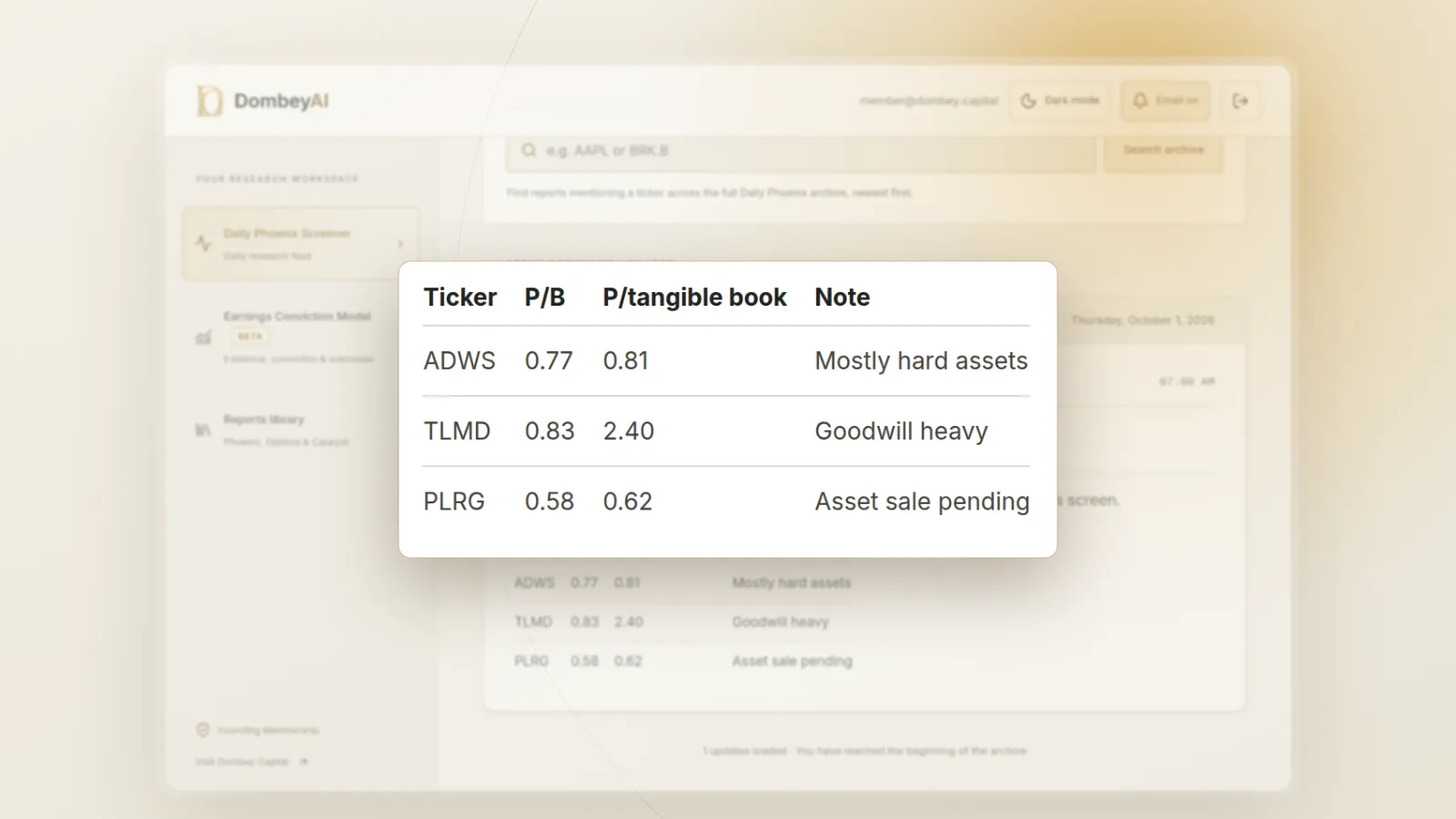
For an acquisitive company, the gap between P/B and P/TBV can be large. A stock at 0.8 times book may be at 2.5 times tangible book once goodwill is removed. Which ratio you rely on depends on whether you believe the acquired businesses still earn enough to justify what was paid.
Quick reference
| Measure | Formula | Best used for | Main weakness |
|---|---|---|---|
| Price-to-book (P/B) | Price / book value per share | Asset-heavy companies, quick screening | Includes goodwill and intangibles at cost |
| Price to tangible book (P/TBV) | Price / tangible book per share | Banks, insurers, serial acquirers | Ignores real but unrecorded assets |
| Return on equity (ROE) | Net income / average equity | Judging whether book value earns its keep | Distorted by one-off gains and leverage |
| Forward P/E | Price / expected next-year EPS | Checking that cheap assets also earn | Depends on estimates that can be wrong |
| Price-to-net-cash | Price / net cash per share | Cash-rich companies below book | Ignores cash burn |
Why a low P/B can be a trap
A stock rarely sits below book by accident for long. The market is usually expressing a view about the assets or the earnings. Four patterns account for most value traps.
Goodwill that is no longer supported
When an acquired business underperforms, its goodwill may be overstated well before the company records an impairment. Under US GAAP, goodwill is tested for impairment at least annually, but management has judgment over the assumptions. Until the write-down arrives, book value includes a number the market has already discounted. When the impairment is recorded, P/B jumps without any change in price.
Impaired or obsolete assets
Physical assets can be overstated too. Inventory of slow-moving products, specialized equipment with no second-hand market, and real estate carried at old cost in a weak local market all fit this pattern. Deferred tax assets are another: they only have value if the company earns enough taxable income to use them, and a valuation allowance can remove them from book quickly.
Losses eroding book value
Book value is not fixed. A company losing money reduces its equity every quarter. A stock at 0.6 times book looks cheap, but if annual losses equal 20% of equity, book value will shrink toward the price within two years. Always ask how book value will look in four to eight quarters, not just today.
Asset-light companies
P/B says little about software, consulting, brand and services companies. Their main assets are staff, code and customer relationships, which accounting rules generally expense rather than capitalize. A high P/B for such a company is not evidence of overvaluation, and a low P/B is rare and usually a sign of serious trouble. For these businesses, earnings and cash flow measures are more informative.
Banks vs asset-light companies
Banks and insurers are where P/B is most useful. Their balance sheets consist mostly of loans, securities and deposits, which are carried at or close to economic value, so book value is a reasonable starting estimate of worth. A bank's earning power also depends directly on its equity, so return on tangible equity and P/TBV are usually read together.
Even here, the quality of the book matters. For a bank, check:
- Loan loss reserves relative to nonperforming loans.
- Concentrations in a single loan type or region.
- Unrealized losses on securities held to maturity, which may not flow through book value but still reduce economic value.
- Regulatory capital ratios, reported in the filings.
For asset-light companies, P/B is close to irrelevant. Comparing a bank at 1.0 times book with a software company at 10 times book tells you nothing about which is cheaper.
How to check asset quality in the filings
The 10-Q and 10-K contain what you need to judge whether book value is real. A practical sequence:
- Read the balance sheet line by line. Note the size of goodwill, intangibles, deferred tax assets, inventory and receivables relative to total equity.
- Read the goodwill note. Look for which reporting units carry the goodwill, when it was last tested, and whether management discloses that any unit's fair value is close to its carrying value. That disclosure is often an early warning.
- Check receivables and inventory trends. If either grows faster than revenue, collections or sell-through may be weakening.
- Check the deferred tax asset valuation allowance. A company with recurring losses and no allowance is assuming future profits it may not earn.
- Read the risk factors and MD&A. Management often signals coming write-downs, restructurings or asset sales there before they appear in the numbers.
- Look for off-balance-sheet obligations. Guarantees, purchase commitments and litigation contingencies can reduce real equity without appearing as liabilities.
Our guide on how to read a 10-Q for special situations covers where each of these items sits in the filing.
Pairing P/B with forward P/E and ROE
P/B tells you what you pay for the assets. It does not tell you what the assets earn. A simple identity links the two:
P/B = P/E x ROE
A company trading at 0.7 times book with a 10% ROE is on about 7 times earnings. A company at 0.7 times book with a 2% ROE is on 35 times earnings. The first may be cheap. The second is cheap on assets but expensive on earnings, and its book value will grow slowly at best.
Using forward P/E adds a check on direction. If forward earnings are expected to be positive and stable, book value should hold or grow, and a low P/B is more likely to close. If forward estimates show losses, book value will shrink and the low P/B may be an illusion.
For cash-rich companies, also compare price with net cash per share. A stock below book and below net cash is a different case from one below book because of factories and inventory.
Worked example
The following companies and numbers are illustrative only.
Company A and Company B both trade at $20 per share and both report book value of $25 per share. Each has 10 million shares, so each shows $250 million of common equity and a P/B of 0.8.
Company A
- Goodwill and intangibles: $20 million
- Tangible book value: $230 million, or $23.00 per share
- P/TBV: 0.87
- Net income over the last year: $27 million, ROE about 11%
- Forward EPS estimate: $2.80, forward P/E about 7.1
Company B
- Goodwill and intangibles: $150 million, mostly from an acquisition three years ago
- Tangible book value: $100 million, or $10.00 per share
- P/TBV: 2.0
- Net loss over the last year: $30 million
- Forward EPS estimate: a loss of $1.50
On P/B alone, the two look identical. Underneath, they are not. Company A trades below tangible book, earns a double-digit return on equity, and is expected to keep earning. Its book value is likely to grow.
Company B trades at twice tangible book. Its goodwill relates to an acquisition that coincides with losses, which raises the question of whether an impairment is coming. If it writes off half the goodwill, book value falls to $17.50 per share and P/B rises to about 1.14. If losses continue at the forecast rate, tangible book shrinks by $15 million a year. The low headline P/B is mostly a measure of assets the market does not believe in.
This is the type of comparison to run on every low-P/B screen result. Dombey's published research applies this kind of asset check before each catalyst; see the research archive.
When low P/B means value
A low P/B is more likely to signal genuine value when several conditions hold together:
- Most of book value is tangible and the assets can be checked against filings or market prices.
- The company is profitable, or close to it, so book value is stable or growing.
- ROE is reasonable for the industry.
- There is a plausible reason the discount could close, such as an asset sale, a buyback below book, a spin-off or a strategic review. A dated stock catalyst makes this more concrete.
- Management is not destroying value through acquisitions at prices well above book.
Companies trading below book because of a pending corporate event often fit the definition of a special situation, where the outcome depends on the event more than on the market.
Where this goes wrong
P/B has real limits that no adjustment fully fixes.
- Accounting rules vary. Different depreciation methods, inventory accounting and fair value choices make book values hard to compare across companies and countries.
- Historical cost understates some assets. Land bought decades ago can be worth far more than its carrying value. P/B will miss this hidden value as easily as it misses overstated assets.
- Buybacks distort the ratio. A company that repurchases a lot of stock above book reduces its equity, which raises P/B. Some high-quality companies have very small or even negative book value for this reason.
- Book value lags reality. Impairments and write-downs are recorded after the economic loss has happened. The market usually moves first.
- Cheap can stay cheap. Without a catalyst or rising returns, a stock can trade below book for many years.
The bottom line
Price-to-book compares the share price with the accounting value of the company's net assets. It is a fast way to find stocks that may be undervalued, and it is most useful for banks, insurers and other asset-heavy businesses. A low P/B only means value when the assets are tangible, fairly stated and earning a reasonable return. Check goodwill, asset quality and the direction of earnings before trusting the ratio, and pair it with ROE and forward P/E to see whether book value is likely to grow or shrink.