

Two different questions
A value investor asks: what is this business worth, and how far below that is the price? The answer comes from earnings power, cash flow or assets. The thesis is a claim about the business. If the claim is right, the investor expects the price to follow over time, though the route and the timing are left open.
An event-driven investor asks: what happens to this price when a specific event resolves, how likely is each outcome, and when will I know? The thesis is a claim about an outcome and a date. The business still matters, but mostly as an input to one number: what the stock is worth if the event fails.
That one difference drives the rest. A value investor can be right about the business and still wait years. An event-driven investor can be wrong about the business and still earn the return, because a signed cash deal pays the agreed price regardless of what the company does next quarter.
Side-by-side comparison
| Dimension | Value investing | Event-driven investing |
|---|---|---|
| Core question | What is the business worth? | What will this event do to the price, and when? |
| Source of return | Price converging to intrinsic value | The event resolving as expected |
| Timeline | Open-ended, often years | Bounded by the event, often weeks to a year |
| Main documents | 10-K, 10-Q, cash flow history | Merger agreement, proxy, tender offer, Form 10, court and agency dockets |
| Valuation output | One intrinsic value range | A value for each outcome, weighted by probability |
| Key risk | Value trap: the value shrinks while you wait | Break or delay: the event fails or slips |
| How losses arrive | Slowly, through erosion | Suddenly, on a single announcement |
| Exit rule | Price reaches value, or the thesis breaks | The event resolves, either way |
| Market exposure | Moves with the market in the meantime | Lower, though breaks cluster in stress |
How time changes the math
Time is where the two diverge most in practice. A value investor treats the holding period as unknown and accepts it. An event-driven investor treats the holding period as part of the price.
This is why event-driven work spends so much effort on dates. A merger needs a known path through approvals; larger US deals filed under the Hart-Scott-Rodino Act face a 30-day initial waiting period, or 15 days for a cash tender offer, according to the FTC, and a second request extends it. A tender offer must stay open at least 20 business days under SEC Rule 14e-1. Those rules set the earliest a position can resolve. The catalyst calendar guide covers how to track them.
A value investor has no equivalent rule to look up. The discount closes when the market changes its mind, when management acts, or not at all.
The research work is different
The two approaches read different documents and build different models.
Value work centers on the business. You read several years of 10-Ks, normalize earnings, check whether cash flow tracks reported profit, and test the balance sheet. The output is an estimate of intrinsic value, often using net cash per share, asset values or a multiple of normalized earnings. The question at the end is whether the margin of safety is wide enough.
Event work centers on the mechanism. You read the merger agreement for conditions, termination rights and the outside date. You read the proxy for the vote, the tender offer documents for proration, and the agency or court docket for timing. The output is a set of outcomes, each with a value and a probability, combined into one expected value. Our piece on probability-weighted valuation for binary events shows the method.
The skills overlap at one point: the break value. To know what you lose if a deal fails, you need a view on what the business is worth on its own. That is value work, done inside an event analysis.
One company, two lenses
Before any event. A value investor sees a stock at $18 against $22 of value, a discount of about 18%. Most of the value is cash, so the downside looks limited. The risk is that management spends the cash poorly or the business shrinks. There is no date. This is a value idea.
After an announcement. Company A agrees to a cash sale to Buyer B at $23 per share, expected to close in five months. The stock rises to $21.80. Now the questions change:
- Deal closes on time: value $23, probability 85%.
- Deal breaks: the stock falls back toward standalone value. Since the market priced it at $18 before, assume $17 to allow for some decline. Probability 15%.
- Expected value: (0.85 x $23) + (0.15 x $17) = $19.55 + $2.55 = $22.10.
At $21.80, the expected gain is $0.30 per share, about 1.4%, against a $4.80 loss if the deal breaks. That is a thin trade. An event-driven investor would likely pass unless they had reason to put the break risk well below 15%.
The value investor's position looks different. They bought at $18 and can now sell at $21.80, close to their estimate of value. The event delivered their thesis early. Holding on for the last $1.20 means taking event risk they did not originally underwrite.
The same company was a value idea before the deal and an event idea after it, and each investor reached a different decision on the same day.
Where the two meet
The most useful positions often combine both. A stock that is cheap on its own and also has a dated event gives two things: a margin of safety if the event fails, and a reason for the discount to close if it succeeds.
Common combinations:
- A stock below net cash with an announced liquidation or tender offer.
- A conglomerate trading below its sum of the parts with a filed spin-off.
- A cheap company that has announced a strategic review, though a review is a soft event and may end with no transaction.
The distinction between hard and soft catalysts matters here. A hard catalyst, such as a signed deal or a tender offer with an expiry date, turns a value idea into an event idea. A soft catalyst, such as a new chief executive or an activist letter, mostly leaves it a value idea with better odds.
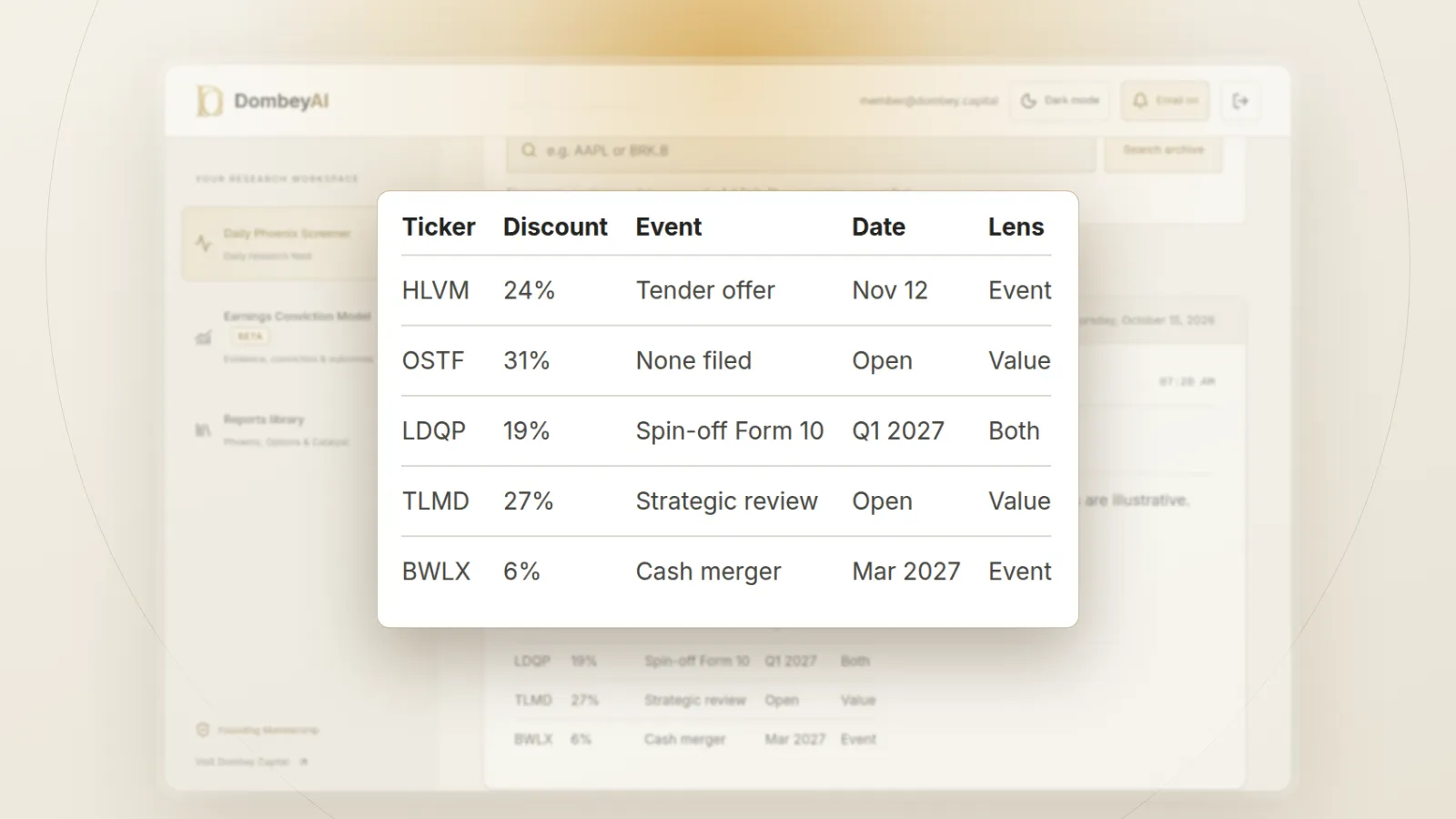
Dombey's published research works this overlap: cheap stocks with a dated legal or corporate event; see the research archive.
Choosing a lens for a given stock
- If the thesis depends on the business improving or the market rerating it, with no date, treat it as a value position and size for a long wait.
- If the thesis depends on a signed or filed event with a known mechanism, treat it as an event position and size for the loss if it breaks.
- If the stock is cheap and has a hard event, check both: the expected value of the event and the standalone value if it fails.
- If an event arrives in a stock you hold for value, reassess as an event position. Your original margin of safety may now be mostly priced in.
- If you cannot name what would force the price to change, you are holding a value position whether you meant to or not.
Where this goes wrong
Calling a value idea event-driven. An investor buys a cheap stock and labels it a catalyst play because a strategic review or a buyback is possible. Without a filed or signed mechanism, there is no date, and the position carries the open-ended risk of a value trap.
Ignoring the business in an event position. A deal that looks certain can still break. If the business has weakened since the announcement, the break price can sit well below the pre-deal price. Event investors who skip the value work lose more than they modeled.
Holding past the thesis. A value investor whose stock gets a takeover bid often keeps holding for the last few percent. That turns a finished value position into an event position nobody analyzed.
Treating time as free. Value investors can afford patience; event investors usually cannot. A delayed event erodes the annual return even when the outcome is the one expected.
Using the wrong sizing rule. Value positions are sized for a slow, partial loss. Event positions should be sized for a fast, large one. Using one rule for both overweights event risk.
The bottom line
Value investing and event-driven investing both buy a gap between price and value, but they differ in what closes it. Value investing relies on the business and the market's eventual judgment, with no date. Event-driven investing relies on a specific event with a mechanism and a timeline, and treats time and the break value as central inputs. The strongest special situations often combine both: a stock that is cheap on its own and has a hard, dated event. Whichever lens you use, write down which one it is before you size the position, as the dated thesis guide describes.