

Oct 16, 2026: Nebius falls with the group as the CoreWeave scare spreads
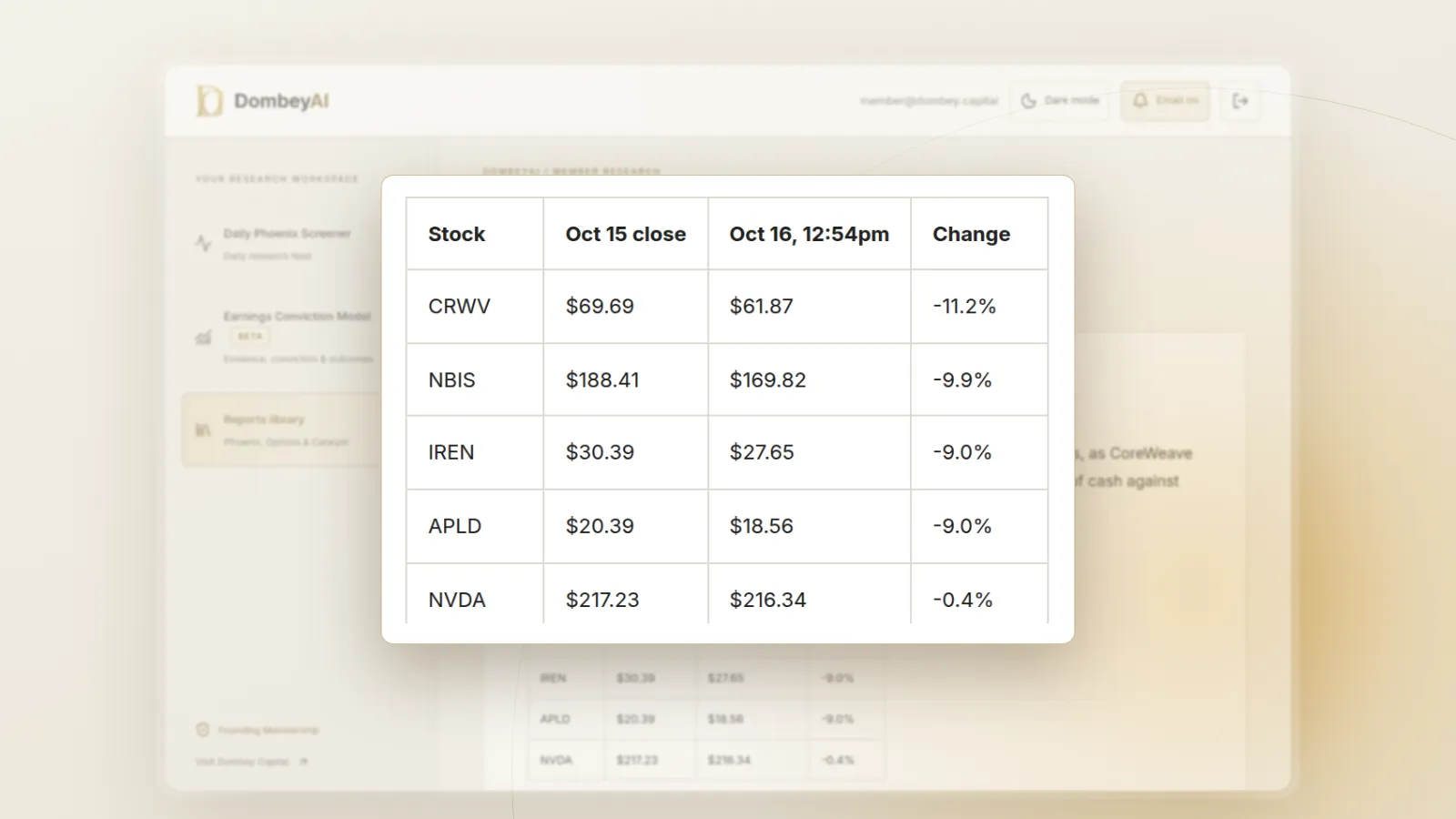
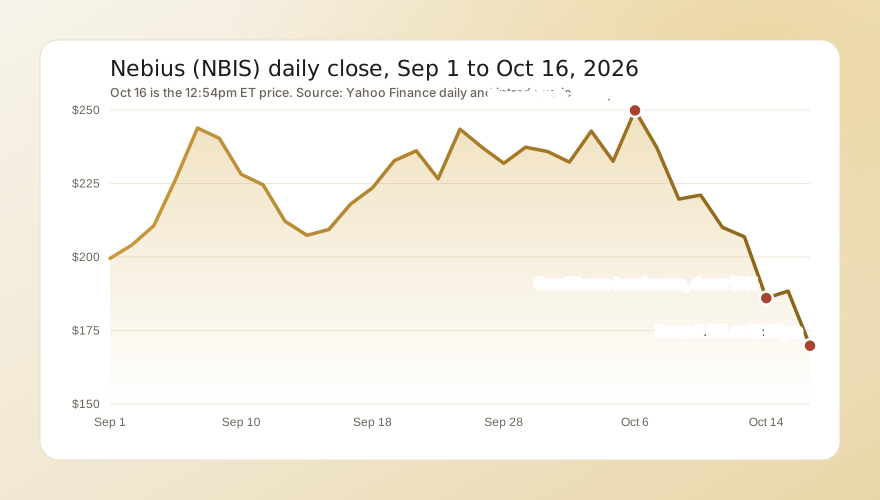
Premarket trading started at $187.50 at 4am and drifted to $185.95 just before the bell, down 1.3%. 24/7 Wall St. had them down 2% to $183.95 at 8:41am. The stock opened at $181.17, hit its high of $182.70 in the first five minutes, and slid for the rest of the morning. 24/7 Wall St. had it down 9% at $172.32 before noon. It reached $169.18 at 12:35pm and traded at $169.82 at 12:54pm, down 9.9%, on 17.4 million shares.
What pushed it down:
- CoreWeave's debt. The selloff began on Oct 14, when CNBC reported CoreWeave bonds yielding near 15%. GuruFocus had Nebius down 10.05% by 10:30am that day, and it closed down 10.1% at $186.01. On Oct 16, Investing.com reported that yields on CoreWeave's 2031 bonds had climbed toward 16% and that its default insurance briefly topped 1,140 basis points; its stock fell 11.2% by 12:54pm. Our article on why CoreWeave stock fell covers its debt in detail.
- Investors sold the business model, not one company. 24/7 Wall St. said investors are "selling the whole group on fears about funding." Goldman Sachs strategist Amanda Lynam called AI-related corporate bonds "at the epicenter of the funding cost debate" in a note that morning, though she also saw "some near-term reversal" in the selloff in that debt.
- Higher borrowing costs for every neocloud. Morningstar wrote that "we foresee a scenario where neoclouds are forced to borrow at higher costs," per Stocktwits, while keeping its $150 price target on Nebius and calling its net debt minimal.
- A fearful market. The CNN Fear and Greed Index read 28 on Oct 16, down from 46 a week earlier, per 24/7 Wall St.
- No company news. SEC EDGAR shows no Nebius 6-K since Oct 1, when it announced the acquisition of Inferize. The only filings since are insider Form 4 and Form 144 notices and a Schedule 13G/A.
The whole group fell at once. At about 12:54pm:
| Stock or fund | Change |
|---|---|
| CoreWeave (CRWV) | -11.2% |
| Nebius (NBIS) | -9.9% |
| Iren (IREN) | -9.0% |
| Applied Digital (APLD) | -9.0% |
| Super Micro (SMCI) | -8.8% |
| iShares software ETF (IGV) | -4.7% |
| Oracle (ORCL) | -3.6% |
| VanEck semiconductor ETF (SMH) | -1.9% |
| Nvidia (NVDA) | -0.4% |
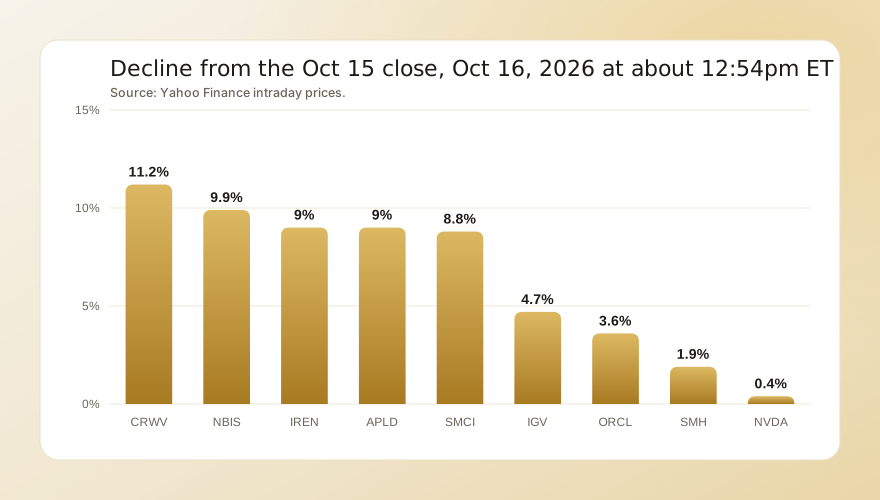
Nebius fell in line with Iren, Applied Digital and Super Micro, and less than CoreWeave, while Nvidia barely moved. That pattern points to selling of the neocloud group rather than to news about Nebius or about AI chip demand.
After the drop, RSI(14) stood at 32, the shares sat 24% below their 50-day average and 2.5% below their 200-day average, volume by 12:54pm was 17.4 million shares against a 20-day average of 18.3 million, and the stock was 43% below its 52-week high of $299.86.
How Nebius pays for its buildout
This is the question the market is asking of every AI cloud company this week. 24/7 Wall St. put it plainly: Nebius "paid for its growth mostly with stock and convertible notes."
In the first half of 2026, per the six-month cash flow statement, Nebius raised:
| Source | Amount |
|---|---|
| Convertible notes | $4.34 billion |
| Sales of treasury shares | $2.85 billion |
| Pre-funded warrants | $2.00 billion |
Since June 30 it has added more:
- A secured loan in July. $775 million priced at SOFR plus 2.50%, backed by deployed GPUs and contracted cash flows from an investment-grade customer, per the shareholder letter.
- $5.0 billion of convertible notes in August. $3.0 billion due 2030 at 0.50% and $2.0 billion due 2034 at 4.50%, upsized from $4.5 billion, with net proceeds of about $4.94 billion. They convert at about $313.46 and $324.65 a share, 85% and 91% above the Oct 16 price, so they act like cheap debt unless the stock recovers.
- A debt-for-stock swap. Nebius exchanged $400 million of its 2.00% notes due 2029 and $400 million of its 3.00% notes due 2031 for about 15.8 million shares.
The stock fell 9.9% on Aug 19, the day the convertible sale was announced, on worries about dilution. That cost shows up again here. Nebius sold 12.7 million shares through its at-the-market program at an average of $223.60 through June 30, with 12.3 million shares left. At $170, the same number of shares raises about 24% less money.
At June 30, debt was $8.55 billion, up from $4.13 billion at the end of 2025, and cash and equivalents were $8.04 billion, up from $3.68 billion. Second-quarter interest expense was $119.1 million. CFO Dado Alonso said on the August call, "We currently have almost no corporate-level debt." Debt stands at 0.97 times equity, a level our guide to what counts as a high debt-to-equity ratio would call moderate for a capital-heavy business.
The contracts behind the bull case
Nebius reported $37.49 billion of remaining performance obligations at June 30, with 36% due in the 24 months to June 2028. Management cites more than $40 billion of customer commitments. Two large contracts anchor it:
- Microsoft. Signed in September 2025, about $17.4 billion through 2031 from GPU capacity at Vineland, New Jersey, rising to about $19.4 billion if Microsoft buys more. The shareholder letter says Nebius has delivered all capacity tranches under the contract.
- Meta. The second agreement, signed March 16, 2026, is worth up to about $27 billion over five years: $12 billion of dedicated capacity on Nvidia's Vera Rubin platform starting in early 2027, plus up to $15 billion for capacity that Nebius may sell to other customers first. The letter says the buildout is on track for early 2027.
The second-quarter numbers show the business scaling. Revenue was $582.3 million, up 454%, ARR reached $3.0 billion, and group adjusted EBITDA was $236.2 million against a $21.0 million loss a year earlier. Management reaffirmed 2026 guidance: ARR of $7 billion to $9 billion, revenue of $3 billion to $3.4 billion, an adjusted EBITDA margin near 40%, and capex of $20 billion to $25 billion. It raised its year-end contracted power target to 5 GW. About 70% of second-quarter deals included prepayments, which management says cover 50% to 60% of the capex for those deals.
The risks
- The spending is far larger than the revenue. Capex of $20 billion to $25 billion this year compares with revenue guidance of $3 billion to $3.4 billion. Nebius spent $8.13 billion in the first half, $5.66 billion of it in the second quarter. The gap has to be filled by prepayments, stock, convertibles or new debt, and each costs more when the stock and credit markets are falling.
- A few customers. Three customers made up 24%, 21% and 14% of second-quarter revenue, per the 6-K.
- Still a net loss. The second-quarter net loss from continuing operations was $190.4 million.
- A rich price even after the drop. The stock trades at 34 times sales, and short sellers held 20.1% of the float.
- Delivery risk. The Microsoft contract lets Microsoft end a GPU service if Nebius misses agreed delivery dates after a grace period, per the September 2025 6-K.
What comes next
- The third-quarter report, expected November 10. Analysts estimate revenue of $905 million, and Nebius has not confirmed the date. Watch ARR against the $7 billion to $9 billion target, prepayments received, and any change to capex. Our guide to preparing for an earnings report covers what tends to move a stock on the day.
- CoreWeave's bonds. As long as those yields stay above 15%, the group trades together. A move back toward par would likely lift Nebius too.
- New financing terms. Nebius says it is working on asset-backed and corporate-level debt. A deal near the July loan's SOFR plus 2.50% would support the case that its contracts give it cheaper money than its peers.
- The Meta buildout. Capacity for the second Meta agreement is due in early 2027, and any slip would hit the backlog that supports the stock.
Analysts' consensus target is $288.67, with a low of $144 and a high of $410.